"AI Becomes a 'Collaborative Researcher,' Not Just a 'Tool'... Paradigm Shift in Drug Development"
Korea Bio Association Forecasts Changes in the Pharmaceutical and Biotech Markets
From Analysis to Hypothesis and Design: Anticipating R&D Productivity Innovation
"Fostering Data and Talent Is Key to Building a 'Korean-Style Ecosystem'"
As artificial intelligence (AI) emerges as a core growth driver in the global bioindustry, there are growing expectations that the traditionally "high-cost, low-efficiency" pharmaceutical and biotech ecosystem will transform into a "low-cost, high-efficiency" market through AI adoption.

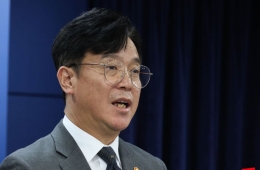
Lee Seunggyu, Vice Chairman of the Korea Bio Association, is delivering the opening remarks at the "Korea Bioeconomy Outlook Seminar" held on the 4th at the Sofitel Ambassador Hotel in Songpa-gu, Seoul. Korea Bio Association
View original imageOn December 4, the Korea Bio Association hosted the "Korea Bioeconomy Outlook" seminar at the Sofitel Ambassador Seoul Hotel in Songpa-gu, Seoul, where industry, academia, and government stakeholders discussed the direction they should take to establish an AI-based bioeconomy ecosystem.
Experts at the event predicted that AI would not only be a simple technological addition but would fundamentally change the speed, cost, and even the research methods of drug development. In particular, they noted that the reality facing global big pharma companies-whose blockbuster drug patents worth a total of $200 billion are set to expire worldwide by 2030-will further accelerate the adoption of AI.
Yoon Heejung, Team Leader of the Basic Life Science Center at the Korea Institute of Science and Technology Evaluation and Planning (KISTEP), explained, "AI reduces the cost of failure by eliminating inefficient candidates early in the initial screening stage. This is the key to fundamentally restoring productivity by lowering the overall pipeline risk and dramatically shortening the development cycle."
There was also an interpretation that the role of AI is expanding beyond that of a simple analytical tool to that of a fellow scientist. If Google DeepMind's AlphaFold ushered in the era of protein structure prediction in 2018, current and future AI is now evaluated as being capable of predicting complex interactions and even designing new proteins.
Yoon stated, "Professor David Baker's Rosetta research, which won this year's Nobel Prize in Chemistry, demonstrated that computers can go beyond predicting protein structures to designing entirely new proteins. In particular, the concept of 'AI co-scientist' introduced by Google Research is significant in that it repositions AI as a collaborative researcher rather than a mere tool." Unlike before, when AI played a passive role in processing data input by humans, it is now expected to evolve into a form that actively participates in the scientific discovery process by generating hypotheses and designing experiments.
Choi Hwanho, CEO of Quantum Intelligence, explained that innovation is also taking place in the fields of "animal testing" and "clinical prediction" through AI and quantum computing technologies. These technologies can address ethical issues while dramatically reducing the failure rate caused by discrepancies between animal data and human clinical results.
Choi noted, "Recently, regulatory agencies in advanced countries such as the United States Food and Drug Administration (FDA) and Europe are easing mandatory animal testing requirements and encouraging alternative testing methods. A new regulatory science market is emerging, driven by the combination of AI and organoid technologies." He added, "In the past, countless animals had to be sacrificed to understand how drugs are absorbed and excreted in the body, but now, this is being replaced by quantum mechanics-based electron distribution calculations and AI, which is becoming the trend."
Amidst major changes in the pharmaceutical and biotech industry, there were also calls for the urgent establishment of a Korean-style ecosystem. Yoon emphasized, "For the domestic biopharmaceutical ecosystem to be competitive, it is urgent to move beyond company-specific strategies and build a 'Korean-style integrated AI drug development ecosystem' that connects industry, academia, research institutes, and hospitals. It is essential for the government to establish a high-quality data infrastructure and foster interdisciplinary talent."
Hot Picks Today
 "Stocks Are Not Taxed, but Annual Crypto Gains Over 2.5 Million Won to Be Taxed Next Year... Investors Push Back"
- "Don't Throw Away Coffee Grounds" Transformed into 'High-Grade Fuel' in Just 90 Seconds [Reading Science]
- Signed Without Viewing for 1.6 Billion Won... Jamsil and Seongbuk Jeonse Prices Jump 200 Million Won in a Month [Real Estate AtoZ]
- "Groups of 5 or More Now Restricted"... Unrelenting Running Craze Leaves Citizens and Police Exhausted
- "Even With a 90 Million Won Salary and Bonuses, It Doesn’t Feel Like Much"... A Latecomer Rookie Who Beat 70 to 1 Odds [Scientists Are Disappearing] ③
Lee Seunggyu, Vice Chairman of the Korea Bio Association, stated, "As the use of AI becomes more widespread, it is establishing itself as a key driver of innovation in the bioindustry structure. The association will prepare for the coming bioeconomy era through the AI-bio alliance and strengthen its role as a platform connecting industry, policy, and research sites."
© The Asia Business Daily(www.asiae.co.kr). All rights reserved.