Amendment to Trade Union Act Enforcement Decree May Intensify Labor-Labor Conflicts
In March 2026, ahead of the implementation of the Yellow Envelope Act (the revised Trade Union and Labor Relations Adjustment Act), the government has prepared a draft amendment to the enforcement decree aimed at unifying bargaining channels for subcontractor unions. However, concerns are being raised that the criteria for separation are excessively detailed, potentially fueling labor-labor conflicts. The 25 specific criteria, which include whether a union belongs to a higher-level organization, could lead to the fragmentation and consolidation of primary and subcontractor unions. There are also criticisms that the rule requiring the Regional Labor Relations Commission to determine substantive control within 20 days is unrealistic. Experts advise that bargaining units should be organized primarily based on the closeness of job functions and work responsibilities, and that caution should be exercised when emphasizing the possibility of criminal penalties in the process of determining employer status.

Economic organization leaders, including Sohn Kyung-shik, Chairman of the Korea Employers Federation, are holding a press conference at the National Assembly Communication Hall urging the suspension of the amendment to the Labor Union Act. Photo by The Asia Business Daily.
View original imageThe core of the amendment to the enforcement decree of the Trade Union Act, which the Ministry of Employment and Labor has announced for public comment, is to allow subcontractor unions to unify their bargaining channels with the primary contractor. If an agreement cannot be reached, the bargaining units may be separated. This is a compromise that takes into account the concerns of management at primary contractors, who worry about being beset by bargaining demands year-round, and the demands of labor groups, who want to guarantee the bargaining rights of individual subcontractor unions.
The main issue lies in the criteria for separating bargaining units. The draft amendment introduces three main criteria for separation: differences in working conditions, employment type, and bargaining practices (Article 14-11). The Regional Labor Relations Commission also considers the intentions of the parties involved when adjusting separation.
Human resources and labor experts view these criteria as excessive. There are as many as 25 detailed standards, and the "scope of union organization," which refers to affiliation with a higher-level body, is also included. Since primary contractor unions are also subject to these criteria, there are concerns that the consolidation and fragmentation of primary and subcontractor unions could intensify confusion at industrial worksites. Park Sanghoon, attorney at HwaWoo Law Firm (16th class of Judicial Research and Training Institute), stated, "For example, if there are about 10 unions at both the primary and subcontractor levels, you could imagine a situation where they are grouped for bargaining according to their affiliation with the Korean Confederation of Trade Unions or the Federation of Korean Trade Unions. This could undermine the intent of the enforcement decree amendment, which is to unify bargaining channels."
On the other hand, Kim Yongmun, attorney at Jipyung Law Firm (35th class), said, "If primary and subcontractor unions are grouped together, the primary contractor union may become the bargaining representative, which may not be beneficial for the subcontractor unions." He added, "It would be more effective to group subcontractors that are closely related in terms of production, logistics, or packaging work. Whether bargaining units will actually be grouped based on higher-level organizations remains to be seen after the amendment is implemented."
The Trade Union Act stipulates that a union with a majority of members becomes the bargaining representative, or a joint bargaining team can be formed according to the proportion of union members (Article 29-2, Paragraph 6). The two major federations oppose the separation of bargaining units based on higher-level organization, arguing that it could lead to legal disputes or conflicts between unions.
There are also concerns about the amendment that requires the Regional Labor Relations Commission to determine, within 20 days, whether the primary contractor must respond to bargaining demands from subcontractor unions-that is, whether the primary contractor has "substantive control." Some doubt whether commission members, who are not full-time, can assess simultaneous bargaining demands in such a short period. The Ministry of Employment and Labor has stated that if the primary contractor does not comply with the commission's decision, it could be charged with an unfair labor practice. Kim Jongsoo, attorney at Sejong Law Firm (37th class), commented, "If the primary contractor is pressured by the threat of criminal penalties, it loses a real opportunity to contest its status as an employer." He also noted that even if a court grants a stay of execution against the commission's bargaining order, the criminal proceedings would continue separately, meaning the bargaining process could be halted but not the criminal case.
The Ministry of Employment and Labor plans to establish detailed guidelines on substantive control and the scope of labor disputes by the end of this year. Regarding calls from the field to include these standards in the enforcement decree by providing a legal delegation clause, the ministry maintains that, since the National Assembly led the passage of the Yellow Envelope Act, it would be difficult for the government to propose additional legal amendments before the law is fully implemented.
Hot Picks Today
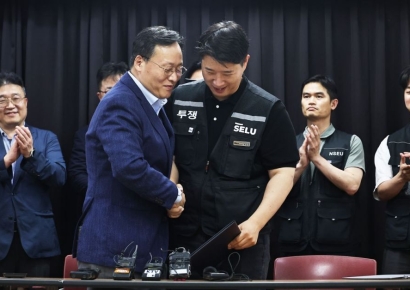 Up to 600 Million Won for Semiconductors, 160 Million Won Bonus for Loss-Making Non-Memory… Samsung Electronics Labor and Management Reach Tentative Deal on Unprecedented Performance Compensation (Comprehensive)
- "Could I Also Receive 370 Billion Won?"... No Limit on 'Stock Manipulation Whistleblower Rewards' Starting the 26th
- "From a 70 Million Won Loss to a 350 Million Won Profit with Samsung and SK hynix"... 'Stock Jackpot' Grandfather Gains Attention
- [Exclusive] 450 Billion Won Korean Investment at Risk as Canadian PE Moves to Acquire US Ascend for $99.2 Million
- "Who Is Visiting Japan These Days?" The Once-Crowded Tourist Spots Empty Out... What's Happening?
Park Seongdong, Legal Times Reporter
※This article is based on content supplied by Law Times.
© The Asia Business Daily(www.asiae.co.kr). All rights reserved.







