Full National Funding for National Trauma Center Operating Expenses
Gwangju City's Financial Burden Eased, Stable Operation Expected
Project Costs to Be Shared Equally by Government and Gwangju
The operating expenses of the National Trauma Healing Center for State Violence will be fully funded by the national government starting next year. Until now, the city of Gwangju has covered 50% of the operating costs, but the government has decided to take full responsibility for personnel and other institutional operating expenses, while the project costs for healing programs and similar initiatives will be split evenly between the government and Gwangju City.

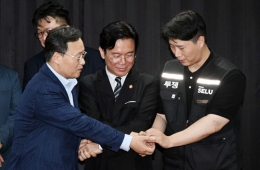
Gwangju Mayor Kang Gijeong and Minister of the Interior and Safety Yoon Hojung visited the National Trauma Healing Center in Hwajeong-dong, Seo-gu, on the morning of the 10th to participate in a horticultural therapy program with bereaved families and victims. Photo by Gwangju City
View original imageOn November 10, Gwangju Mayor Kang Gijeong held a 'State Violence Victims Meeting' with Yoon Hojung, Minister of the Ministry of the Interior and Safety, who visited Gwangju, and announced, "Starting next year, the government will fully support the operating expenses of the Healing Center." He added, "With the inauguration of the Lee Jaemyung administration, the issue of operating expenses has been resolved. Gwangju City will also actively cooperate with the government to ensure the stable operation of the Healing Center."
Gwangju City has continuously requested that the full amount of operating expenses be covered by the national government in accordance with the purpose of the center's establishment. Due to recent legal amendments, from 2026, all institutional operating expenses, including personnel costs, will be borne by the national government. On the other hand, project costs for healing programs and similar activities will continue to be shared equally between the government and Gwangju City.
On this day, Mayor Kang and Minister Yoon met with victims of state violence participating in a horticultural therapy program and listened to their experiences regarding the healing effects and difficulties they have faced. The participants suggested expanding outdoor healing programs.

Kang Gijeong, Mayor of Gwangju Metropolitan City, and Yoon Hojung, Minister of the Ministry of the Interior and Safety, visited the National Trauma Healing Center in Hwajeong-dong, Seo-gu, on the morning of the 10th to hold a meeting with bereaved families and victims. Photo by Gwangju City
View original imageMinister Yoon stated, "Since the government will fully cover the operating expenses requested by Gwangju City starting next year, I hope more people will be able to receive help," and added, "From next year, we will ensure there are no disruptions in program operations so that the emotional needs of state violence victims are properly addressed."
Hot Picks Today
 Dramatic Agreement Reached on Eve of Samsung Electronics General Strike... Minister Kim Young-hoon: "Showcased Korea's Strength in Dialogue" (Update)
- "It Has Now Crossed Borders": No Vaccine or Treatment as Bundibugyo Ebola Variant Spreads [Reading Science]
- "From a 70 Million Won Loss to a 350 Million Won Profit with Samsung and SK hynix"... 'Stock Jackpot' Grandfather Gains Attention
- "Stocks Are Not Taxed, but Annual Crypto Gains Over 2.5 Million Won to Be Taxed Next Year... Investors Push Back"
- "Who Is Visiting Japan These Days?" The Once-Crowded Tourist Spots Empty Out... What's Happening?
Meanwhile, the National Trauma Healing Center for State Violence was established to treat the aftereffects of trauma and psychological distress suffered by victims and their families as a result of state violence. The center offers individualized healing programs such as horticultural and exercise therapy, case management counseling, as well as social healing programs.
© The Asia Business Daily(www.asiae.co.kr). All rights reserved.