Lee Junseok: "Korea-U.S. Tariff Talks Achieved Resolution of Structural Uncertainty... Time to End the Trump-Yoon Suk Yeol Rescue Narrative"
Positive Assessment of Tariff Reductions on Automobiles and Semiconductors
Regret Over Failure to Reach Agreement Ahead of Japan
Concerns Raised About High Steel Tariffs and Investment Burdens
Lee Junseok, leader of the Reform New Party, drew attention by emphasizing the significance of the South Korea-U.S. summit, stating, "It should be evaluated as an achievement that can resolve much of the structural uncertainty our economy has experienced." Lee also argued that narratives within the conservative bloc, such as the Trump-Yoon Suk Yeol rescue theory, should be addressed and clarified.
At the Supreme Council meeting of the Reform New Party held at the National Assembly on this day, Lee offered his assessment of the tariff negotiations between the leaders of South Korea and the United States. He said, "It is regrettable that the South Korea-U.S. FTA system, which was established through the determination of President Roh Moo-hyun and the persistent efforts of President Lee Myung-bak, has been dismantled, making it difficult to call this a true settlement. If we had reached an agreement ahead of Japan, we could have secured a more advantageous position, but it is unfortunate that our unstable political situation this year prevented us from doing so."

Lee Junseok, leader of the Reform New Party, is speaking at the Supreme Council meeting held at the National Assembly in Yeouido, Seoul on the 23rd. Photo by Yonhap News.
View original imageHe mentioned both positive evaluations and concerns. Lee stated, "It is deeply regrettable that we failed to maintain the high tariff rates in the steel sector and the tariff gap with Japan. However, the reduction of tariffs on automobiles and semiconductors, which are our key export items, is seen as an achievement that can resolve much of the structural uncertainty our economy has recently faced."
He also pointed out concerns, such as the excessive investment burden compared to economies like Japan, the commitment to invest over a ten-year period, the 15% tariff rate being a burden for export companies, and uncertainties regarding the recovery of investment funds.
Lee stated, "It is undeniable that we have retreated significantly from the trade environment we previously enjoyed, and the public is closely watching to see what additional agreements may be pursued in areas such as security and technology following the tariff negotiations. Continuous monitoring of the medium- and long-term ripple effects of this agreement on our economy is essential, and thorough verification and in-depth discussion must take place during the National Assembly ratification process."
He added, "I extend my respect to the diplomatic authorities and the working-level negotiation team who led these difficult negotiations, and I also express my deep gratitude and support to export companies such as Hyundai Motor, which have quietly endured high tariff burdens."
Hot Picks Today
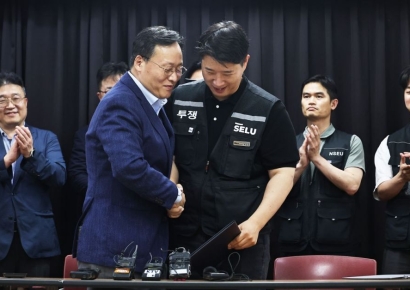 Up to 600 Million Won for Semiconductors, 160 Million Won Bonus for Loss-Making Non-Memory… Samsung Electronics Labor and Management Reach Tentative Deal on Unprecedented Performance Compensation (Comprehensive)
- "Could I Also Receive 370 Billion Won?"... No Limit on 'Stock Manipulation Whistleblower Rewards' Starting the 26th
- "From a 70 Million Won Loss to a 350 Million Won Profit with Samsung and SK hynix"... 'Stock Jackpot' Grandfather Gains Attention
- [Current State of Foreigner K-Finance]③"The Essence Is Ultimately Communication... Lending and Financial Education Must Go Hand-in-Hand"
- "Who Is Visiting Japan These Days?" The Once-Crowded Tourist Spots Empty Out... What's Happening?
Meanwhile, Lee stated, "With the conclusion of this agreement, groundless claims that continue within the conservative bloc-such as the Trump-Yoon Suk Yeol rescue theory, the Mostan conspiracy theory, and allegations of U.S. interference in fraudulent elections-should be put to rest. In an environment flooded with distorted and false information, neither the rebuilding of a healthy conservative movement nor constructive policy competition is possible," he pointed out.
© The Asia Business Daily(www.asiae.co.kr). All rights reserved.
!["Please Help": How Much Do Those Bowing 90 Degrees Really Earn? [Data Pick]](https://cwcontent.asiae.co.kr/asiaresize/307/2026052010120870131_1779239528.png)