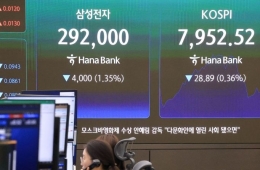
Korea Investment & Securities: "KOSPI Correction After Chuseok Holiday? Unlikely to Be Significant"
On September 19, Korea Investment & Securities stated that, although average returns tend to be weaker right after Chuseok compared to after Lunar New Year, the correction in the KOSPI-which has recently been hitting all-time highs-is unlikely to be severe.

Yeom Dongchan, a researcher at Korea Investment & Securities, explained in the report "Momentum Over Potential Supply Gaps" released the same day, "With about 10 trading days remaining before the holiday, it is important to keep in mind the possibility of a short-term slowdown in the upward trend."
Researcher Yeom pointed out, "It is difficult to respond to external issues during the holiday period, and market volatility tends to increase immediately after the holidays. In particular, volatility tends to be even greater after Chuseok than after Lunar New Year." For example, in 2023, the KOSPI fell by more than 2% in a single day immediately after the Chuseok holiday due to uncertainty over the U.S. budget bill.
Yeom also noted that, unlike individual investors, foreign and institutional investors tend to reduce their buying activity starting two to three trading days before the holiday.
However, despite the potential for a supply gap, Yeom analyzed that the extent of any correction would not be significant. He explained, "Past experience shows that when momentum is strong enough to break through previous highs, stock prices have not easily come to a halt. While it is necessary to consider the possibility of a slowdown in the index's upward trend, the rally could continue for a while longer."
Hot Picks Today
 If They Fail Next Year, Bonus Drops to 97 Million Won... A Closer Look at Samsung Electronics DS Division’s 600M vs 460M vs 160M Performance Bonuses
- Opening a Bank Account in Korea Is Too Difficult..."Over 150,000 Won in Notarization Fees Just for a Child's Account and Debit Card" [Foreigner K-Finance Status]②
- Seongdong Police Station Chief Placed on Standby for Misuse of Official Vehicle... National Police Agency Launches Audit
- Room Prices Soar from 60,000 to 760,000 Won and Sudden Cancellations: "We Won't Even Buy Water in Busan" — BTS Fans Outraged
- "Who Is Visiting Japan These Days?" The Once-Crowded Tourist Spots Empty Out... What's Happening?
He further suggested, "When momentum remains strong, a trend following strategy is likely to be a more appropriate response than waiting for a correction."
© The Asia Business Daily(www.asiae.co.kr). All rights reserved.
!["Please Help Us": How Much Do Those Bowing 90 Degrees These Days Actually Earn? [Data Pick]](https://cwcontent.asiae.co.kr/asiaresize/307/2026052010120870131_1779239528.png)