Industry Pushback over Reduced Free Emissions Allowances... Steel and Petrochemicals Warn of "Double Blow" from Electricity Costs
Proportion of Paid Allocations Expected to Rise Sharply in 4th Plan
Government Schedules Meeting Amid Questions Over Effectiveness of Public Hearing
Industry: "Prepared Plans and Roadmaps Rendered Meaningless"
The 4th National Emissions Allowance Allocation Plan (2026-2030), currently being developed by the government, has faced fierce opposition from the industrial sector. The main point of contention is the significant reduction in free allowances and a sharp increase in the proportion of allowances that companies must purchase directly. There are growing concerns that this could further drive up electricity rates, causing corporate production costs to balloon.
According to industry sources on September 15, the Ministry of Environment recently held a public hearing on the 4th allocation plan and listened to feedback from stakeholders. It was widely expected that the government would announce a plan to reduce the total emissions cap by 22% compared to the 3rd planning period (2021-2025). However, the Ministry of Environment did not disclose any specific figures at the hearing. Some interpreted this as the government deliberately withholding numbers to gauge the level of industry backlash.

The industrial sector's biggest concern centers on the possibility of a sharp increase in the proportion of paid allocations. Under the paid allocation system, companies that emit carbon must purchase allowances. The government plans to significantly raise the paid allocation ratio in the power generation sector from the current 10% to 50% by 2030, and in the industrial sector from 10% to 15%.
The market stabilization reserve, which the government uses to adjust supply during periods of economic overheating or downturn, will also be greatly expanded. The reserve, which was about 14 million tons during the third period, will be increased more than eightfold to 113 million tons in the fourth period. Since this reserve is created by deducting it from the industrial sector's allocation, dissatisfaction in the industry is high.
Industry representatives are concerned that a higher proportion of paid allocations will dramatically increase their electricity costs. As free allocations decrease, companies will be forced to buy more allowances directly from the market. If the paid allocation in the power generation sector is expanded, the cost of carbon will be passed on to electricity prices. Currently, domestic allowance prices are in the range of 8,000 to 9,000 won per ton. The government aims to raise the price to between 40,000 and 60,000 won per ton by increasing the share of paid allocations. According to the Korea Energy Economics Institute, if the paid allocation ratio for power generation is raised to 50% and allowance prices reach 30,000 won per ton, industrial electricity rates could rise by as much as 2.5 trillion won annually.

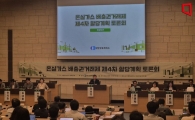
On the 9th, the Korea Chamber of Commerce and Industry held the "4th Allocation Plan Forum on the Greenhouse Gas Emissions Trading System" at the Chamber of Commerce building to explore measures for the efficient operation of the emissions trading system and enhancing industrial competitiveness. Photo by Ji Eun Oh
View original imageThe steel and petrochemical industries, in particular, are expected to be hit the hardest. These two sectors account for about 20% of domestic greenhouse gas emissions, and when refining and cement are included, they make up nearly 40% of total industrial emissions. Because they operate facilities such as blast furnaces and naphtha cracking centers (NCCs), which are structurally difficult to decarbonize, achieving actual reductions is challenging. An industry official said, "While we support the goal of carbon neutrality, reducing allocations and raising electricity rates without considering reality threatens the survival of companies."
Frustration also erupted at the public hearing held on September 12. When the announcement omitted specific totals and reduction rates, participants responded that "discussions without numbers are meaningless." A representative from the Korea Chamber of Commerce and Industry requested, "Once the figures are available, please hold a forum or briefing session to gather feedback."
Another issue is that the current proposal is not aligned with the 2030 Nationally Determined Contribution (NDC) greenhouse gas reduction targets. The NDC sets the reduction target for the industrial sector at 11.4%, but the 4th allocation plan groups non-power generation sectors together and demands a reduction of nearly 30%. Industry representatives explained that their investment plans and roadmaps, which had been prepared in advance, have been rendered meaningless overnight.
Related Articles
 "Tripling Emissions Quota Reductions Impossible"... Strong Opposition from Steel and Petrochemical Industries to Government Plan
Industry discontent is expected to erupt at a meeting with the Ministry of Environment scheduled for September 17. On that day, the Ministry of Environment plans to announce the specific figures for the total emissions cap.
© The Asia Business Daily(www.asiae.co.kr). All rights reserved.







