U.S. Media Predict 'Strategic Flexibility, $35 Billion Investment' as Key Agenda for South Korea-U.S. Summit
NYT: Concerns in South Korea Over U.S. Demands for 'Strategic Flexibility'
WSJ: 'MASGA' Becomes a Kind of National Slogan in South Korea
On the eve of the South Korea-U.S. summit between President Lee Jaemyung and U.S. President Donald Trump, U.S. media outlets have identified the strategic flexibility of U.S. Forces Korea and the concretization of a $350 billion investment fund for the U.S. as key agenda items.

On the 24th (local time), The New York Times (NYT) reported, "Both leaders survived assassination attempts before taking office and share an interest in meeting with North Korean leader Kim Jong Un. However, when it comes to the 70-year-long alliance, especially the potential conflict between China and Taiwan, the two sides have different priorities."
NYT stated, "The Trump administration wants to expand the role of U.S. Forces Korea to counter China and is demanding that South Korea take greater responsibility for its own defense. Regarding the policy the U.S. calls 'strategic flexibility,' South Korea is concerned that its defense against North Korea will become weaker and that it may be drawn into a war over Taiwan." The report also mentioned that there have been public opinion polls indicating that, in response to U.S. demands for a $350 billion investment package leveraging tariffs and increased cost-sharing for U.S. troop stationing, many South Koreans now prefer the country to possess its own nuclear weapons rather than rely on American protection.
NBC, in its report on the 22nd ahead of President Lee Jaemyung's visit to Japan, stated, "The summit between President Lee and President Trump may include discussions on specifying the details of a $350 billion investment fund for U.S. industries, centered around shipbuilding cooperation, which President Trump has emphasized." NBC further noted, "A more important topic for both leaders is the future of the decades-old military alliance. The U.S. has long urged South Korea to accept greater flexibility in using the roughly 30,000 troops stationed in Korea for missions outside the peninsula to deter North Korea, and these demands have intensified under President Trump." The report also assessed that "the Trump administration may seek to reorganize U.S. Forces Korea to secure the capability to respond to a potential conflict with China over Taiwan."
The Wall Street Journal (WSJ) listed tariffs, the role of U.S. Forces Korea, and South Korea's defense spending as expected agenda items for the summit, and pointed out that "'MASGA' (Make American Shipbuilding Great Again) has become a kind of national slogan in South Korea."
WSJ analyzed that the shipbuilding issue is especially significant amid the potential risk of U.S.-China conflict over Taiwan. China's navy has already surpassed the U.S. in terms of fleet size, and the gap is expected to widen further. In contrast, the U.S. Navy is facing delays in introducing new ships due to production backlogs, and as older ships are retired, its overall naval power is shrinking.
Hot Picks Today
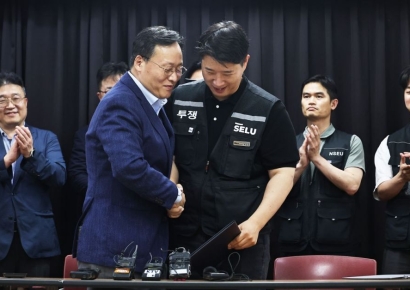 Up to 600 Million Won for Semiconductors, 160 Million Won Bonus for Loss-Making Non-Memory… Samsung Electronics Labor and Management Reach Tentative Deal on Unprecedented Performance Compensation (Comprehensive)
- "Could I Also Receive 370 Billion Won?"... No Limit on 'Stock Manipulation Whistleblower Rewards' Starting the 26th
- "From a 70 Million Won Loss to a 350 Million Won Profit with Samsung and SK hynix"... 'Stock Jackpot' Grandfather Gains Attention
- [Exclusive] 450 Billion Won Korean Investment at Risk as Canadian PE Moves to Acquire US Ascend for $99.2 Million
- "Who Is Visiting Japan These Days?" The Once-Crowded Tourist Spots Empty Out... What's Happening?
WSJ reported, "Last year, Hanwha Ocean and Hyundai Heavy Industries won four U.S. Navy maintenance contracts to repair non-combat ships for the U.S. 7th Fleet stationed in Japan. If legal regulations in the U.S. are relaxed, this could expand into warship repair projects." The report continued, "After meeting with President Trump, President Lee is scheduled to visit the Philadelphia Shipyard in the U.S., which Hanwha Ocean acquired for about $100 million."
© The Asia Business Daily(www.asiae.co.kr). All rights reserved.