Creator Organizations Urge Establishment of Compensation System for AI Training Using Creative Works
Organizations representing creators in various fields, including literature, broadcasting, film, music, fine arts, and photography, have called on the National Assembly and the government to establish a fair compensation system for creative works used in artificial intelligence (AI) training.

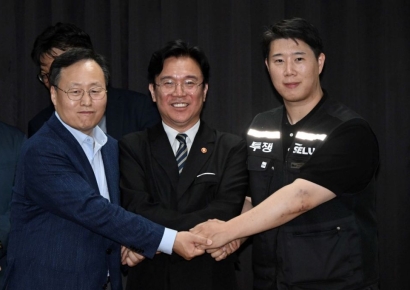
Fifteen creator organizations issued a joint statement on the 14th at the Broadcasting Center in Yangcheon-gu, Seoul, urging the establishment of a fair compensation system for creative works used in artificial intelligence (AI) training. Photo by Byun Seonjin
View original imageOn the 14th, fifteen creator organizations?including the Korean Writers Association, the Korea Copyright Association for Culture and Arts, and the Korean Fine Arts Association?issued a joint statement at the Broadcasting Center in Mok-dong, Yangcheon-gu, Seoul, conveying this demand.
They stated, "We recognize that the advancement of the AI industry is an inevitable trend of the times and a key factor in future national competitiveness." However, they also emphasized, "If the government focuses solely on short-term industrial promotion and neglects the protection of creative works?which are the true foundation of AI development?this will be a complex misstep that could collapse the creative ecosystem."
The creator organizations expressed concern that a vast number of works?including literature, scripts, and comics?have been collected and used to train generative AI, which learns patterns and develops sentence generation capabilities, without the permission of the creators.
In response, they asserted, "To address the serious legislative gap and copyright infringement resulting from the unauthorized use of creative works in AI training, the Basic Act on Artificial Intelligence (the Basic Act on the Advancement and Trust-Building of Artificial Intelligence) must require the transparent disclosure of training data and compliance with copyright law. Furthermore, a fair compensation system for creative works used in AI training must be established."
The Basic Act on Artificial Intelligence, which was enacted in January and will take effect next year, only addresses the development of the AI industry and does not include provisions related to AI training data. Regarding this, the creator organizations pointed out, "Major domestic AI companies are refusing to disclose the data used for training under the pretext of 'trade secrets.' As a result, creators are unable to know how their content is being used in AI training. Even if they pursue legal action to seek remedies for damages, the reality in Korea is that creators bear a heavy burden of proof in lawsuits against large corporations."
Hot Picks Today
 Samsung Electronics Introduces New "Special Performance Bonus" for Semiconductors, Paid Entirely in Company Shares
- "Could I Also Receive 370 Billion Won?"... No Limit on 'Stock Manipulation Whistleblower Rewards' Starting the 26th
- Opening a Bank Account in Korea Is Too Difficult..."Over 150,000 Won in Notarization Fees Just for a Child's Account and Debit Card" [Foreigner K-Finance Status]②
- Jeon Du-hwan with a Starbucks Tumbler, "Donjjul" Proof Shots... Has Starbucks Become a Far-Right Symbol?
- "Who Is Visiting Japan These Days?" The Once-Crowded Tourist Spots Empty Out... What's Happening?
In conclusion, the creator organizations declared, "We firmly oppose any policy or institutional approach that focuses solely on technological advancement while disregarding the rights of creators. We urge the prompt establishment of policy measures to protect the rights of creators guaranteed by the Constitution and to ensure the survival of the creative ecosystem."
© The Asia Business Daily(www.asiae.co.kr). All rights reserved.
!["Please Help Us": How Much Do Those Bowing Deeply for Your Vote Really Earn? [Data Pick]](https://cwcontent.asiae.co.kr/asiaresize/307/2026052010120870131_1779239528.png)