Deputy Prime Minister Choi Sang-mok: "Next Year's Growth Rate Forecast Inevitably Downgraded... Will Fall Below Potential Growth Rate"
Revealed at the press conference on the 23rd
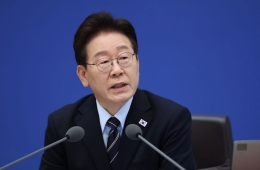
Choi Sang-mok, Deputy Prime Minister for Economic Affairs and Minister of Economy and Finance, stated on the 23rd, "It is inevitable to lower the economic growth rate forecast for next year," adding, "There is a high possibility that it will fall slightly below the potential growth rate." This indicated that the government plans to lower the growth rate forecast ahead of the announcement of the economic policy direction, which outlines the framework for next year's economic policy management.

At a press briefing held at the Government Complex Sejong on the same day, Deputy Prime Minister Choi said, "Downside risks have increased, making it inevitable to lower the growth forecast, and I believe it is likely to fall slightly below the potential growth rate." This means the government has no choice but to significantly lower the real Gross Domestic Product (GDP) growth rate forecast, which was previously projected at 2.6% for this year and 2.2% for next year.
He added, "The level of the potential growth rate itself is not satisfactory," and "There is a concern that the potential growth rate will also decline." Furthermore, he expressed worry that "due to various circumstances next year, the decline in the potential growth rate may accelerate."
On the 19th, the Bank of Korea presented the country's potential growth rate for 2024?2026 as 2% based on a new calculation method. Potential GDP refers to the maximum production level or economic scale that a country can achieve by mobilizing all production factors such as labor, capital, and resources without causing inflation. The potential growth rate is the growth rate of this potential GDP and serves as an indicator to gauge a country's economic potential or fundamental strength.
Deputy Prime Minister Choi refrained from commenting on questions related to the martial law incident. When asked, "There were paralyzing contents about the National Assembly in the martial law-related documents, and directions for fiscal management in preparation for martial law were specified. To what extent were you aware of this?" he responded, "I will not answer directly," adding, "I have sufficiently answered in the National Assembly."
Regarding questions about his opinion on the exercise of veto power over the special investigation law on insurrection to be discussed at the Cabinet meeting, he said, "Acting Prime Minister Han Duck-soo will make decisions and I believe there will be procedures such as seeking opinions at the Cabinet meeting." He also stated, "As a member of the Cabinet, I believe it is my duty to participate in the discussion process at the Cabinet meeting."
Park Chan-dae, floor leader of the Democratic Party of Korea, said the day before, "If Prime Minister Han Duck-soo does not promulgate the special investigation law on insurrection by the 24th, we will immediately hold him accountable." This was a final warning that if Acting Prime Minister Han does not promulgate the special investigation law or exercises the right to request reconsideration (veto) at the Cabinet meeting scheduled for the 24th, he could be impeached immediately.
Hot Picks Today
 "Stocks Are Not Taxed, but Annual Crypto Gains Over 2.5 Million Won to Be Taxed Next Year... Investors Push Back"
- "Don't Throw Away Coffee Grounds" Transformed into 'High-Grade Fuel' in Just 90 Seconds [Reading Science]
- Signed Without Viewing for 1.6 Billion Won... Jamsil and Seongbuk Jeonse Prices Jump 200 Million Won in a Month [Real Estate AtoZ]
- "Groups of 5 or More Now Restricted"... Unrelenting Running Craze Leaves Citizens and Police Exhausted
- "Even With a 90 Million Won Salary and Bonuses, It Doesn’t Feel Like Much"... A Latecomer Rookie Who Beat 70 to 1 Odds [Scientists Are Disappearing] ③
Regarding the opposition party's pressure for the impeachment of Acting Prime Minister Han and the resulting potential government vacuum, which they emphasize can be resolved by the Deputy Prime Minister Choi's acting system, he responded, "We are doing our best centered on the Han Duck-soo Prime Minister system to firmly maintain and stably manage our economy's external credibility at this time."
© The Asia Business Daily(www.asiae.co.kr). All rights reserved.