[2024 National Audit] "Tax Revenue Shortfall Is Due to Government's Economic Management Failure"... Heated Exchange at the Finance and Economy Committee Audit

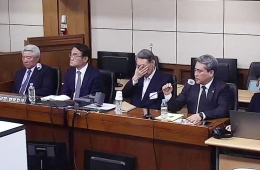
Choi Sang-mok, Deputy Prime Minister for Economic Affairs and Minister of Economy and Finance, is responding to a lawmaker's question at the '2024 Planning and Finance Committee National Audit' held at the Government Complex Sejong on the 10th.
View original imageAt the National Assembly's Planning and Finance Committee's audit, criticism targeting the government's economic management capabilities continued over the large-scale tax revenue shortfall for the second consecutive year. There was also criticism that the government’s overly optimistic macroeconomic outlook led to the massive tax revenue shortfall.
At the audit held on the 10th at the Government Complex Sejong, Jeong Tae-ho, a member of the Democratic Party of Korea, pointed out, "The total national tax revenue in 2025 has regressed to the level of three years ago, and the cause of this tax revenue shortfall is not simply an error in tax revenue estimation but a failure in the government's economic management." He added, "When comparing the government's projections and actual figures for key economic indicators during the 2023 budget formulation, errors occurred such as GDP growth rate -1.1%, export growth rate -18.5%, import growth rate -11.1%, and consumer price inflation rate -0.6%."
Deputy Prime Minister Choi responded, "From the fourth quarter of 2022, our exports and corporate growth deteriorated sharply, which was at a level that no expert had anticipated," but added, "(The government) will take this as a lesson and strive to enhance fiscal sustainability." The Ministry of Economy and Finance announced the '2024 Tax Revenue Re-estimation Results' on the 26th of last month, revealing that this year's tax revenue is expected to fall short by 29.6 trillion won (an error rate of 8.1%) compared to initial estimates, but did not disclose specific measures to address the tax revenue shortfall.
In his opening remarks that day, Deputy Prime Minister Choi stated, "We will prepare specific measures within this month regarding local allocation tax and local education finance grants, which are expected to sharply decline due to the tax revenue shortfall." This was a response from the Ministry of Economy and Finance to criticisms that reductions in allocation tax and grants could increase the financial burden on local governments.
There was also criticism that the government's measures to address the tax revenue shortfall by using surplus funds from various funds were merely temporary fixes. Park Hong-geun, a Democratic Party member, said, "Because of the massive tax revenue shortfall, a lot of the Public Fund Management Fund (Gongja Fund) was used to fill the gap, which has led to the Gongja Fund becoming insolvent. Since it is insufficient to cover the shortfall with other funds, issuing national bonds is inevitably reaching record levels, resulting in temporary fixes that take from one place to give to another."
He further criticized, "(The government's 'sound fiscal' stance) is like 'Ha-seok-sang-dae' (a Korean idiom meaning a futile effort), 'Yang-du-gu-yuk' (meaning double-dealing), and 'Jo-sam-mo-sa' (meaning a short-sighted trick)." Another member of the same party, Choi Ki-sang, also criticized, "The Ministry of Economy and Finance neither goes through the National Assembly’s deliberation and resolution nor consults with local governments when withholding local allocation resources," calling it "an incompetent and arrogant Ministry of Economy and Finance." Yoon Ho-jung raised his voice, saying, "We need to properly analyze the causes of failure in tax revenue estimation," and added, "If it cannot be revealed through the audit, it must be uncovered through a state audit investigation."
![[2024 National Audit] "Tax Revenue Shortfall Is Due to Government's Economic Management Failure"... Heated Exchange at the Finance and Economy Committee Audit](http://www.asiae.co.kr/news/img_view.htm?img=2024101015493453883_1728542974.jpg)
Deputy Prime Minister Choi said, "I feel sorry and bear heavy responsibility for the tax revenue shortfall," but added, "Using surplus funds from the funds was a second-best option rather than issuing national bonds, and it was inevitable." He also said, "Going forward, we plan to reform the tax revenue estimation model from the outset by discussing it together with the private sector and the National Assembly Budget Office."
Regarding the criticism that tax cuts for the wealthy caused the tax revenue shortage, Deputy Prime Minister Choi responded, "I find it difficult to agree that such an outcome was caused by tax cut policies." In response to the accusation that fiscal spending was increased for this year's general election, he said, "There was a strong awareness that domestic demand was very weak in the first half of this year," and added, "The actual spending was not significantly larger compared to the past."
Meanwhile, concerning allegations of financial support for the new Czech nuclear power plant, the government drew a line, stating that it is not true that the government promised financial support. Deputy Prime Minister Choi said, "Mentioning typical financial support does not mean a promise; it means that international financial support can be provided to help our companies," and explained, "When securing such orders, it is common to mention financial support to some extent," adding, "You can understand that there was that level of mention."
Hot Picks Today
 "Parents Deposited 10 Million Won for Me"... Se...
- "Is It Safe to Keep Using Obesity Medications?"... Startling Study Results Relea...
- "SK Hynix Stock Windfall"... Teenager With Wads of Cash Turns Thief at Jewelry S...
- "Major Crash Is Coming... Buy Even If You Have to Skip a Meal" 'Rich Dad' Shares...
- "Save 30 Million Won, Grow It to 100 Million": Dramatic Pledge Sparks "Is This a...
Recently, allegations have been raised mainly by opposition parties that the Letters of Intent (LOI) submitted by the Export-Import Bank of Korea and the Korea Trade Insurance Corporation during the Czech nuclear power plant bidding process included financial support details. However, Deputy Prime Minister Choi said, "While supporting companies' bidding activities, especially where our technology is needed, providing financial support is something we can sufficiently do to help our companies," and added, "Ultimately, it should be judged based on what we can do for the national interest."
© The Asia Business Daily(www.asiae.co.kr). All rights reserved.