Medical Community "Education Impossible" VS Government "Public Harm"... Second Legal Battle
The government and the medical community clashed for the second time in court on the 22nd over the expansion and allocation of medical school quotas. The medical community argued that increasing the number of medical school seats would make quality education impossible, while the government countered that if the suspension of the quota increase decision were granted, harm to the public would be inevitable.

The Seoul Administrative Court, Administrative Division 13 (Chief Judge Park Jeong-dae), held a hearing on the suspension of execution requested by residents and medical students against the Ministry of Health and Welfare and the Ministry of Education regarding the decision to increase and allocate 2,000 medical school seats for the 2025 academic year. The plaintiffs' representative argued, "If the quota is expanded, medical education will become impossible, causing irreparable damage related to the right to receive quality education," and added, "Urgency is recognized as this must be prevented through the suspension of execution procedure."
On the other hand, the government's representative rebutted, "The medical schools to which the applicants belong have no increase at all, so they lack standing and the case should be dismissed," and stated, "Considering the number of patients each doctor cares for, if the suspension of execution is granted, clear harm to the public will occur."
The court said, "Please submit additional written documents preferably by next Thursday," and added, "Since this is a socially significant issue, we will make a decision without delay."

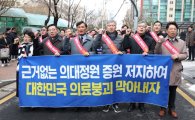
On the 20th, representatives of regional medical school professors, whose quotas were significantly expanded by the government's allocation, held a press conference in front of the court before the hearing, claiming that "education is practically impossible." Professor Choi Jung-guk, chairman of the professors' council at Chungbuk National University College of Medicine, where the admission quota increased from 49 to 200, said, "This is not an environment where the increased number of students can be educated," and added, "Both students and professors have cried out that they do not want this, but I don't know how we are supposed to respond."
Professor Oh Se-ok, chairman of the professors' council at Pusan National University College of Medicine, where the quota increased from 125 to 200, also said, "We must abandon the misconception that increasing regional medical school quotas will increase essential regional medical personnel," and strongly criticized, "Is President Yoon Seok-yeol, who advocates for liberal democracy, following Kim Jong-un's communist bomb-style dictatorship?"
Related Articles
 The Korean Academy of Medical Sciences: "Government's Claim of '10,000 Doctor Shortage' is a Misinterpretation of the Report"
- [Reporter’s Notebook] '2,000 Students' Mechanically Allocated to Regional Medical Schools
- The Government Also Responds... Han Deok-su Announces "Additional Support for 247 Public Health Doctors and Military Medical Officers"
- Medical School Professors' Mass Resignation 'D-3'... Is There Still a Chance for Dialogue?
Meanwhile, on the same day, the same court's Administrative Division 11 (Chief Judge Kim Jun-young) is reviewing the suspension of execution case filed by representatives of professors' councils from 33 medical schools nationwide regarding the increase in medical school quotas. The hearing for this case was held on the 14th. The suspension of execution applications separately filed by Park Dan, president of the Korean Intern Resident Association, examinees, parents, and medical students in the Seoul area were assigned to Administrative Division 3 (Chief Judge Choi Su-jin) and Administrative Division 4 (Chief Judge Kim Jeong-jung) of the same court, but hearing dates have not yet been scheduled.
© The Asia Business Daily(www.asiae.co.kr). All rights reserved.







