[This Week's Market Trend] Riding the 'Low PBR Wave'... Hyundai Motor Hits 52-Week High
Representative example of 'Korea Discount'
52-week high in 9 months, 'Cherry Blossom Dividend' also a positive factor
PBR 0.58x, lowest among top 10 listed companies
Operating profit ranks 1st among listed companies... Clear growth in North America and Europe
![[This Week's Market Trend] Riding the 'Low PBR Wave'... Hyundai Motor Hits 52-Week High](http://www.asiae.co.kr/news/img_view.htm?img=2024020515522955270_1707115950.jpg)
The stock price of Hyundai Motor Company, once known as a representative stock of the "Korea Discount" (undervaluation of the Korean stock market), is finally rising. Despite "record-breaking performance," Hyundai's stock price had been sluggish but is now rapidly surging, riding the wave of a "low price-to-book ratio (PBR)." On the 2nd, Hyundai Motor hit a 52-week high for the first time in nine months, and on the 5th, it set a new 52-week high again, closing at 238,000 KRW, up 4.85% from the previous session. Consequently, Hyundai Motor ranked second in weekly search rankings on FnGuide, attracting significant attention. Securities firms are raising Hyundai's target price one after another, with some suggesting a target price exceeding 300,000 KRW, surpassing the all-time high of 289,000 KRW recorded in January 2021.
The market expects Hyundai Motor to be one of the main beneficiaries of the "Corporate Value-Up Program" to be announced by the Financial Services Commission at the end of this month. This program is a policy that encourages listed companies to voluntarily make efforts to enhance shareholder value. In particular, it is expected to benchmark Japan's approach, which demands improvement plans for companies with a "low PBR" below 1. Recently, companies with a PBR below 1 have been attracting attention in the domestic stock market. Hyundai Motor has the lowest PBR among the top 10 companies by market capitalization, standing at 0.58 as of the closing price on the 5th. Eunyoung Lim, a researcher at Samsung Securities, said, "The PBR of 1 for the KOSPI will be led by the automobile sector."
Operating Profit Up 300% in 4 Years... Expected to Be World No.1 by 2026
![[This Week's Market Trend] Riding the 'Low PBR Wave'... Hyundai Motor Hits 52-Week High](http://www.asiae.co.kr/news/img_view.htm?img=2024020510345554666_1707096895.jpg)
In 2023, Hyundai Motor posted the highest sales (162.664 trillion KRW) and operating profit (15.127 trillion KRW) in its history. Compared to 2019 (3.685 trillion KRW), Hyundai's operating profit increased by 310%. It ranks first among domestic listed companies in terms of operating profit. Samsung Electronics, which had held the top spot for 14 consecutive years (2009?2022) in this category, was pushed to third place (6.57 trillion KRW). Kia Motors, also part of Hyundai Motor Group, ranked second (11.6 trillion KRW). Hyundai Motor also became the first automobile manufacturer to receive the "Export Tower" award. The "Export Tower" is an award given by the Ministry of Trade, Industry and Energy when a single corporation achieves export performance exceeding a specific threshold, setting a new record.
Hyundai Motor's "storming run" is shaking up the global automobile market landscape. There are forecasts that Hyundai Motor Group, together with Kia Motors, will become the world's number one in sales volume by 2026. Samsung Securities predicts that Hyundai Motor Group's sales volume will reach 9.2 million units in 2026, making it the global leader, followed by Japan's Toyota at 8.9 million units and Volkswagen Group at 7.7 million units. In 2023, Toyota ranked first with 11.15 million units, Volkswagen Group second with 9.23 million units, and Hyundai Motor Group third with 7.3 million units (Hyundai Motor 4.22 million, Kia Motors 3.08 million).
Strong Lineup, Increased Share in North America and Europe
![[This Week's Market Trend] Riding the 'Low PBR Wave'... Hyundai Motor Hits 52-Week High](http://www.asiae.co.kr/news/img_view.htm?img=2024020510294654650_1707096586.jpg)
The driving force behind the forecast that Hyundai could surpass Toyota, once seen as an "unbeatable wall," comes from its diverse portfolio. Hyundai has built a wide lineup ranging from compact cars to large vehicles and sport utility vehicles (SUVs). As of Q4 2023, SUVs accounted for 55.2% of sales, passenger cars 33.4%, and Genesis 5.3%. The share of "eco-friendly vehicles," including electric vehicles (EVs), reached 15.8%. This diversification is a distinctive advantage compared to companies whose sales are concentrated in specific lineups. Hyunsoo Lee, a researcher at Yuanta Securities, said, "Leveraging the advantage of producing various vehicle types, sales of hybrids and other models are expected to expand in 2024."
A solid global production network and expanded influence in North America and Europe, the world's largest automobile markets, are also strengths. Hyundai's overseas plants are located across four continents: Europe (Czech Republic, T?rkiye, Russia), Asia (India, China), North America (Alabama, USA), and South America (Brazil). The sales distribution by region is North America (21.5%), domestic (18.1%), Europe (15.1%), and others (45.3%). In 2019, Europe accounted for 13.1% and North America 19.9%. Over four years, the combined share of Europe and North America increased from 33% to 36.6%.
Successful Westward Expansion through Swift EV Transition... Strong SUV and Hybrid Lineup
![At the 2023 CEO Investor Day, Jang Jae-hoon, CEO of Hyundai Motor Company, mentioned a global electric vehicle sales target of 300,000 units by 2030. <br>[Photo by Hyundai Motor Company]](http://www.asiae.co.kr/news/img_view.htm?img=2023062015465769970_1687243617.jpg)
At the 2023 CEO Investor Day, Jang Jae-hoon, CEO of Hyundai Motor Company, mentioned a global electric vehicle sales target of 300,000 units by 2030.
[Photo by Hyundai Motor Company]
Hyundai attributes its successful "westward expansion" into North America and Europe to its "customized portfolio." Europe is a market where a rapid transition to electric vehicles is underway, with the European Union (EU) planning to ban the sale of new internal combustion engine vehicles such as gasoline and diesel from 2035. Hyundai sold 226,000 eco-friendly vehicles in Europe in 2023, a 10.9% increase from 207,000 units in 2022. In North America, sales growth continued for 17 consecutive months through December last year. The sales boom was led by SUVs, which accounted for 75.8% of the 906,000 units sold in North America in 2023. This is the highest SUV sales ratio across all regions, reflecting a lineup suited to North America's preference for large vehicles.
Hyundai's swift transition to electric vehicles is particularly notable compared to Toyota, the current world leader. Toyota, criticized for sticking only to hybrids and hydrogen vehicles, sold 24,500 electric vehicles in 2022 and is estimated to have sold just over 100,000 units last year?far below Hyundai's 2023 EV sales of 285,241 units.
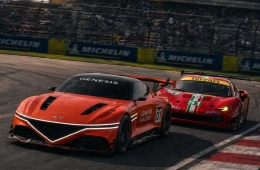
Hyundai is pushing the "electric vehicle transition" under the leadership of Hyundai Motor Group Chairman Chung Eui-sun. Genesis plans to make all new models launched from 2025 electric vehicles. For the entire brand, Hyundai's strategy is to stop selling internal combustion engine vehicles from 2040. The global EV sales target for 2030 is set at 2 million units. To achieve this, Hyundai is building EV-dedicated plants in Ulsan and Georgia, USA, among other infrastructure developments. Hyukjin Yoon, a researcher at SK Securities, said, "Despite the recent slowdown in the EV market, preference for eco-friendly vehicles will continue. There is also ample growth potential for hybrid lineups such as the Ioniq and the all-new Santa Fe."
Record-Breaking 'Cherry Blossom Dividend' Coming... Positive for Supply and Demand
The securities industry views Hyundai's shareholder-friendly policies positively. Seonjae Song, a researcher at Hana Securities, said, "Hyundai maintains a dividend payout ratio of 25%, quarterly dividends four times a year, and a shareholder return policy of repurchasing and retiring 1% of issued shares annually." Notably, if investors buy before the record date for year-end dividends (February 29), they can receive the year-end dividend, and after the March general meeting of shareholders, they can also receive the first-quarter dividend. This has led to the term "cherry blossom dividend," positively influencing short-term supply and demand.
Hyundai's year-end dividend is a record high of 8,400 KRW per share, a 40% increase from 6,000 KRW the previous year. Given last year's record performance, the quarterly dividend decided after the March general meeting is also expected to be substantial. Jayoung Koo, Executive Director of Hyundai Motor IR, said, "We promised to retire 1% of treasury shares annually for three years. After completing the target of 3% retirement, we will positively consider additional treasury share repurchases." This year's treasury share retirement is scheduled to be completed by April.
Strong Labor Union Remains a Constant Risk
However, compared to rival companies, Hyundai's "premium brand" competitiveness is somewhat lacking. Although Genesis, launched as an independent brand in 2015, has shown steady quantitative growth, it still lacks the "premium" image compared to competitors. A bigger issue lies elsewhere. While the competitiveness of the Genesis brand can improve over time, the recurring issue of a "strong labor union" during wage and collective bargaining negotiations remains an ongoing challenge.
Hot Picks Today
Last year, negotiations were difficult due to the union's demand to extend the retirement age from the current 60 to 64. Although a strike was narrowly avoided, the retirement age extension was not achieved, making it likely that similar issues will recur. Moreover, labor union risks are expected to continue, as union membership rates at Hyundai's U.S. plants exceed 30%, not just domestically.
© The Asia Business Daily(www.asiae.co.kr). All rights reserved.