Yoon Visits First Aging Residential Area Since Inauguration, Calls for "Reevaluation of Redevelopment and Reconstruction Procedures from the Start" (Comprehensive)
"More Housing Supply Needed in Urban Areas"... Signals for Supply Expansion and Deregulation
Previous Government's Regulatory Tightening Caused Supply Disruptions and Market Overheating
Background of Visiting Aging Residential Areas... Goal is 'Rapid Supply in Urban Areas' with High Demand
Yoon: "Will Change Redevelopment and Reconstruction Start Criteria to Aging"
Impact of Yoon Administration's Deregulation Policy... Easier Safety Inspections and Designation of Maintenance Zones
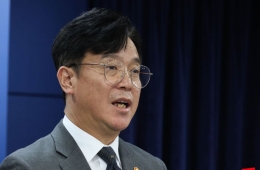
President Yoon Suk-yeol visited an aging residential redevelopment site for the first time since his inauguration on the 21st and stated, "We will reexamine the redevelopment and reconstruction project procedures from the ground up to ensure that more housing can be supplied in urban areas." Since the previous administration's tightening of redevelopment project reviews revealed limitations in housing supply, leading to an overheated housing market, the plan is to simultaneously promote supply expansion and regulatory relaxation to stabilize the market. The president's signal to expand supply is expected to significantly help alleviate the supply shortage.
On the morning of the same day, President Yoon inspected the Moa Town site in Jungnang-gu, Jung-hwa 2-dong, Seoul, and discussed the direction of redevelopment and reconstruction of aging residential areas in the city with experts and residents.
The Moa Housing to be built in Moa Town is a project that renovates aging low-rise residential areas that do not meet redevelopment requirements on a small scale, making large-scale redevelopment difficult. It is similar to Seoul City's previous project called the 'Street Housing Redevelopment Project,' but the key difference is that the land area criteria have been significantly relaxed to gather low-rise multi-family houses and multi-household houses into one complex and rebuild them. Unlike the existing project method, the development period is also shortened by more than half, enabling housing supply in urban areas within a short period.
President Yoon's emphasis on the same day, during his first visit to an aging residential development site since taking office, that "Since the aging houses have remained in the same condition as 30 years ago, causing great inconvenience to the people, they must be replaced with comfortable and safe housing," aligns with this context. During the presidential campaign, he visited reconstruction and remodeling project sites, and after inauguration, he visited permanent rental housing and instructed measures to strengthen tenant deposit protection, but he judged that the basic supply framework alone has limitations for housing supply in urban areas.
![[Image source=Yonhap News]](http://www.asiae.co.kr/news/img_view.htm?img=2023122113185896648_1703132338.jpg)
In particular, President Yoon said, "Currently, to proceed with reconstruction and redevelopment, one must first receive a safety diagnosis of the existing housing and have the risk acknowledged to start the project. Because of this, an absurd situation arises where residents hope their own homes become dangerous," and emphasized, "In the future, the criteria for starting redevelopment and reconstruction should be completely changed to aging."
He continued, "For small-scale urban maintenance projects like Moa Town, which I visited today, the government will further strengthen support," promising, "We will accelerate the improvement of residents' living environments by expanding financial support and relocation loans." Furthermore, he pledged, "The government will also do its best to rationalize various regulations for fundamental housing market stabilization," and added, "We will improve living environments so that people can find homes close to their workplaces within the city, rather than moving to the outskirts in search of new houses."
In fact, the government has set a roadmap to supply 2.7 million households (based on permits and approvals) over five years. The new supply volume is concentrated in the metropolitan area according to the demand segment. Including Seoul (500,000 households), 1.58 million households will be supplied in the metropolitan area alone. Compared to 2018?2022, Seoul will see an increase of 180,000 households, and the metropolitan area will see an increase of 290,000 households.
The waiting demand within the metropolitan area is focusing on the 520,000 households to be supplied through the activation of redevelopment projects in downtown areas such as Seoul. The Ministry of Land, Infrastructure and Transport has eased the reconstruction burden charge (a system that recovers part of the housing price increase due to reconstruction) and lowered safety diagnosis standards to activate reconstruction, so it is expected that smooth supply different from the previous administration will be achieved. On the same day, President Yoon also met with residents to exchange opinions on the necessity of small-scale maintenance projects, residents' hardships due to excessive redevelopment and reconstruction regulations and project delays, and the need to expand urban housing supply.
![[Image source=Yonhap News]](http://www.asiae.co.kr/news/img_view.htm?img=2023122113195196651_1703132391.jpg)
Market reactions to the two pillars of 'supply expansion' and 'regulatory relaxation' are also appearing rapidly. The number of safety diagnosis approvals, which was only 65 cases in the past five years, has already reached 163 cases this year alone, and the designation of maintenance zones, which averaged only 28,000 households annually, has more than doubled to 62,000 households this year.
The Blue House believes that President Yoon's on-site visit and the directive to 'reexamine from the ground up' the redevelopment project procedures will preemptively block side effects caused by supply shortages that the market fears. As of August this year, nationwide housing construction starts have decreased by more than half compared to the same period last year, and permits and approvals have decreased by nearly 40%, raising concerns about a supply cliff in the next two to three years. Considering that housing supply (move-in) usually occurs two to three years after construction starts and three to five years after permits and approvals, a supply shortage may occur in the next two to three years.
Park Sang-woo, the nominee for the new Minister of Land, Infrastructure and Transport, also repeatedly promised to ease redevelopment project regulations along with accelerating the supply of the 3rd New Towns. Park, the first nominee from the Ministry of Land in 10 years, recently told reporters, "In my judgment, the real estate market is currently declining significantly, so I will basically take a stance of regulatory relaxation when dealing with the market." Park previously led regulatory easing policies such as lifting the speculative overheated district designation for the three Gangnam districts in Seoul and temporarily exempting the reconstruction excess profit charge when he served as director of the Housing and Land Office at the Ministry of Land.
Hot Picks Today
 "Stocks Are Not Taxed, but Annual Crypto Gains Over 2.5 Million Won to Be Taxed Next Year... Investors Push Back"
- "Don't Throw Away Coffee Grounds" Transformed into 'High-Grade Fuel' in Just 90 Seconds [Reading Science]
- Signed Without Viewing for 1.6 Billion Won... Jamsil and Seongbuk Jeonse Prices Jump 200 Million Won in a Month [Real Estate AtoZ]
- "Groups of 5 or More Now Restricted"... Unrelenting Running Craze Leaves Citizens and Police Exhausted
- "Even With a 90 Million Won Salary and Bonuses, It Doesn’t Feel Like Much"... A Latecomer Rookie Who Beat 70 to 1 Odds [Scientists Are Disappearing] ③
Meanwhile, before visiting Moa Town on the same day, President Yoon visited a multi-family house in Jungnang-gu to check on a single elderly resident and inspected cold-weather protection measures for vulnerable groups. This was four days after he instructed on the 17th to "strengthen safety and care for vulnerable groups such as elderly living alone in preparation for the cold wave." He also expressed the government's commitment to welfare for the vulnerable while encouraging the efforts of the accompanying life support workers.
© The Asia Business Daily(www.asiae.co.kr). All rights reserved.