US Stocks and Bonds 'Santa Rally'... "Pivot May Actually Be Poison"
Powell Signals Rate Cut Next Year
US Treasury Yields Back to 3% Range After 5 Months
Dow Jones Hits Record High for Second Day
Growing Voices Warn "Market Optimism Excessive"
"If Financial Conditions Ease Too Quickly, Rate Cut Timing Will Be Delayed"
Jerome Powell, Chairman of the U.S. Federal Reserve (Fed), has signaled a rate cut next year, sparking a so-called 'Santa Rally' in the U.S. stock and bond markets. The yield on the 10-year U.S. Treasury note has fallen to the 3% range for the first time in about five months, while the Dow Jones Industrial Average hit record highs for the second consecutive day. However, some warn that if financial conditions become excessively loose amid a still-robust U.S. economy, with sharp rises in stock and bond prices, the Fed's inflation response could become more complicated, potentially delaying the timing of rate cuts.
U.S. 10-Year Treasury Yield Falls to 3% Range... Stock Market Also Rallying

According to the global bond market on the 14th (local time), the yield on the 10-year U.S. Treasury note fell 10 basis points (1bp = 0.01 percentage point) from the previous trading day to 3.929%. This is the first time since late July that the 10-year Treasury yield has dropped below 4%. A decline in bond yields indicates a rise in bond prices. The 2-year Treasury yield, which is sensitive to Fed monetary policy, also fell 8bp to 4.297%, the lowest level since June.
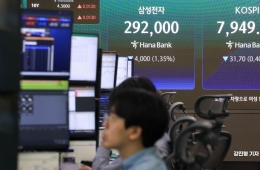
The stock market also rose for the second consecutive day. The Dow Jones Industrial Average closed at 37,248.35, up 0.43% from the previous session, marking a record high for the second day in a row. The S&P 500, dominated by large-cap stocks, rose 0.26% to 4,719.55, and the tech-heavy Nasdaq Composite increased 0.2% to 14,761.56. European and Asian markets also rose together. The Euro Stoxx 600 index climbed 0.9%, while the UK, Hong Kong, and South Korean markets all gained more than 1%. As of 10:20 a.m. on the 15th, the KOSPI index was up 1.12% from the previous trading day at 2,572.71, continuing its two-day rise. Both international oil prices and gold prices also increased.
The previous day, the Fed kept the benchmark interest rate steady at 5.25-5.5%, delivering a dovish (monetary easing-favoring) message that boosted market expectations for rate cuts, which in turn stirred global financial markets. Jerome Powell stated, "Discussions about when policy easing (rate cuts) will be appropriate have become more visible." Contrary to expectations of hawkish (monetary tightening-favoring) remarks, he hinted at the possibility of ending monetary tightening.
Rick Rieder, Global Chief Investment Officer (CIO) of Bonds at U.S. asset management firm BlackRock, analyzed, "The market is performing so well because everyone believes Powell will push monetary easing at the fastest pace in decades."
Concerns Over Overbought Territory... "Market Optimism May Be Wrong Again"
As stock and bond prices surge, some voices are warning that the market may be getting ahead of itself again. At the beginning of the year, investors expected rate cuts within the year, but those predictions were completely off, and there are warnings that the Fed’s policy may again fall short of market expectations. According to financial data provider FactSet, traders expect the Fed to start cutting rates in March next year and lower rates to around 3.9% by year-end, which is significantly below the Fed’s own year-end forecast of 4.6%.
Michael Rosen, CIO of Angeles Investment, diagnosed, "Over the past two years, the market has been ahead of reality, and it is still ahead regarding how much the Fed will cut rates." Joe Brusuelas, Chief Economist at RMS, said, "The Fed will not cut rates before June next year," adding, "(The stock rally) is too excessive and premature considering the fundamental economic conditions."
Although inflation and labor market overheating are easing, the U.S. economy remains robust, leading to expectations that the Fed will not move quickly to cut rates. According to the U.S. Department of Commerce, November retail sales rose 0.3% month-over-month to $705.7 billion, showing strength contrary to the Wall Street Journal (WSJ) consensus forecast of -0.1%. This was also an improvement over the previous month’s revised decline of -0.2%. The result exceeded expectations, helped by the Black Friday effect.
Rosen, CIO, said, "Five to six rate cuts next year would be reasonable if there were clear signs of a significant recession, but I don’t see such signs," adding, "Even the Fed’s statements do not indicate that they intend to make that many (five to six) cuts." If a soft landing of the U.S. economy without recession is possible, the Fed has no need to rush rate cuts.
Hot Picks Today
 Up to 600 Million Won for Semiconductors, 160 Million Won Bonus for Loss-Making Non-Memory… Samsung Electronics Labor and Management Reach Tentative Deal on Unprecedented Performance Compensation (Comprehensive)
- "Could I Also Receive 370 Billion Won?"... No Limit on 'Stock Manipulation Whistleblower Rewards' Starting the 26th
- "From a 70 Million Won Loss to a 350 Million Won Profit with Samsung and SK hynix"... 'Stock Jackpot' Grandfather Gains Attention
- Opening a Bank Account in Korea Is Too Difficult..."It Costs 150,000 Won Just to Open a Child's Account or Check Card" [Foreigner K-Finance Status]②
- "Who Is Visiting Japan These Days?" The Once-Crowded Tourist Spots Empty Out... What's Happening?
The WSJ reported, "Some investors are questioning how sustainable this rally is," and added, "If financial conditions become too loose, the Fed may try to eliminate the need for rate cuts."
© The Asia Business Daily(www.asiae.co.kr). All rights reserved.
!["Please Help": How Much Do Those Bowing 90 Degrees Really Earn? [Data Pick]](https://cwcontent.asiae.co.kr/asiaresize/307/2026052010120870131_1779239528.png)