Korean Prime Minister: "Yellow Envelope Act Undermines Labor-Management Relations... Will Cause On-Site Conflicts and Confusion"
Yellow Envelope Act and Broadcasting 3 Acts Veto Hint

Prime Minister Han Duck-soo is delivering an opening remark at the provisional cabinet meeting held at the Government Seoul Office in Jongno-gu, Seoul on the 1st. The meeting is set to deliberate on the exercise of the veto right regarding the Yellow Envelope Act and the amendment to the Broadcasting 3 Acts, which were passed by the National Assembly plenary session. Photo by Jo Yong-jun jun21@
View original imagePrime Minister Han Duck-soo on the 1st expressed concerns about the 'Yellow Envelope Act (Amendment to the Labor Union and Labor Relations Adjustment Act)' passed by the National Assembly led by the Democratic Party of Korea, stating that it "could significantly undermine labor-management relations and cause conflict and confusion in industrial sites," suggesting a recommendation for the presidential right of reconsideration (veto). He also officially announced a recommendation for veto regarding the Broadcasting Three Acts (Broadcasting Act, Broadcasting Culture Promotion Act, Korea Educational Broadcasting System Act).
At an extraordinary Cabinet meeting held at the Government Seoul Office on the same day, Prime Minister Han said, "The government has repeatedly explained the side effects and problems of the amendment, but it is very regrettable and unfortunate that it was passed in the National Assembly without sufficient discussion." Regarding the Yellow Envelope Act, he mentioned, "It expands the concept of the employer, who is a party to collective bargaining, to a vague notion of 'a person in a position to substantially and concretely control or determine the working conditions of workers,' which is expected to cause confusion at the workplace due to differing interpretations," adding, "The unclear concept may also violate the constitutional principle of legality and clarity in criminal law."
Furthermore, he criticized, "As the scope of labor disputes is greatly expanded, it has become possible to resolve issues that were previously settled through adjustment, judicial procedures, or official mediation bodies by means of strikes," and "This inevitably strengthens the tendency of labor unions to resolve any issue through power exertion rather than dialogue and compromise."
Prime Minister Han also pointed out, "According to the consistent stance of the Supreme Court, the general principle under civil law is that liability for damages caused by multiple illegal acts should be jointly and severally borne, and the same principle applies to labor unions," but "the amendment grants a special privilege by making an exception to the civil law principle of liability for damages only for labor unions." He added, "This will make it difficult to hold labor unions accountable for damages caused by illegal strikes, thereby encouraging illegal strikes."
Regarding the Broadcasting Three Acts, he stated, "The government is striving to separate broadcasting from political power and establish fairness and publicness to restore public trust in public broadcasting, and it is also a time when a comprehensive reform of public broadcasting is necessary," but criticized, "The amendment is excessively focused on changing the governance structure rather than establishing a future-oriented new role for public broadcasting."
Hot Picks Today
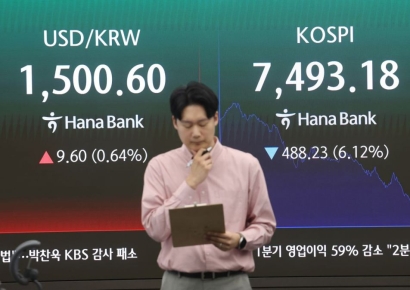 After Topping 8,000 Instead of Hitting 10,000... KOSPI Plunges—When Will It Rebound?
- [Breaking] Court Rules Against Samsung Electronics Union...1 Billion Won per Day Penalty for Exceeding Strike Scope
- "What? It Wasn't a Wristwatch?" This Brand's Stock Soared 15%, Then Plunged After Official Announcement
- [Breaking] Court Rules Against Samsung Electronics Union...1 Billion Won per Day Penalty for Exceeding Strike Scope
- "That? It's Already Stashed" Nightlife Scene Crosses the Line [ChwiYak Nation] ③
He emphasized, "Although the purpose of the amendment is to guarantee the independence and political neutrality of public broadcasting, it is pointed out that the content may produce the opposite result," and "By forming the board of directors centered on specific interest groups or biased organizations, fairness and public interest may be compromised, and granting the right to recommend directors to stakeholders who are subject to checks and supervision poses a very high risk of rendering the board of directors dysfunctional."
© The Asia Business Daily(www.asiae.co.kr). All rights reserved.