Triple Decline in 'Production, Consumption, Investment' After 3 Months... Semiconductor Production Down 11.4% (Comprehensive)
Statistics Korea Announces October Industrial Activity Trends
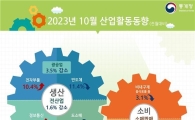
Last month, industrial production, retail sales, and facility investment all declined, marking a shift to a 'triple decrease.' This is the first time in three months since July. Semiconductor production dropped by more than 11%.

According to the 'October Industrial Activity Trends' released by Statistics Korea on the 30th, total industrial production decreased by 1.6% compared to the previous month. This reverses the upward trend seen for two consecutive months in August (2.0%) and September (1.1%). The decline was larger than in June (0%) and July (-0.8%). This is the largest decrease in three years and six months since April 2020 (-1.8%).
The contraction in production was largely influenced by the semiconductor sector. Last month, manufacturing production increased in electronic components (10.4%) and others, but production decreased in semiconductors (-11.4%) and machinery equipment (-8.3%), resulting in a 3.5% decline compared to the previous month. The trend of double-digit growth seen consecutively in August (5.2%) and September (1.8%) was broken after three months. In particular, semiconductor memory production such as DRAM and flash memory was sluggish. Semiconductor shipments in October also fell by 29.0% compared to the previous month.

Kim Bo-kyung, Economic Trend Statistics Officer at Statistics Korea, explained, "Production volume decreased due to a reduction in working days caused by the designation of a temporary holiday in October," adding, "There was also a base effect on manufacturing production, which showed high growth rates in August and September." He further noted, "In terms of year-on-year comparison, manufacturing production has shown positive growth for two consecutive months, indicating a continued trend of economic improvement." Manufacturing production recorded 2.7% in September and 1.0% in October compared to the same month last year.
Manufacturing inventories also increased by 0.4% compared to the previous month. Inventories decreased in semiconductors (-9.6%), telecommunications and broadcasting equipment (-10.3%), and automobiles (-2.0%). The manufacturing inventory ratio (inventory/shipment) rose by 8.4 percentage points to 122.3%. Previously, the manufacturing inventory ratio was 124.3% in August and 113.9% in September. The average operating rate in manufacturing fell by 2.7 percentage points to 70.3%. Service production also decreased by 0.9% compared to the previous month due to declines in wholesale and retail (-3.3%) and finance and insurance (-1.2%).
Retail sales also failed to escape the downward trend. Retail sales, which indicate consumption, decreased by 0.8% compared to the previous month as sales declined in non-durable goods such as food and beverages (-3.1%). Despite the designation of a temporary holiday last month, consumer demand did not revive. Officer Kim diagnosed, "There is a recent trend of slowing private consumption, especially a sluggish consumption in the goods sector."
Facility investment also decreased by 3.3% compared to the previous month as investments declined in machinery such as special industrial machinery (-4.1%) and transportation equipment including automobiles (-1.2%). Construction performance increased by 0.7% compared to the previous month, with civil engineering (-1.0%) seeing a decrease in construction performance, but architecture (1.3%) showing an increase.
Related Articles
 Triple Decline in October 'Production, Consumption, Investment'... Semiconductor Down 11.4%
The coincident composite index, which reflects the current economic situation, fell by 0.1 points compared to the previous month. However, the leading composite index, which forecasts future economic conditions, rose by 0.3 points compared to the previous month.
© The Asia Business Daily(www.asiae.co.kr). All rights reserved.