'25 Years Focused on Battery' Kim Dongmyeong's Team, Prioritizing 'Mastery of Operation' Over Speed
[LG Energy Solution 2.0]
Overcoming Electric Vehicle Demand Slump Crisis Through Generational Change
Turning Point from Quantitative to Qualitative Growth
Differentiation by Diversifying Product Line Amid Intensifying Competition
Having grown remarkably in just three years since its establishment, LG Energy Solution is attempting a new leap forward under the new Kim Dong-myung administration. The battery crisis triggered by sluggish electric vehicle demand may continue into next year. In other words, it is a generational change amid crisis. Attention is focused on whether Kim Dong-myung's leadership will find solutions to overcome this crisis.

Key positions in the 'Kim Dong-myung administration' have been filled by personnel born in the late 1960s and 1970s.
Along with CEO Kim, born in 1969, the newly established Chief Digital Officer (CDO) and Chief Strategy Officer (CSO) positions were filled by Executive Director Lee Jin-gyu, born in 1969, who previously led LG CNS's Smart Factory Division, and Executive Director Kang Chang-beom, born in 1971, who worked as a team leader at LG Chem. The Chief Production Officer (CPO) role was assigned to Executive Director Son Chang-wan, born in 1970, who heads the Small Battery Division's Production Center.
Executive Director Jang Seung-kwon, born in 1969, is responsible for finance and accounting, while Executive Director Lee Kang-yeol, born in 1971, was appointed as Purchasing Center Head. Choi Seung-don, promoted to Vice President and head of the Automotive Battery Development Center, was born in 1972. Chief Technology Officer (CTO) and Small Battery Division Head positions were taken by Executive Directors Kim Je-young and Oh Yoo-sung, both born in the same year. Most of these appointees are more than a decade younger than their predecessors.
The battery industry is passing a turning point from explosive quantitative growth to qualitative growth. If LG Energy Solution's '1.0' phase focused on initial technology development and large-scale facility investment aligned with the electrification era of automobiles, the '2.0' phase emphasizes facility process management and next-generation technology research and development (R&D).

As the electric vehicle market, a front-line industry, changes daily, on-site experience, expertise, and swift decision-making have become more important than ever in the battery industry.
Battery industries worldwide, including China, North America, and Europe, are overheated. Supported by competitive government subsidies, production facilities have surged, and as large-scale plants began operations, battery supply chains faced crises. With raw material prices soaring, battery companies have been desperately securing new resource channels.
Although supply chains have gradually stabilized, new crises of demand sluggishness and price declines have emerged. Battery companies are forced to slow down and cool off by halting joint ventures with automakers, postponing investments, or restructuring.
LG Energy Solution has secured a solid path by acquiring customers among the top 10 global automakers, including General Motors (GM), Volkswagen, Hyundai Motor·Kia, Stellantis, Honda, Ford, Volvo, and Toyota. However, the trend of speed adjustment could not be resisted. The cancellation of investment plans for a joint plant in Europe is a representative example.
Moreover, from next year, large plants will begin operations mainly in North America. Following the joint plant with Stellantis in Canada next year, the 2nd and 3rd plants jointly established with GM, as well as joint plants with Honda and Hyundai Motor, will simultaneously come online by 2025. Efficient process management and early yield improvement?the 'art of operation'?are urgently needed.
LG Energy Solution is seeking breakthroughs through product diversification, including new cylindrical lines and strengthening mid-to-low-priced products. The pilot line for the 46 series (46mm diameter cylindrical battery) being built at the Ochang Energy Plant will start mass production in the second half of next year. Low-cost lithium iron phosphate (LFP) batteries will also be produced starting in 2026. For next-generation all-solid-state batteries, commercialization targets are 2026 for polymer-based and 2030 for sulfide-based types.
Jeong Won-seok, a researcher at Hi Investment & Securities, said, "Although concerns about electric vehicle demand have recently surfaced, it is merely a slight speed adjustment; the direction toward electric vehicle transition is clear. LG Energy Solution has secured various customers, boasts high earnings stability, and possesses diverse products including high-nickel and competitively priced LFP batteries based on advanced technology."
Hot Picks Today
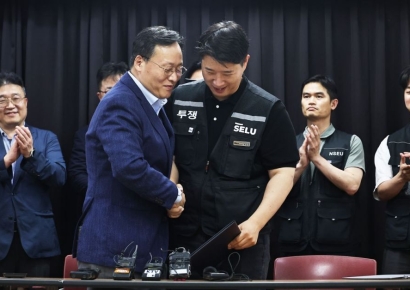 Up to 600 Million Won for Semiconductors, 160 Million Won Bonus for Loss-Making Non-Memory… Samsung Electronics Labor and Management Reach Tentative Deal on Unprecedented Performance Compensation (Comprehensive)
- "Could I Also Receive 370 Billion Won?"... No Limit on 'Stock Manipulation Whistleblower Rewards' Starting the 26th
- "From a 70 Million Won Loss to a 350 Million Won Profit with Samsung and SK hynix"... 'Stock Jackpot' Grandfather Gains Attention
- Opening a Bank Account in Korea Is Too Difficult..."It Costs 150,000 Won Just to Open a Child's Account or Check Card" [Foreigner K-Finance Status]②
- "Who Is Visiting Japan These Days?" The Once-Crowded Tourist Spots Empty Out... What's Happening?

An industry insider said, "CEO Kim is a battery expert who understands the current industry situation better than anyone. He must quickly stabilize the organization for the future and demonstrate leadership by enhancing capabilities."
© The Asia Business Daily(www.asiae.co.kr). All rights reserved.
!["Please Help": How Much Do Those Bowing 90 Degrees Really Earn? [Data Pick]](https://cwcontent.asiae.co.kr/asiaresize/307/2026052010120870131_1779239528.png)