Yoon: "Wage Arrears Are Criminal Acts... The Principle of Labor-Management Rule of Law Applies Fairly to All" (Comprehensive)
"Delayed Wage Payments Threaten Family Life" ... Urgent Call for Swift Processing of the 'Labor Standards Act' and Others
Relay Tour Praised as "A Large and Reliable Playground Called Multilateral Trade Order"
Pointing Out Administrative Network Outage, "Must Thoroughly Investigate with Cyber Attack in Mind"
President Yoon Suk-yeol on the 28th defined wage arrears in industrial sites as a criminal act, stating, "Not receiving wages on time threatens the lives of workers and their families." He particularly urged the swift passage of the amendment to the Labor Standards Act that imposes disadvantages on habitual wage-arrears employers, emphasizing that "policies must support workers to receive their overdue wages as soon as possible."
President Yoon presided over a Cabinet meeting at the Yongsan Presidential Office that morning, saying, "Already this year, more than 220,000 victims of wage arrears have occurred, with damages exceeding 1.4 trillion won," and conveyed this request.
Strengthening penalties such as criminal punishment for employers who habitually delay wages, as well as restrictions on public bidding and financial loan sanctions, is a core principle of the Yoon administration’s labor policy. The government and ruling party have also introduced a 'Habitual Wage Arrears Eradication Plan' based on this, and it appears that President Yoon has identified 'wage arrears' as the top priority issue for improving people’s livelihoods as the year-end approaches.
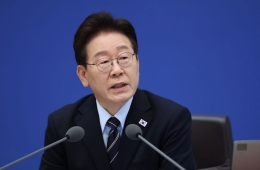
![President Yoon Suk-yeol is speaking at the Cabinet meeting held on the 28th at the Yongsan Presidential Office building in Seoul. <br>[Photo by Yonhap News]](http://www.asiae.co.kr/news/img_view.htm?img=2023112810393168629_1701135572.jpg)
President Yoon Suk-yeol is speaking at the Cabinet meeting held on the 28th at the Yongsan Presidential Office building in Seoul.
[Photo by Yonhap News]
President Yoon expressed concern about wage arrears, saying, "It threatens the lives of families," and added, "Many young people taking their first steps into society are unable to repay student loans or cover housing costs due to wage arrears, leading to credit delinquency." He emphasized, "Our law treats wage arrears as a criminal offense," and stressed, "The principle of labor and management rule of law must be applied fairly to both workers and employers."
He also urged the prompt passage of related bills. President Yoon said, "I ask that the amendment to the Labor Standards Act, which restricts habitual wage-arrears employers from participating in various government subsidy projects and imposes disadvantages in public bidding and financial transactions, be definitely passed in this National Assembly." Along with sanctions, he mentioned institutional support to help workers easily receive overdue wages. He also called for discussions on amending the Wage Claim Guarantee Act to ease conditions so that employers can more easily utilize government loan systems. It appears he pointed out that currently, employers applying for government loans to pay overdue wages must prove conditions such as a more than 50% increase in inventory or a more than 15% decrease in sales.
During his overseas trips, President Yoon said government ministries listened to voices from the field of people’s livelihoods, raising issues such as the monopoly of large internet shopping mall platforms and bedbug pest control. He said, "Those running small internet shopping malls are seeing the online market becoming increasingly monopolized, with many similar businesses around them closing, leaving less than half remaining," and requested, "The government should have a strong will and interest in institutional improvements regarding the harms and problems of monopolized large platforms."
He also shared the achievements of the past ten days of trips, including the Asia-Pacific Economic Cooperation (APEC) Summit, a state visit to the United Kingdom, and the bid for the 2030 World Expo in Paris, France. He focused especially on informing the public about economic benefits from each trip. Representative examples include investment declarations by U.S. automobile and semiconductor companies totaling $1.16 billion during the APEC Summit, the establishment of a foundation for a new nuclear power plant project worth 32 trillion won during the UK state visit, and cooperation between Korea and France in AI (artificial intelligence), quantum technology, space, and defense industries. President Yoon evaluated, "Our country, which lacks substantial natural resources, has grown into a global economic powerhouse because there was a large and reliable playing field of multilateral trade order where companies could freely compete."
The exercise of the right to request reconsideration (veto) was postponed. This was because the 'Yellow Envelope Act' (amendment to the Labor Union and Labor Relations Adjustment Act) and the 'Broadcasting Three Acts' (amendments to the Broadcasting Act, Korea Broadcasting Culture Promotion Agency Act, and Korea Educational Broadcasting System Act) were not submitted. Following the achievements of the trips and the announcement of the 2030 World Expo host city, the focus is on people’s livelihoods for now.
These two bills were transferred to the government from the National Assembly on the 17th and have a processing deadline of the 2nd of next month, making it unavoidable to hold a separate extraordinary Cabinet meeting this week. However, the exercise of the veto is practically inevitable. The Presidential Office views the Yellow Envelope Act as likely to encourage strikes and cause confusion in industrial sites amid difficult economic conditions.
In line with this, the government’s commitment to support the recovery of the people’s economy was reaffirmed. President Yoon said, "If there is no food, no entertainment, and no place to rest, workers and their families will not want to go there. Places where people do not come, companies cannot find either, and companies cannot go there." He urged, "The Industrial Location Act, which blocks the installation and entry of basic facilities such as convenience and leisure facilities for workers within industrial complexes, must be amended as soon as possible." Emphasizing the flexibilization of industrial complex industries was in the same context. President Yoon pointed out, "New advanced industries are emerging day by day, but the law remains unchanged, so the appearance of industrial complexes is stuck in the past," and added, "The Industrial Cluster Act, which restricts tenant industries, must be amended so that advanced and new industries can enter existing industrial complexes and grow together."
Hot Picks Today
 "Stocks Are Not Taxed, but Annual Crypto Gains Over 2.5 Million Won to Be Taxed Next Year... Investors Push Back"
- "Don't Throw Away Coffee Grounds" Transformed into 'High-Grade Fuel' in Just 90 Seconds [Reading Science]
- Signed Without Viewing for 1.6 Billion Won... Jamsil and Seongbuk Jeonse Prices Jump 200 Million Won in a Month [Real Estate AtoZ]
- "Groups of 5 or More Now Restricted"... Unrelenting Running Craze Leaves Citizens and Police Exhausted
- "Even With a 90 Million Won Salary and Bonuses, It Doesn’t Feel Like Much"... A Latecomer Rookie Who Beat 70 to 1 Odds [Scientists Are Disappearing] ③
Regarding the recent administrative network paralysis incident, he ordered a thorough analysis. Mentioning chronic issues such as split orders and frequent changes of management companies, he said, "We must thoroughly investigate, keeping in mind the possibility of external cyberattacks."
© The Asia Business Daily(www.asiae.co.kr). All rights reserved.