Korea Electric Power Corporation Turns Profitable but Stock Price Recovery Still a Long Way Off
Limitations on Stock Price Increase Despite Q3 Operating Profit of 1.9966 Trillion Won
Possibility of Decreased Operating Profit in Q4
Kiwoom, Hyundai Motor, SK Securities Lower KEPCO Target Price

Korea Electric Power Corporation (KEPCO) succeeded in returning to profitability after 10 quarters, but it seems more time is needed for its stock price to recover. Although it recorded a temporary profit, forecasts suggest that the stock price increase will be limited.
According to the Korea Exchange on the 15th, KEPCO closed at 17,400 KRW, down 2.63% from the previous day. Following the announcement of a return to profit in the third quarter of this year, the stock price rose more than 5% on the 13th but reversed to a decline the next day, failing to maintain the upward momentum.
KEPCO posted an operating profit of 1.9966 trillion KRW in the third quarter of this year, turning profitable compared to the same period last year. Sales increased by 23.8% to 24.47 trillion KRW. Yuje-seon, a researcher at Hana Securities, analyzed, "Amid the overall increase in electricity demand during the peak season, residential demand remained solid, and the rise in electricity rates contributed to revenue growth," adding, "Cost reductions due to the decline in raw material prices were the main factor behind the return to profitability."
Despite the return to profit, some securities firms lowered their target prices, negatively impacting the stock price. Kiwoom Securities lowered KEPCO’s target price from 24,000 KRW to 22,500 KRW, Hyundai Motor Securities adjusted it down from 21,000 KRW to 20,000 KRW, and SK Securities reduced it from 25,000 KRW to 21,000 KRW. Jong-hyung Lee, a researcher at Kiwoom Securities, explained, "We lowered the target price by 6% compared to the previous level, reflecting the rebound in coal prices since September." Min-sik Na, a researcher at SK Securities, said, "We lowered the target price reflecting the decrease in book value per share (BPS) due to the capital reduction carried out throughout this year."
Although the profit trend is expected to continue in the fourth quarter, it is forecasted to be weaker than in the third quarter. Kwang-rae Park, a researcher at Shinhan Investment Corp., said, "The factors that drove the strong performance in the third quarter are expected to continue in the fourth quarter, making profitability achievable," adding, "The system marginal price (SMP), which is the price for purchasing electricity from power producers, stabilized downward to an average of around 130 KRW from the 1st of last month to the 13th of this month. The average selling price is expected to rise 12% year-on-year due to the recently announced increase in industrial electricity rates, but the absolute operating profit scale will shrink as electricity sales volume in the fourth quarter decreases compared to the third quarter."
Researcher Jong-hyung Lee said, "International oil prices rebounded short-term from the low point in June to September, and consequently, liquefied natural gas (LNG) prices and SMP may temporarily rebound in the fourth quarter," adding, "Also, due to the seasonal off-peak period leading to a decrease in electricity sales volume and a decline in the utilization rate of base-load power plants, cost structure deterioration is expected compared to the third quarter, so fourth-quarter performance will be weaker than the third quarter."
Opinions have been raised that additional electricity rate hikes are necessary to improve the deteriorated financial structure. Hye-jung Jeong, a researcher at KB Securities, explained, "With the inevitable reduction in KEPCO bond issuance limits next year, to accelerate the recovery of KEPCO’s financial soundness, additional profit improvement factors such as electricity rate hikes after the general election or a decline in energy prices are needed."
Hot Picks Today
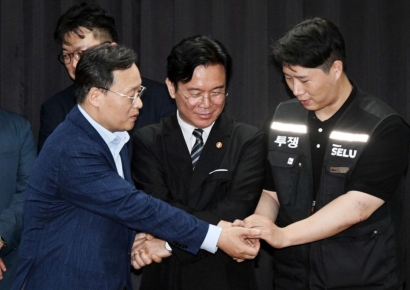 Dramatic Agreement Reached on Eve of Samsung Electronics General Strike... Minister Kim Young-hoon: "Showcased Korea's Strength in Dialogue" (Update)
- "It Has Now Crossed Borders": No Vaccine or Treatment as Bundibugyo Ebola Variant Spreads [Reading Science]
- Japanese Courts Reduce Paperwork, Ushering in Full-Fledged Era of Electronic Civil Litigation
- "Stocks Are Not Taxed, but Annual Crypto Gains Over 2.5 Million Won to Be Taxed Next Year... Investors Push Back"
- "Who Is Visiting Japan These Days?" The Once-Crowded Tourist Spots Empty Out... What's Happening?
Dong-jin Kang, a researcher at Hyundai Motor Securities, said, "The annual required internal cash flow is 23 trillion KRW, including 18 trillion KRW for facility investment and about 5 trillion KRW for interest expenses. Considering annual depreciation of 13.5 trillion KRW and a 90% execution rate of facility investment, annual operating profit should be around 7 to 8 trillion KRW to maintain the financial structure without additional borrowing," adding, "To improve the financial structure even slightly, it is necessary to be in a situation where stable operating profits of over 10 trillion KRW can be generated."
© The Asia Business Daily(www.asiae.co.kr). All rights reserved.