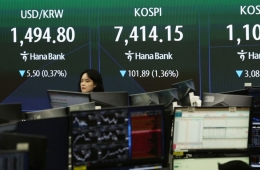
Foreign Stock Funds Withdraw $2.2 Billion Last Month... Largest Outflow in 16 Months
3 Consecutive Months of Net Outflow
Significant Exchange Rate Drop After Dovish FOMC
Due to prolonged concerns over high interest rates and increased geopolitical risks, foreign investors withdrew $2.2 billion from domestic stocks last month. This is the largest amount in 1 year and 4 months.
According to the "International Finance and Foreign Exchange Market Trends since October 2023" released by the Bank of Korea on the 10th, foreign securities investment funds saw a net outflow of $2.78 billion last month.
Among securities investment funds, stock funds experienced a net outflow of $2.2 billion. This is the largest scale since June last year (-$3.01 billion). The Bank of Korea explained, "Amid strengthened global risk aversion sentiment due to the war between Israel and the Palestinian armed group Hamas, the net outflow expanded due to profit-taking in sectors such as secondary batteries."
Bond funds also saw a net outflow of $580 million, increasing compared to the previous month (-$100 million). The Bank of Korea stated, "A slight net outflow continued mainly in public funds."
The average KRW-USD exchange rate slightly rose from 1,349.3 won in September to 1,350.5 won in October (an increase of 1.2 won), but as of the 8th of this month, it sharply dropped to 1,310.6 won. The Bank of Korea explained, "The rate fell sharply due to the more dovish-than-expected Federal Open Market Committee (FOMC) results, the decline in U.S. Treasury yields, the resulting weakness of the dollar, as well as the expansion and improved outlook of South Korea's current account surplus." After the November FOMC, Jerome Powell, Chair of the Federal Reserve, assessed that "inflation has moderated since mid-last year," raising market expectations for the end of interest rate hikes.
The volatility of the KRW-USD exchange rate increased compared to the previous month. During October, the daily fluctuation range of the KRW-USD exchange rate was 5.8 won, larger than September's 3.5 won, and the volatility rate was 0.43%, up from 0.26% in September.
In October, the average daily foreign exchange transaction volume in the domestic interbank market was $30.55 billion, down by $1.99 billion compared to the previous month ($32.54 billion).
The credit default swap (CDS) premium on Korean government bonds (based on the 5-year Foreign Exchange Stabilization Fund bonds) averaged 40 basis points (bp) in October (1 bp = 0.01 percentage points), up 8 bp from the previous month (32 bp), but since November, it has fallen to around 35 bp (as of the 8th) due to eased concerns over Federal Reserve tightening.
Hot Picks Today
!["Rather Than Endure a 1.5 Million KRW Stipend, I'd Rather Earn 500 Million in the U.S." Top Talent from SNU and KAIST Are Leaving [Scientists Are Disappearing] ①](https://cwcontent.asiae.co.kr/asiaresize/93/2026051914165468840_1779167814.png) "Rather Than Endure a 1.5 Million KRW Stipend, I'd Rather Earn 500 Million in the U.S." Top Talent from SNU and KAIST Are Leaving [Scientists Are Disappearing] ①
"Rather Than Endure a 1.5 Million KRW Stipend, I'd Rather Earn 500 Million in the U.S." Top Talent from SNU and KAIST Are Leaving [Scientists Are Disappearing] ①
- "No Cure Available, Spread Accelerates... Already 105 Dead, American Infected"
- "If That's the Case, Why Not Just Buy Stocks?" ETFs in Name Only, Now 'Semiconductor-Heavy' and a Playground for Short-Term Traders
- "Believing He Was Being Ostracized"... Man in His 60s Attempts Arson at Coworker's Home
- "How Did an Employee Who Loved Samsung End Up Like This?"... Past Video of Samsung Electronics Union Chairman Resurfaces
CDS are financial derivatives that act as insurance to compensate for losses when the issuing country or company defaults on bonds. The premium rises when the economic risk of the country increases.
![[Image source=Yonhap News]](http://www.asiae.co.kr/news/img_view.htm?img=2023110810443144996_1699407871.jpg)
© The Asia Business Daily(www.asiae.co.kr). All rights reserved.