US Fed Holds Rates Steady Consecutively Amid Soaring Treasury Yields... Leaves Rate Hike Option Open (Comprehensive)
The U.S. central bank, the Federal Reserve (Fed), has once again kept its benchmark interest rate unchanged. This decision comes despite still strong economic indicators, due to the recent sharp rise in long-term government bond yields, which has tightened financial conditions further. However, the Fed also left the door open for additional tightening, stating that the war against inflation is not over and that it would not be difficult to raise rates again after the pause. This statement is interpreted as leaving the 'rate hike card' on the table to prevent investors' expectations that the rate hike cycle is ending from potentially leading to a resurgence of inflation.
On the 1st (local time), following the Federal Open Market Committee (FOMC) regular meeting, the Fed announced in its policy statement that it would keep the federal funds rate unchanged at 5.25?5.5%. This marks the second consecutive pause following September. The FOMC stated, "Tightened financial and credit conditions for households and businesses could weigh on economic activity, employment, and inflation," and added, "When determining the appropriate extent of additional policy firming to return inflation to the 2% target, we will consider the cumulative tightening of monetary policy, the lagged effects of monetary policy on economic activity and inflation, and economic and financial developments." With this pause, the interest rate gap between South Korea and the U.S. remains at 2 percentage points (based on the upper bound of U.S. rates).
![[Image source=Getty Images Yonhap News]](http://www.asiae.co.kr/news/img_view.htm?img=2023110207225737628_1698877378.jpg)
Recent Surge in Treasury Yields Acknowledged as Influencing Fed's Pause Decision
Fed Chair Jerome Powell acknowledged during the subsequent press conference that the sharp rise in long-term Treasury yields since this summer has tightened financial conditions further. He said, "Looking at the overall financial situation, including rising long-term rates, a strong dollar, and declining stock markets, these factors could influence future monetary policy," and pointed out, "The important thing is that the (surging) long-term rates can affect borrowing costs and the economy." This admission confirms that the recent rise in Treasury yields played a role behind the unanimous decision to pause.
Earlier, at the September FOMC, the Fed hinted that an additional rate hike could follow within the year alongside the pause. However, ahead of this month's FOMC, many analyses inside and outside Wall Street suggested that the recent surge in Treasury yields reduced the need for further Fed tightening. The policy statement released this day also drew attention by adding the word 'financial' to the existing phrase 'tightened credit conditions for households and businesses.' Peter Boockvar, Chief Investment Officer (CIO) at Bleakley Financial Group, analyzed, "This sends a message that the rise in long-term rates should be considered another form of monetary tightening."
At the same time, Chair Powell emphasized that current financial conditions are not restrictive enough to end the war on inflation. When asked whether the December FOMC, the year's last meeting, would mark the 'peak' if rates were not raised, he responded cautiously, "We have not decided yet," adding, "We will consider all data on the economy, inflation, and the labor market." He also stressed that "a pause in rate hikes does not mean it will be difficult to raise rates again," indicating readiness to hike rates if necessary. Regarding the market's expectations for rate cuts, he flatly dismissed them, saying, "We are not discussing that."
The key factor remains the still strong indicators. The U.S. GDP for Q3, released last week, showed a 4.9% year-on-year increase, the highest growth since Q4 2021. The Department of Labor's JOLTS (Job Openings and Labor Turnover Survey) report released on this day showed September job openings at 9.55 million, exceeding both the previous month and Wall Street forecasts, confirming labor market strength. Reflecting this background, the FOMC policy statement adjusted its economic assessment phrase from 'solid pace' to 'strong pace' and changed the wording regarding job growth from 'slowed' to 'moderated.' For the Fed, this means that while pausing rate hikes, it pointed out strong economic indicators and hinted at the need for further tightening.
Chair Powell reaffirmed the Fed's existing stance, stating, "Recent months' inflation slowdown indicators are only a starting point for building confidence in achieving the 2% target," and emphasized that lowering inflation requires below-trend growth and easing labor market overheating.
![[Image source=Getty Images Yonhap News]](http://www.asiae.co.kr/news/img_view.htm?img=2023110207245337630_1698877494.jpg)
"Powell's Hawkish Remarks Lack Persuasiveness" Market Remains Dovish... December Pause Expected
Despite Chair Powell's remarks emphasizing the possibility of further hikes, the market interpreted this FOMC meeting as dovish (favoring monetary easing). This is because the core inflation easing trend continues and the sharp rise in Treasury yields has tightened financial conditions, reducing the need for Fed action. Greg McBride, Chief Financial Analyst at Bankrate, said, "The Fed has left the option to raise rates open, but the recent months' rise in long-term rates has had the effect of monetary tightening," and evaluated, "The Fed has effectively done its job."
Many voices interpret the hawkish (monetary tightening-favoring) remarks as a kind of rhetoric to prevent a jump in expected inflation. Dean Maki, Chief Economist at hedge fund Point72 Asset Management, emphasized, "If the Fed completely rules out rate hikes, the next question becomes 'When will rate cuts come?' so it is important to keep the possibility of rate hikes on the table." Edward Moya, Senior Market Analyst for the Americas at OANDA, said, "The Fed tried a 'hawkish hold,' but Wall Street does not believe additional rate hikes will occur in this tightening cycle," and criticized, "Chair Powell tried to talk a hawkish game but lacked sufficient persuasiveness."
When asked about the Fed's September dot plot signaling one more hike this year, Chair Powell said, "The dot plot is a forecast, not a promise. Many things can change," and added, "A new dot plot will be released in December." This comment fueled market expectations that there will be no additional hikes this year. Kali Cox, an analyst at eToro, said, "The Fed is paying attention to the big picture. They know that blindly raising rates in already quite tight conditions could push the economy to the brink."
Market expectations for a December pause have strengthened. According to the Chicago Mercantile Exchange (CME) FedWatch tool, as of this day, federal funds futures markets price in over a 77% probability that the Fed will keep rates unchanged at 5.25?5.5% at the December FOMC, up from the previous day's 68%. The probability of a December 'baby step' (0.25 percentage point hike) stands at around 22%. Most investors view the possibility of further hikes as low, regardless of the prolonged high-rate environment.
Hot Picks Today
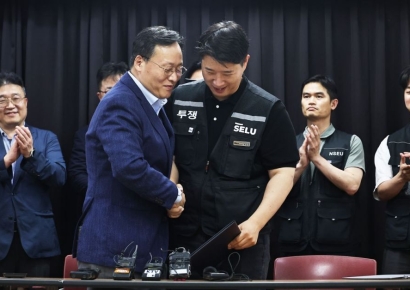 Up to 600 Million Won for Semiconductors, 160 Million Won Bonus for Loss-Making Non-Memory… Samsung Electronics Labor and Management Reach Tentative Deal on Unprecedented Performance Compensation (Comprehensive)
- "Could I Also Receive 370 Billion Won?"... No Limit on 'Stock Manipulation Whistleblower Rewards' Starting the 26th
- "From a 70 Million Won Loss to a 350 Million Won Profit with Samsung and SK hynix"... 'Stock Jackpot' Grandfather Gains Attention
- [Exclusive] 450 Billion Won Korean Investment at Risk as Canadian PE Moves to Acquire US Ascend for $99.2 Million
- "Who Is Visiting Japan These Days?" The Once-Crowded Tourist Spots Empty Out... What's Happening?
On this day, New York stock markets closed higher, extending gains during Chair Powell's press conference. The Dow Jones Industrial Average rose 0.67% from the previous close. The large-cap S&P 500 index gained 1.05%, and the tech-heavy Nasdaq index climbed 1.64%. In the New York bond market, Treasury yields fell. After the Treasury Department released its borrowing plan by maturity earlier in the morning, yields had been declining and further dropped during Powell's press conference. The global benchmark 10-year U.S. Treasury yield fell to around 4.74%, while the 2-year yield, sensitive to monetary policy, dropped to about 4.95%.
© The Asia Business Daily(www.asiae.co.kr). All rights reserved.