'Life Imprisonment Without Parole' Amendment Passed at Cabinet Meeting
The government's proposed 'life imprisonment without parole (absolute life sentence)' has passed the first step toward institutionalization.
On the 30th, the Ministry of Justice announced that a revision to the Criminal Act, which includes the establishment of life imprisonment without parole, was deliberated and approved at the Cabinet meeting held at the Yongsan Presidential Office. The revision bill will be publicly announced for more than 20 days, then submitted to the National Assembly for approval, after which the government will promulgate and implement it.

The revision bill includes provisions for courts to distinguish life sentences into 'parole-allowed' and 'parole-not-allowed' categories when sentencing. Judges will be required to specify whether parole is permitted when imposing a life sentence, and parole will only be possible for life sentences where parole is allowed. (Newly established Article 42, Paragraphs 2 and 3 of the Criminal Act)
The current Criminal Act adopts a 'relative life sentence' system, allowing parole under certain conditions for life imprisonment. Inmates serving life sentences who have maintained good behavior and shown clear remorse may be eligible for parole after serving 20 years. The revision adds the phrase, "However, in the case of life imprisonment, it shall be limited to life sentences where parole is allowed according to Article 42, Paragraph 2," to the parole conditions stipulated in Article 72 of the Criminal Act.
The death penalty will remain unchanged and will coexist with life imprisonment without parole, continuing to hold the status and social effect as the most severe punishment under Korean criminal law.
The Ministry of Justice conducted a legislative notice period from August 14 to September 25 to gather various opinions on the revision bill. Since South Korea has not carried out executions since December 1997, creating a gap in punishment for heinous criminals, the Ministry expects that establishing life imprisonment without parole will enable graduated punishment according to the severity of the crime. The Ministry also referred to cases from advanced countries such as the United States, which implement both the death penalty and life imprisonment without parole.
Hot Picks Today
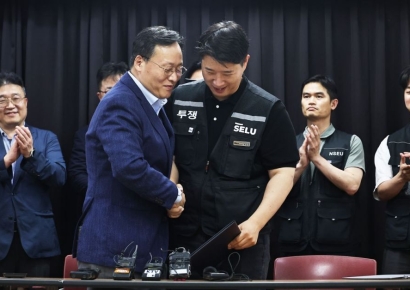 Up to 600 Million Won for Semiconductors, 160 Million Won Bonus for Loss-Making Non-Memory… Samsung Electronics Labor and Management Reach Tentative Deal on Unprecedented Performance Compensation (Comprehensive)
- "Could I Also Receive 370 Billion Won?"... No Limit on 'Stock Manipulation Whistleblower Rewards' Starting the 26th
- "From a 70 Million Won Loss to a 350 Million Won Profit with Samsung and SK hynix"... 'Stock Jackpot' Grandfather Gains Attention
- [Current State of K-Finance for Foreign Nationals]①From Niche to Core... Banks Go All-In on First-Mover Competition
- "Who Is Visiting Japan These Days?" The Once-Crowded Tourist Spots Empty Out... What's Happening?
Han Dong-hoon, Minister of Justice, stated regarding life imprisonment without parole, "I believe this system is essential to consider the pain of victims who have lost their entire lives to heinous crimes and the bereaved families who must suffer lifelong, and to protect innocent citizens from heinous crimes in the future." He added, "I will do my best to ensure the passage of the law."
© The Asia Business Daily(www.asiae.co.kr). All rights reserved.