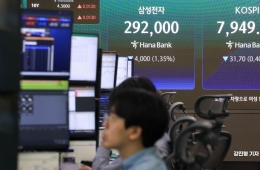
[Weekly Market Outlook] Impact of US Credit Rating Downgrade... 'Boxpi' Market Expected for the Time Being
This week (7th to 11th), the domestic stock market is expected to maintain a cautious stance for the time being as it monitors the aftermath of the downgrade of the United States' sovereign credit rating.
According to NH Investment & Securities on the 6th, the expected weekly KOSPI band is 2540 to 2660 points. The U.S. economic indicators remain robust, and corporate second-quarter earnings have been better than expected, which are factors supporting an increase. However, the recent downgrade of the U.S. sovereign credit rating to the second lowest ever and Japan's revision of its Yield Curve Control (YCC) policy are cited as downward factors.
So far, the Bank of Japan (BOJ) has implemented the YCC policy by setting an upper limit on the 10-year government bond yield, a long-term interest rate indicator, and purchasing unlimited government bonds if market rates exceed this limit. However, going forward, the BOJ will allow some flexibility for the 10-year bond yield to exceed 0.5% depending on market conditions, and it has widened the interest rate condition for unlimited bond purchases from the previous 0.5% to 1%. This was explained as an effort to avoid market distortion, but in financial markets, it is interpreted as the Japanese government beginning to modify its ultra-loose monetary policy.
![[Weekly Market Outlook] Impact of US Credit Rating Downgrade... 'Boxpi' Market Expected for the Time Being](http://www.asiae.co.kr/news/img_view.htm?img=2023080208274327182_1690932464.png)
Additionally, last week, Fitch, one of the three major international credit rating agencies, downgraded the U.S. sovereign credit rating. However, the securities industry agrees that the shock will not be as severe as when Standard & Poor's (S&P) downgraded the U.S. credit rating in 2011. At that time, the Eurozone financial crisis overlapped, and due to a preference for safe assets, U.S. Treasury yields fell sharply. This time, unlike the past, the financial market reaction has been muted. The robust U.S. employment and inflation indicators, which show a steady U.S. economic trend, also support the downside of U.S. Treasury yields. However, some stocks are considered overvalued, which is expected to act as a 'cooling' factor for the stock market.
Kim Young-hwan, a researcher at NH Investment & Securities, said, "With the stock market feeling price pressure on some stocks and interest rate rise factors such as the U.S. credit rating downgrade coming to the fore, there is a possibility that the stock market will enter a cooling phase using this as an excuse." However, he added, "These factors are not judged to be enough to change the trend of the stock market," and "The U.S. CAPEX investment underway in the process of global supply chain restructuring and the resulting strong exports in Korea's advanced sectors remain valid." He further recommended, "While keeping in mind that the stock market may enter a short-term box range, after the adjustment, it is advisable to accumulate stocks in advanced sectors related to the U.S. supply chain restructuring."
Hot Picks Today
 Up to 600 Million Won for Semiconductors, 160 Million Won Bonus for Loss-Making Non-Memory… Samsung Electronics Labor and Management Reach Tentative Deal on Unprecedented Performance Compensation (Comprehensive)
- "Could I Also Receive 370 Billion Won?"... No Limit on 'Stock Manipulation Whistleblower Rewards' Starting the 26th
- "From a 70 Million Won Loss to a 350 Million Won Profit with Samsung and SK hynix"... 'Stock Jackpot' Grandfather Gains Attention
- [Current State of K-Finance for Foreign Nationals]①From Niche to Core... Banks Go All-In on First-Mover Competition
- "Who Is Visiting Japan These Days?" The Once-Crowded Tourist Spots Empty Out... What's Happening?
Choi Yoo-jun, a researcher at Shinhan Investment Corp., also said, "Although risk aversion sentiment has appeared due to the (U.S. credit rating) downgrade, unlike the 2011 downgrade period, the stock price decline was limited due to different perceptions of the economic path and the learning effect." He added, "If this event does not affect the economic path, the stock index is expected to recover its trend." However, he noted, "The cautious sentiment toward stocks may continue to confirm additional impacts," and "After going through a volatility phase, the stock price path will be determined by earnings."
© The Asia Business Daily(www.asiae.co.kr). All rights reserved.