US Biden Administration Attacks: "Credit Rating Downgrade Is Trump's Responsibility"
The Biden administration in the United States has attributed the downgrade of the country's credit rating by international credit rating agency Fitch to the previous Trump administration, criticizing the evaluation system itself.
![Janet Yellen, U.S. Secretary of the Treasury <span>[Photo by Yonhap News]</span>](http://www.asiae.co.kr/news/img_view.htm?img=2023070618475889452_1688636878.jpg)
On the 2nd (local time), Janet Yellen, U.S. Treasury Secretary, stated during a visit to the IRS office in McLean, Virginia, "I strongly oppose Fitch's decision and believe it is entirely unfair." She emphasized, "Fitch's flawed evaluation was based on outdated data and failed to reflect improvements in governance and related indicators over the past two and a half years since the Biden administration took office."
Yellen further argued that Fitch's quantitative evaluation model showed a significant decline during the Trump administration from 2018 to 2020 but improved under the Biden administration, a factor that was not reflected. She countered, "Fitch's decision is perplexing when viewed against the strong economy we are experiencing in the United States," adding, "Fitch's decision does not change the fact that U.S. Treasury securities are the world's safest assets and that the U.S. economy is fundamentally strong."
Kevin Munoz, spokesperson for Biden's presidential campaign, referred to the downgrade as the "Trump downgrade," holding the previous administration accountable. He stated, "This 'Trump rating downgrade' is a direct result of the extreme MAGA (Make America Great Again, former President Trump's campaign slogan) Republican agenda," pointing out, "Donald Trump caused millions of jobs to disappear and expanded deficits through disastrous tax cuts for the wealthy and large corporations."
Munoz also mentioned that regarding the debt ceiling negotiation issues cited by Fitch as reasons for the downgrade, former President Trump had indicated that he was willing to risk a default to enforce his demands.
The Biden administration's strong opposition appears to consider both the economic impact of the credit rating downgrade and its political repercussions. As the administration is campaigning for re-election by highlighting economic achievements such as large-scale investment attraction, declining inflation, and low unemployment rates, the credit rating downgrade could potentially disrupt election strategies.
Hot Picks Today
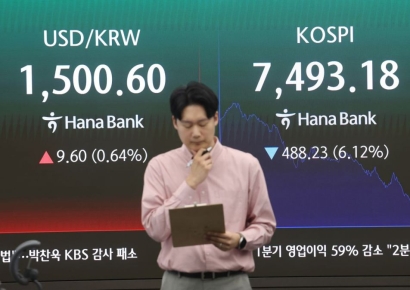 After Topping 8,000 Instead of Hitting 10,000... KOSPI Plunges—When Will It Rebound?
- "Samsung and Hynix Were Once for the Underachievers"... Hyundai Motor Employee's Lament
- [Breaking] Court Rules Against Samsung Electronics Union...1 Billion Won per Day Penalty for Exceeding Strike Scope
- Six Economic Organizations Urge Withdrawal of Samsung Electronics Strike Plan...Warn of National Loss of Opportunity
- "That? It's Already Stashed" Nightlife Scene Crosses the Line [ChwiYak Nation] ③
Previously, Fitch downgraded the U.S. credit rating from 'AAA' to 'AA+'. This is the first time in 12 years since S&P downgraded the U.S. credit rating in 2011 that a major international credit rating agency has lowered the U.S. rating. Fitch cited political conflicts over raising the federal government's debt ceiling, fiscal deterioration, and the national debt burden as the reasons behind the downgrade.
© The Asia Business Daily(www.asiae.co.kr). All rights reserved.







