Jeonnam Governor Kim Young-rok Appeals with a Deep Bow for 'Civil-Military Airport Relocation' Acceptance in Muan
"Proactive Review of Southwest Region Development and Preparation of Support Measures for Damage Compensation"
Jeonnam Governor Kim Young-rok earnestly appealed on the 15th, bowing deeply, that “Muan County should magnanimously accept the relocation of Gwangju civilian airport and military airport in order to develop Muan International Airport as the gateway airport to the southwestern region of the country.”

On the same day, Governor Kim announced a statement titled ‘A Message to the Residents for the Revitalization of Muan International Airport and the Development of the Southwestern Region’ at the provincial government briefing room, stating, “We will not force only the sacrifice of Muan residents. We will devote all our efforts to preparing groundbreaking support measures that sufficiently offset the damages to the relocation areas.”
The province has made various efforts to revitalize Muan International Airport, including extending the runway, expanding the passenger terminal, and supporting regular routes. Additionally, it is focusing on the second phase of the Honam High-Speed Railway project worth 2.5 trillion won and the establishment of the Gyeongjeon Line and Triangle circular railway network, which can be used by residents of western Gwangju, Jeonnam, and Gyeongnam.
However, despite these efforts, the number of users at Muan International Airport dropped from 900,000 in 2019 to 46,000 last year due to COVID-19 and other factors, and the cumulative deficit over the past six years reached 93 billion won. The biggest reason cited is the lack of connection between international and domestic flights, which greatly restricts airport usage.
Governor Kim emphasized, “Although the integration of Muan International Airport and Gwangju civilian airport is reflected in the national plan, it has not been realized due to the military airport relocation issue. We must secure aviation demand through integration as soon as possible, operate more domestic and international routes, and bring the airport back on track within five years.” He added, “Considering the infrastructure for the civilian airport relocation to be completed in 2025, the relocation of Gwangju military airport to Muan International Airport should also be proactively reviewed.”
Governor Kim believes that if domestic flights and the military airport are established at Muan International Airport, it will signal a green light for Muan County’s flagship projects, which have been at a standstill, such as the aviation industry and the K-Food convergence complex. It will also lay the foundation for southwestern region development projects including a national industrial complex dedicated to renewable energy, data centers, attraction of public institutions, construction of a future new city, and revitalization of tourism in the southwestern region.
Governor Kim acknowledged, “We are well aware of the concerns of Muan residents regarding the military airport relocation,” and stressed, “We will secure a noise buffer zone of approximately 3,636,000 square meters (1.1 million pyeong) and prepare additional measures for areas outside the buffer zone. We will provide accurate information related to the military airport through explanatory meetings and cooperate with the government, Gwangju City, and experts to devise the optimal solution.”
He also stated, “We will do our best to prepare groundbreaking development plans and support measures that sufficiently offset the damages to the relocation areas, and Jeonnam Province will actively support the revision of the Local Autonomy Act to promote the elevation of Muan to city status.”
He continued, “The revitalization of Muan International Airport will increase tourists and expand corporate investment,” and emphasized, “Muan County should magnanimously accept the joint relocation of Gwangju civilian airport and military airport for the development of the southwestern region and move toward a better future.”
He then bowed deeply to the residents, expressing his hope for their active listening and cooperation.
Furthermore, he said, “We will not emphasize only the sacrifice of Muan residents,” and requested, “I hope the residents objectively consider the future and actively express their opinions at explanatory meetings related to the military airport relocation, which will be held jointly by the government, Jeonnam Province, and Gwangju City.”
Hot Picks Today
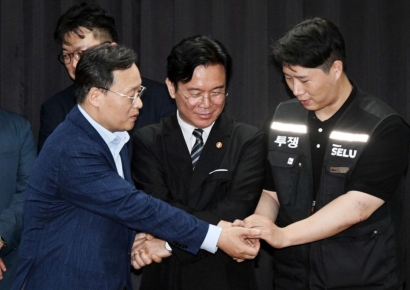 Dramatic Agreement Reached on Eve of Samsung Electronics General Strike... Minister Kim Young-hoon: "Showcased Korea's Strength in Dialogue" (Update)
- "It Has Now Crossed Borders": No Vaccine or Treatment as Bundibugyo Ebola Variant Spreads [Reading Science]
- "From a 70 Million Won Loss to a 350 Million Won Profit with Samsung and SK hynix"... 'Stock Jackpot' Grandfather Gains Attention
- "Stocks Are Not Taxed, but Annual Crypto Gains Over 2.5 Million Won to Be Taxed Next Year... Investors Push Back"
- "Who Is Visiting Japan These Days?" The Once-Crowded Tourist Spots Empty Out... What's Happening?
Finally, he added, “Through resolving the military airport relocation issue and revitalizing Muan International Airport, we will create a turning point for the win-win development of Gwangju and Jeonnam, and Muan International Airport must be revitalized and developed as the gateway international airport of Gwangju and Jeonnam.”
© The Asia Business Daily(www.asiae.co.kr). All rights reserved.