Yoon's 1st Anniversary Message... "Fake Peace, Huge Opposition, Collapsed System... Time Needed for Recovery" (Comprehensive)
Live Remarks Reflecting on One Year Before Inauguration at Cabinet Meeting
Criticizing Past Government's Anti-Market Policies, Warning of Jeonse and Stock Scams
"Pushing Socially Vulnerable into the Abyss of Despair"... Emphasizing Policies for the People
Prioritizing Economic Diplomacy... "Continuing as Korea's No.1 Salesperson in Sales Diplomacy"
President Yoon Suk-yeol pointed out the fake peace that relies on the goodwill of the enemy on the 9th, stating, "It will take time to restore the broken system and achieve tangible results." As President Yoon marks his first anniversary in office tomorrow, he shared his reflections on one year of state administration, mentioning the incompetence of the previous government and the situation of the giant opposition party in the National Assembly, expressing his intention to focus on law, principles, and national interests in all domestic and foreign issues, including diplomacy.
On the morning of the same day, President Yoon presided over a Cabinet meeting at the Yongsan Presidential Office, saying, "Our government has respected the rule-based international order over the past year and fulfilled responsibilities and contributions commensurate with our economic capabilities in the international community." He reviewed the key activities of the Yoon administration and encouraged Cabinet members to follow up on related measures. Considering that President Yoon decided not to hold a first-anniversary press conference, his remarks at the Cabinet meeting, broadcast live, are interpreted as a public message outlining the direction of state administration in the second year of his administration.
![[Image source=Yonhap News]](http://www.asiae.co.kr/news/img_view.htm?img=2023050910495224514_1683596991.jpg)
From Jeonse and Stock Fraud to Drugs and North Korea Policy... Detailed Criticism of the Moon Administration
President Yoon evaluated past diplomatic schedules and achievements point by point, first expressing his determination to "place the economy at the center of diplomacy," but he emphasized more the difficulties the government faced in advancing core state tasks over the past year. He criticized the previous administration's state management in detail, including jeonse fraud, drug crimes, and failures in North Korea policy. Regarding the increasingly controversial jeonse fraud, he said, "The anti-market and abnormal policies of the past government, which caused rapid house price increases and market disruption, became the soil for jeonse fraud." He added that various investment frauds, including stocks and virtual assets, occurred as a result, stating, "Ordinary citizens and the younger generation have suffered irreparable damage and are in despair."
He also pointed out the previous government's poor monitoring system, such as the "dissolution of the Securities Crime Joint Task Force." President Yoon said, "The weakening of the financial market's monitoring system against unfair practices allowed virtual asset crimes and financial investment frauds to flourish," and criticized, "The disabling of the monitoring and detection system that relied on the goodwill of criminals has pushed countless socially vulnerable people into the abyss of despair."
He mentioned the weakening of law enforcement against drug organizations and distribution during the previous government's prosecution reform process. He then evaluated, "Since our government took office, we have restored law enforcement against major drug crimes and established a joint investigation headquarters between the police and prosecution, striving to make Korea a drug-free country."
He also remarked on the difficulty of organizing necessary systems due to obstruction by the giant opposition party, saying, "There were also difficulties in organizing necessary systems due to being blocked by the giant opposition party." He pointed out that the three major reforms requiring legislation?labor, pension, and education?have all been slowed down due to opposition from the opposition party, and delivered a message to garner public consensus, saying, "It takes tremendous time and effort to rebuild what has collapsed."
He did not omit the previous government's security measures that relied solely on North Korea's goodwill. He mentioned the resumption of the Korea-U.S. joint military exercises, which had been suspended for several years, changes to the Korea-U.S. Mutual Defense Treaty based on conventional military power, opposition to military resolution of conflicts and changes by force, emphasizing, "It goes without saying that these are necessary and beneficial for our security, economy, companies, and citizens."
Additionally, he highlighted the importance of civil defense drills, which had been discontinued since August 2017, the early days of the Moon Jae-in administration. President Yoon pointed out, "Civil defense drills were not conducted due to a security perspective relying on fake peace," and added, "Considering the six years of non-implementation, the government decided to start drills first at public institutions and then normalize them as drills involving the entire population."
![[Image source=Yonhap News]](http://www.asiae.co.kr/news/img_view.htm?img=2023050721402922575_1683463228.jpg)
Korea-Japan Relations Toward a New Future... "The Horizon Is Expanding Through Sales Diplomacy"
President Yoon reviewed the government's diplomatic activities, including Korea-Japan, Korea-U.S., and Korea-U.S.-Japan relations. He particularly evaluated the new changes in Korea-Japan relations through the recent Korea-Japan summit, saying, "If we face the dark past history with sincerity without ignoring it, Korea and Japan can overcome the difficulties they face and open a new future." Following the government's proposal of a third-party solution to the issue of forced labor victims and Prime Minister Kishida's expression of regret toward the victims, the Korea-Japan relationship is expected to solidify beyond the normalization stage.
President Yoon mentioned the broad cooperation plans agreed upon at the Korea-Japan summit in areas such as economy, industry, science, culture, and human exchange, the dispatch of a Korean inspection team to Fukushima contaminated water, and the joint visit by the Korea and Japan leaders to the Hiroshima memorial for Korean atomic bomb victims during the G7 summit, emphasizing, "These are things that were unimaginable until just recently but are now happening between Korea and Japan." He explained that through the recent Korea-U.S. summit, Korea-Japan summit, and the upcoming Korea-U.S.-Japan summit during the G7, the trilateral security cooperation will be strengthened to build peace in the region.
He also stressed that Korea's diplomatic horizon is expanding, citing important meetings and conferences attended over the past year based on universal values such as freedom, human rights, and the rule of law, as well as examples of sales diplomacy. According to the Presidential Office, excluding informal talks and phone meetings, President Yoon attended 35 bilateral meetings and 13 multilateral meetings, visiting 10 countries. Among these, he deepened relations with traditional allies such as the U.S. in response to North Korea's nuclear and missile threats, became the first Korean president to attend a North Atlantic Treaty Organization (NATO) summit (June last year), announced digital norms establishment and official development assistance (ODA) to bridge gaps at the UN General Assembly (September last year), announced the government's first Indo-Pacific strategy (November last year), and co-hosted the Democracy Summit (March this year), thereby increasing Korea's influence in the international community.
President Yoon said, "The international community, having experienced the horrors of World War I and II, has built an order based on norms of sovereign equality, territorial integrity, and peaceful resolution of conflicts over the past 70 years, realizing freedom, peace, and prosperity." He added, "Our constitution stipulates that the government and citizens must comply with these international norms as domestic law. Therefore, our government has opposed military resolution of conflicts and changes by force." He pledged, "Amid fierce geopolitical competition and multilayered international relations, the Republic of Korea will play a hub role for world peace and prosperity."
Hot Picks Today
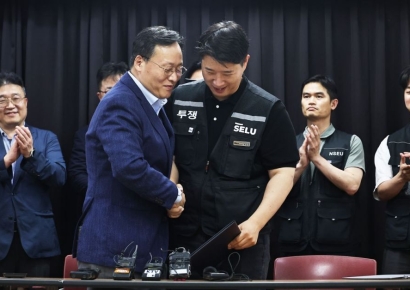 Up to 600 Million Won for Semiconductors, 160 Million Won Bonus for Loss-Making Non-Memory… Samsung Electronics Labor and Management Reach Tentative Deal on Unprecedented Performance Compensation (Comprehensive)
- "Could I Also Receive 370 Billion Won?"... No Limit on 'Stock Manipulation Whistleblower Rewards' Starting the 26th
- "From a 70 Million Won Loss to a 350 Million Won Profit with Samsung and SK hynix"... 'Stock Jackpot' Grandfather Gains Attention
- [Current State of K-Finance for Foreign Nationals]①From Niche to Core... Banks Go All-In on First-Mover Competition
- "Who Is Visiting Japan These Days?" The Once-Crowded Tourist Spots Empty Out... What's Happening?
Explaining the achievements of sales diplomacy, he promised to actively promote Korea's excellence to global business leaders to attract quality investment. President Yoon noted that during last year's NATO summit, cooperation on semiconductors and supply chains was strengthened, and large-scale defense exports were achieved. When Crown Prince and Prime Minister Mohammed bin Salman of Saudi Arabia visited Korea in November last year, 26 contracts and memorandums of understanding (MOUs) worth a total of $30 billion (about 40 trillion won) were signed, signaling the start of large-scale oil money attraction. During his visits to the United Arab Emirates (UAE) and Switzerland in January this year, he signed 48 MOUs and attracted $30 billion (about 40 trillion won) in investment during the state visit to the UAE. Last month, during his state visit to the U.S., he secured $5.9 billion (about 7.9 trillion won) in investment and signed 50 MOUs. President Yoon said, "I have taken it upon myself to be Korea's number one salesperson over the past year and have conducted top-level sales diplomacy," promising, "I will continue to place the economy at the center of diplomacy and work hard to expand exports of our products and attract investment from advanced overseas companies."
© The Asia Business Daily(www.asiae.co.kr). All rights reserved.