Mandatory Indoor Mask Wearing on Public Transportation Lifted Starting March 20
Mandatory Facilities, Indoor Mask Wearing 'Mandatory' Maintained
Busan City announced that starting from the 20th, it will issue a revised administrative order on mandatory mask-wearing and lift the indoor mask-wearing obligation for ▲public transportation ▲open-type pharmacies inside large facilities without walls or partitions (such as marts and stations).

This follows the revision of the Central Disease Control Headquarters' mask-wearing guidelines, which includes the implementation of the ‘Additional Adjustment of Indoor Mask-Wearing Obligation’.
The Central Disaster and Safety Countermeasures Headquarters announced that, considering the continued stabilization of the quarantine situation and the high willingness to wear masks indoors even after the first phase adjustment of indoor mask-wearing obligations on March 15 (implemented on January 30, 2023), it will nationwide implement the ‘Additional Adjustment Plan for Indoor Mask-Wearing Obligation’ from March 20. This plan includes lifting the mask-wearing obligation for some mandatory facilities such as ▲public transportation ▲open-type pharmacies inside large facilities without walls or partitions (such as marts and stations).
Accordingly, among the indoor mask-wearing mandatory facilities applied to Busan City, the mask-wearing obligation for public transportation and open-type pharmacies inside large facilities without walls or partitions such as marts and stations will be lifted. Other mandatory facilities, including general pharmacies, will maintain the indoor mask-wearing ‘obligation’.
The facilities where the indoor mask-wearing obligation remains are ▲admission-type facilities among infection-vulnerable facilities ▲medical institutions ▲pharmacies (open-type pharmacies inside large facilities without walls or partitions such as marts and stations are exempt from fines).
Admission-type facilities among infection-vulnerable facilities include long-term care hospitals, long-term care institutions, mental health promotion facilities, and welfare facilities for the disabled.
Despite this measure, the city strongly recommends mask-wearing in cases of ▲suspected COVID-19 symptoms or contact with someone showing such symptoms ▲being in a high-risk group for COVID-19 or contact with a high-risk individual ▲recent contact with a confirmed COVID-19 case (mask-wearing recommended for two weeks from the date of contact) ▲being in a 3-mil (closed, crowded, close-contact) environment with poor ventilation ▲situations where many people are densely gathered and engaging in droplet-generating activities such as shouting, singing, or talking.
Even though the indoor mask-wearing obligation on public transportation is lifted, mask-wearing is strongly recommended when using public transportation during peak congestion times.
Lee Sora, Director of the Citizen Health Bureau of Busan City, said, “We sincerely thank the citizens of Busan for wearing masks on public transportation such as buses, subways, and taxis to prevent the spread of COVID-19.” She added, “Please make sure to comply with mask-wearing in the remaining mandatory facilities such as medical institutions, pharmacies, and admission-type infection-vulnerable facilities.”
Hot Picks Today
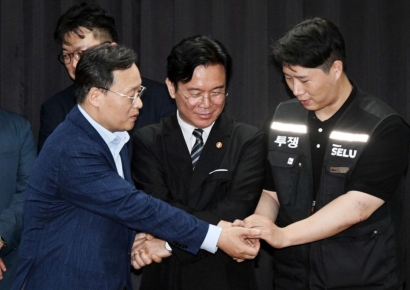 Dramatic Agreement Reached on Eve of Samsung Electronics General Strike... Minister Kim Young-hoon: "Showcased Korea's Strength in Dialogue" (Update)
- "It Has Now Crossed Borders": No Vaccine or Treatment as Bundibugyo Ebola Variant Spreads [Reading Science]
- "Even With a 90 Million Won Salary and Bonuses, It Doesn’t Feel Like Much"... A Latecomer Rookie Who Beat 70 to 1 Odds [Scientists Are Disappearing] ③
- "Stocks Are Not Taxed, but Annual Crypto Gains Over 2.5 Million Won to Be Taxed Next Year... Investors Push Back"
- "Who Is Visiting Japan These Days?" The Once-Crowded Tourist Spots Empty Out... What's Happening?
She emphasized again, “Even though the indoor mask-wearing obligation on public transportation is lifted, the need to wear masks does not disappear. We ask for your continued participation in personal quarantine practices such as wearing masks in 3-mil (closed, crowded, close-contact) environments, hand washing, and regular ventilation, which are the most important measures to prevent the spread of COVID-19 and reduce the burden on the healthcare system.”
© The Asia Business Daily(www.asiae.co.kr). All rights reserved.