SMEs "Loan 950 trillion, interest rate cuts needed... Not the time for financial sector bonus parties"
Jungdanhyeop to Hold Press Conference on the 20th
"Double Hardship from High Inflation and High Interest Rates"
Urges Financial Sector to Share the Burden

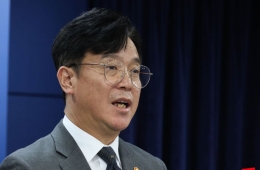
Kim Ki-moon, President of the Korea Federation of Small and Medium Business (center) / Photo by Kang Jin-hyung aymsdream@
View original image[Asia Economy Reporter Kim Bo-kyung] The small and medium-sized enterprises (SMEs) and small business sectors have called for the financial industry to make efforts for mutual growth, such as lowering loan interest rates. They also criticized the practice of holding bonus parties amid high inflation and high interest rates, saying it is out of touch with public sentiment.
The Korea Federation of SMEs (Korea Federation) held a press conference on the 20th at the Korea Federation of SMEs in Yeouido, Seoul, appealing for shared pain from high interest rates among SMEs and small business owners. The Korea Federation consists of 16 SME organizations, including the Korea Federation of SMEs, the Korea Federation of Small and Medium Business, and the Innobiz Association.
At the press conference, nine representatives of SME organizations attended, including Kim Ki-moon, president of the Korea Federation of SMEs; Oh Se-hee, president of the Korea Federation of Small and Medium Business; Jo In-ho, president of the Korea Mechanical Equipment Construction Association; Lee Jeong-han, president of the Korea Women Entrepreneurs Association; Kim Bun-hee, president of the Korea Women Venture Association; and Seok Yong-chan, president of the Korea Management Innovation SME Association.
During the COVID-19 response process, SME loans increased from 716 trillion won at the end of 2019 to 953 trillion won at the end of last year, and loans to small business owners and self-employed individuals rose from 685 trillion won at the end of 2019 to 1,014 trillion won in the third quarter of 2022. With the rise in loan interest rates, interest expenses have also surged, causing what they describe as a "double hardship."
In a statement released that day, the Korea Federation pointed out that while SMEs and small business owners are suffering from high interest rates, the financial sector recorded its highest performance, with five major banks paying nearly 1.4 trillion won in bonuses last year.

On the 3rd, a restaurant in Myeongdong, Seoul, where self-employed people’s worries are deepening, was quiet. Photo by Mun Ho-nam munonam@
View original imageThey said, "In a difficult economic situation due to high inflation and high interest rates, this is an act out of touch with public sentiment," adding, "During the IMF foreign exchange crisis, the financial sector overcame the risk of bankruptcy through large-scale public fund injections. Now is the time to fulfill social responsibility."
They urged for an immediate reduction in loan interest rates for SMEs and small business owners, enhancement of the effectiveness of interest burden relief systems, and the creation of a financial culture that coexists with SMEs and small business owners.
They argued, "The limits and support scope of low-interest refinancing loans with low execution rates should be expanded, and the targets and scale of the interest subsidy support project should be further increased."
They also called for "the creation of a mutual growth finance index to disclose banks' efforts for mutual growth," and raised their voices saying, "The 500 billion won mutual growth fund announced by the financial sector should be significantly expanded and used to alleviate the burden on vulnerable borrowers."
Meanwhile, the Korea Federation of SMEs released the results of a "Survey on Financial Difficulties of SMEs Related to High Interest Rates," conducted with 300 SMEs and small business owners. According to the survey, the most common difficulty experienced when borrowing from financial institutions was "high loan interest rates (85.7%)."
Negative opinions about the banks' record-high operating profits based on interest income reached 79.3%. The reasons cited were "excessive interest rate margin profits (62.2%)" and "excessive retirement and bonus payments (22.7%)."
Hot Picks Today
 "Stocks Are Not Taxed, but Annual Crypto Gains Over 2.5 Million Won to Be Taxed Next Year... Investors Push Back"
- "Don't Throw Away Coffee Grounds" Transformed into 'High-Grade Fuel' in Just 90 Seconds [Reading Science]
- Signed Without Viewing for 1.6 Billion Won... Jamsil and Seongbuk Jeonse Prices Jump 200 Million Won in a Month [Real Estate AtoZ]
- "Groups of 5 or More Now Restricted"... Unrelenting Running Craze Leaves Citizens and Police Exhausted
- "Even With a 90 Million Won Salary and Bonuses, It Doesn’t Feel Like Much"... A Latecomer Rookie Who Beat 70 to 1 Odds [Scientists Are Disappearing] ③
As the most necessary measures (multiple responses allowed) to alleviate the burden of high interest rates and establish a mutual growth financial culture, respondents indicated △ restraint on raising loan interest rates above the bank's base rate (73.7%) △ expansion of interest burden relief policies such as interest subsidy support projects (45.7%) △ enhancement of effectiveness of low-interest refinancing loans and rights to request interest rate reductions (35.7%).
© The Asia Business Daily(www.asiae.co.kr). All rights reserved.