Ruling Party and Government "Start Discussions on Applying Labor Standards Act to Businesses with Fewer Than 5 Employees... Customized Care for Elementary Students to be Implemented in Early 2025" (Comprehensive)
Changing Work Hour Framework and Reforming Seniority-Based Wage System
Promoting Integration of Kindergarten and Elementary Education
Introducing Neulbom Elementary School from 2025

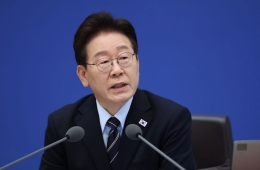
Prime Minister Han Duck-soo is delivering opening remarks at the High-level Party-Government Consultation held at the Prime Minister's Official Residence in Jongno-gu, Seoul on the 18th. Photo by Kim Hyun-min kimhyun81@
View original image[Asia Economy Reporter Naju-seok] The ruling party and the government decided on the 18th to actively pursue labor reform. They agreed to legislate wage and working hour systems within a short period. The ruling party and government plan to integrate early childhood care and education and, starting from 2025, provide customized education and care services until 8 p.m. at the ‘Elementary Neulbom School’ during the elementary education stage.
Park Jeong-ha, chief spokesperson of the People Power Party, introduced these plans during a briefing on the results of the 6th High-level Ruling Party-Government Council held at the Prime Minister’s official residence in Samcheong-dong, Jongno-gu, Seoul.
The ruling party and government stated, "Based on the recommendations proposed by the Future Labor Market Research Group on the 12th, we have decided to actively promote labor market reforms for future generations."
The Future Labor Market Research Group publicly released a recommendation on the 12th proposing to reform the current extended working hour management unit from ‘week’ to a maximum of ‘year’ and to change the seniority-based wage system, represented by the step system, to a job- and performance-based wage system.
In this regard, the ruling party and government agreed to prepare legislation as soon as possible. Additionally, they decided to immediately start social discussions on improving the dual structure of the labor market, including the application of the Labor Standards Act to workplaces with fewer than five employees and the dispatch system.
Jung Jin-seok, emergency committee chairman of the People Power Party, said, "The Yoon Seok-yeol administration must not give up and must firmly hold the reins of reform to achieve labor reform that no previous administration has accomplished." He added, "Reports from the International Monetary Fund (IMF) and the Organisation for Economic Co-operation and Development (OECD) warn that the Korean economy cannot revive its vitality without resolving the dual labor market and the gap between regular and irregular workers." He emphasized, "We must supply jobs to future generations through labor reforms that enhance labor market flexibility and improve labor-management cooperation."
Joo Ho-young, floor leader of the People Power Party, said, "Labor reform has become an urgent task that cannot be postponed any longer as the realities of industry and labor have completely changed due to IT and the Fourth Industrial Revolution. However, Korea’s labor practices and wage system in the 2020s are still bound by the Labor Standards Act enacted in 1953." He stressed, "Gaining public support and securing cooperation from the opposition party are the keys to the success of labor reform." Floor leader Joo also emphasized expanding the social safety net for labor reform. He said, "Large-scale labor reform may cause temporary employment instability or wage issues, so various negotiation cards such as expanding the social safety net must be prepared in advance." He added, "We need to thoroughly study cases like Germany’s Hartz reforms and prepare adequately."
Regarding educational issues, the ruling party and government decided to strengthen the state’s responsibility for education and care from early childhood to the elementary level. To this end, they agreed to integrate early childhood education and care. They plan to build social consensus through consultations among experts and stakeholders.
They also decided to introduce the ‘Elementary Neulbom School,’ which provides education and care services before and after school. Starting in 2025, elementary students will be able to receive customized education and care services until 8 p.m.
For lower grades, "various educational programs such as basic academic support and arts and physical education will be provided, and morning and evening care services for dual-income families will be gradually expanded. For upper grades, high-quality after-school programs such as AI, coding, big data, small-group and level-based classes will be expanded through active private sector participation."
Hot Picks Today
 "Stocks Are Not Taxed, but Annual Crypto Gains Over 2.5 Million Won to Be Taxed Next Year... Investors Push Back"
- "Don't Throw Away Coffee Grounds" Transformed into 'High-Grade Fuel' in Just 90 Seconds [Reading Science]
- KEPCO Three-Year Bond Yield Surpasses 4%... Warning Signs of Liquidity Crunch in Bond Market
- "Groups of 5 or More Now Restricted"... Unrelenting Running Craze Leaves Citizens and Police Exhausted
- "Even With a 90 Million Won Salary and Bonuses, It Doesn’t Feel Like Much"... A Latecomer Rookie Who Beat 70 to 1 Odds [Scientists Are Disappearing] ③
Regarding the indoor mask-wearing mandate, the ruling party and government agreed to actively consider lifting it soon following the emergency committee chairman’s request. They also agreed to actively review and respond to allegations of statistical manipulation by Statistics Korea and the Ministry of Land, Infrastructure and Transport.
© The Asia Business Daily(www.asiae.co.kr). All rights reserved.