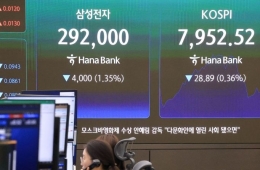
[Good Morning Stock Market] Riding the 'UK-US Tailwind' to Rise?... Under the Influence of Plunging China
Expectations for US Big Tech Earnings Boost Fed Pivot Possibility
Pound Stabilizes on UK Financial Chief's Prime Minister Nomination
![[Good Morning Stock Market] Riding the 'UK-US Tailwind' to Rise?... Under the Influence of Plunging China](http://www.asiae.co.kr/news/img_view.htm?img=2022102508441480711_1666655053.jpg)
[Asia Economy Reporter Ji Yeon-jin] On the 24th (local time), the U.S. stock market closed higher, reflecting expectations for strong earnings from major big tech companies such as Alphabet and Microsoft, as well as hopes for a slowdown in the Federal Reserve's (Fed) tightening pace. The Dow Jones Industrial Average rose 1.34%, the Standard & Poor's (S&P) 500 increased 1.19%, and the Nasdaq Composite gained 0.86%.
News that Rishi Sunak, former UK Chancellor of the Exchequer, was appointed as the new Prime Minister just three days after Liz Truss resigned helped ease political uncertainty in the UK, leading to a stronger pound and a decline in UK government bond yields, which stabilized investor sentiment. Meanwhile, despite intervention by the Bank of Japan (BOJ), the yen's structural weakness due to ultra-loose monetary policy is widely seen as inevitable, and yen volatility has expanded again.
Following the sharp plunge of the Hong Kong Hang Seng Index (-6.4%) the previous day, Chinese ADR stocks such as Alibaba (-12.5%), Baidu (-12.6%), and Nio (-15.7%) also experienced a steep decline in the U.S. stock market. This is largely attributed to intensified regulations on private companies, including platforms, under the strengthened authoritarian regime established after the recent Chinese Communist Party leadership transition, as well as escalating hostile relations with the U.S. and continued adherence to the zero-COVID policy, which have increased policy uncertainty. However, given the sharp drop in stock prices the previous day, there is a forecast for a technical rebound in the Greater China markets.
◆ Seo Sang-young, Researcher at Mirae Asset Securities = The U.S. stock market rose amid political issues in the UK and China, supported by positive news from individual companies, which is positive for the Korean stock market. Although Chinese-related companies fell sharply, this was more due to psychological factors than fundamentals, and some investment firms view the reaction as excessive and expect a rebound, which is also positive. In fact, the decline in related companies narrowed in the late U.S. trading session, and large tech stocks showed strength, raising expectations for the earnings season. Considering this, the Korean stock market is expected to start with a rise of around 0.3% and maintain a solid performance. It is also expected to be influenced by the direction of the Chinese stock market, which saw a sharp decline the previous day.
◆ Han Ji-young, Researcher at Kiwoom Securities = Despite the simultaneous plunge in Greater China markets the previous day, the domestic stock market closed higher, supported by expectations for a slowdown in the Fed's policy pace and the Korean government's announcement of a '50 trillion won + alpha' financial stability package. Today, although uncertainty from China remains, the strength of Western stock markets driven by existing positive factors such as the Fed and the UK, along with the earnings season impact on individual companies like Kia Motors, is expected to result in a steady stock price trend. Additionally, with foreign investors continuing a net buying trend since October, and global passive and asset allocation funds possibly shifting some investments from China, where policy uncertainty has increased, to other Asian countries including Korea, attention should be paid to foreign capital flows into Asian markets including Korea for the time being.
Hot Picks Today
 If They Fail Next Year, Bonus Drops to 97 Million Won... A Closer Look at Samsung Electronics DS Division’s 600M vs 460M vs 160M Performance Bonuses
- Opening a Bank Account in Korea Is Too Difficult..."Over 150,000 Won in Notarization Fees Just for a Child's Account and Debit Card" [Foreigner K-Finance Status]②
- Hundreds of Billions Stolen with Twin USIMs... 32 Members of Chinese Hacking Group Apprehended
- Room Prices Soar from 60,000 to 760,000 Won and Sudden Cancellations: "We Won't Even Buy Water in Busan" — BTS Fans Outraged
- "Who Is Visiting Japan These Days?" The Once-Crowded Tourist Spots Empty Out... What's Happening?
The November U.S. Federal Open Market Committee (FOMC) rate hike is already priced in by the market, while the 10-year Treasury yield has exceeded the 4.2% level, maintaining pressure from rising long-term interest rates. However, amid the recent weakening of overall financial market conditions including stocks, bonds, and foreign exchange, some Fed officials have raised concerns about policy side effects and appropriate benchmark interest rate settings, fueling expectations for a slowdown in the Fed's tightening pace. Furthermore, with Lisa Sunak, a former Chancellor of the Exchequer and a market-friendly figure, elected as the new UK Prime Minister, concerns about fiscal deterioration due to tax cuts appear to have eased. Also, the sharp depreciation of the Japanese yen, which had raised fears of an extreme crisis like a currency crisis, has been somewhat contained by large-scale intervention by the BOJ.
© The Asia Business Daily(www.asiae.co.kr). All rights reserved.
!["Please Help Us": How Much Do Those Bowing 90 Degrees These Days Actually Earn? [Data Pick]](https://cwcontent.asiae.co.kr/asiaresize/307/2026052010120870131_1779239528.png)