Foreign Investors' 13 Consecutive Days of Net Buying in 'K-Bargain Sale'... Mainly Semiconductor and Secondary Battery Stocks
![[Image source=Yonhap News]](http://www.asiae.co.kr/news/img_view.htm?img=2022102411020679480_1666576925.jpg)
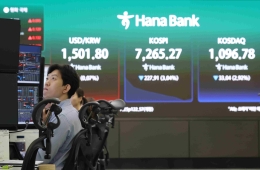
[Asia Economy Reporter Myunghwan Lee] As the domestic stock market has hit new yearly lows this month, approaching historic lows, foreign investors have focused on buying semiconductor and secondary battery-related stocks.
According to the Korea Exchange on the 24th, foreign investors recorded net purchases for 13 consecutive trading days from the 29th of last month to the 19th of this month in the KOSPI market. This long streak of net buying is the first in over two years since November 2020. The foreign buying momentum is interpreted as a bargain hunting move amid the domestic stock market's decline due to the strong dollar and concerns over a global economic recession. On the 30th of last month, during the foreign investors' net buying period, the KOSPI closed at 2155.49, setting a new yearly low.
During the 13-day net buying rally, foreign investors accumulated large-cap semiconductor stocks and secondary battery-related stocks. In this period, SK Hynix ranked first with foreign investors purchasing 853.4 billion KRW worth of shares. Samsung Electronics closely followed in second place with net purchases of 843.2 billion KRW. These stocks became buying targets as concerns over the semiconductor industry led to their continued weakness. On the 29th of last month, major semiconductor stocks including Samsung Electronics and SK Hynix recorded new 52-week lows.
Foreign investors also concentrated their purchases on secondary battery stocks such as LG Energy Solution (3rd), Samsung SDI (4th), and LG Chem (7th). Secondary battery stocks also experienced short-term price adjustments earlier this month amid unfavorable market conditions. Additionally, solar energy-related stock Hanwha Solutions (6th) and defense stock Korea Aerospace Industries (9th) ranked high among foreign net purchases.
The securities industry forecasts that foreign investors will continue their buying trend for the time being from a supply-demand perspective. In addition to the current index correction, the strong dollar has relatively lowered the value of the Korean won, making prices attractive from the foreign investors' standpoint.
Researcher Suyeon Kim of Hanwha Investment & Securities stated, "The U.S. government's strengthened semiconductor sanctions against China and China's determination for Taiwan unification are attracting foreign funds into domestic semiconductors," adding, "Although foreign demand is still concentrated in large-cap stocks, it could spread to small and mid-cap stocks such as semiconductor equipment."
Hot Picks Today
 "Samsung and Hynix Were Once for the Underachievers"... Hyundai Motor Employee's Lament
- After Topping 8,000 Instead of Hitting 10,000... KOSPI Plunges—When Will It Rebound?
- "What? It Wasn't a Wristwatch?" This Brand's Stock Soared 15%, Then Plunged After Official Announcement
- Samsung Electronics Labor-Management Hold Second Post-Adjustment Talks...Central Labor Commission Chair: "Will Do My Best to Prevent a Strike"
- "That? It's Already Stashed" Nightlife Scene Crosses the Line [ChwiYak Nation] ③
© The Asia Business Daily(www.asiae.co.kr). All rights reserved.