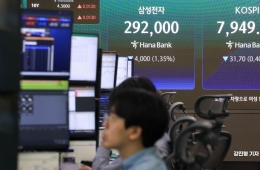
Taiwan TSMC Cuts Capital Expenditure Again This Year... 10% ↓
Adjusted Downward by 10% from $40 Billion to $36 Billion

[Asia Economy Reporter Kim Pyeonghwa] Taiwanese foundry (semiconductor contract manufacturing) company TSMC has lowered its capital expenditure (CAPEX) target once again this year following a previous reduction in July. The company explained that it cannot escape the impact as the global semiconductor market is entering a full-fledged downturn.
According to foreign media including the US Wall Street Journal (WSJ) on the 13th (local time), TSMC announced during its Q3 conference call that it would lower its CAPEX target for this year by 10%, from the previous $40 billion (approximately 57.132 trillion KRW) to $36 billion (approximately 51.4188 trillion KRW).
TSMC stated that the adjustment is inevitable due to the global semiconductor market entering a harsh period and the effects of inflation. Wei Zhejia, TSMC’s CEO, said, "The semiconductor industry is expected to decline in 2023," adding, "TSMC is not immune to this."
This is not the first time TSMC has taken such a step. In its Q2 earnings announcement in July, TSMC adjusted its CAPEX plan for this year from a range of $40 billion to $44 billion (approximately 57.132 trillion to 62.8144 trillion KRW) down to the lower bound of $40 billion. At that time, TSMC cited inventory conditions and equipment supply delays as reasons for the decision.
Despite the unfavorable market conditions, TSMC expects its growth to continue next year. The company explained that demand related to high-performance computing (HPC) through data centers remains steady, and semiconductor demand is also increasing in the automotive industry.
According to the earnings report released that day, TSMC’s Q3 revenue rose 47.9% year-over-year to NT$613.143 billion (approximately 27.432 trillion KRW). Operating profit increased by 81.5% to NT$310.324 billion (approximately 13.8839 trillion KRW). TSMC forecasted Q4 revenue to increase by 29% year-over-year to between $19.9 billion and $20.7 billion (approximately 28.3953 trillion to 29.5368 trillion KRW).
Meanwhile, regarding concerns over the US semiconductor and equipment regulations targeting China, TSMC stated that the impact is not significant. CEO Wei Zhejia explained, "(The China regulations) mainly target high-performance specifications such as artificial intelligence (AI) or supercomputers," adding, "Our initial internal assessment is that the impact on the company is limited and manageable."
Hot Picks Today
 Up to 600 Million Won for Semiconductors, 160 Million Won Bonus for Loss-Making Non-Memory… Samsung Electronics Labor and Management Reach Tentative Deal on Unprecedented Performance Compensation (Comprehensive)
- "Could I Also Receive 370 Billion Won?"... No Limit on 'Stock Manipulation Whistleblower Rewards' Starting the 26th
- "From a 70 Million Won Loss to a 350 Million Won Profit with Samsung and SK hynix"... 'Stock Jackpot' Grandfather Gains Attention
- [Scientists Are Disappearing]④A Shaky Regional Research Ecosystem... "Professors Now Take the Initiative"
- "Who Is Visiting Japan These Days?" The Once-Crowded Tourist Spots Empty Out... What's Happening?
Earlier, on the 7th (local time), the US Department of Commerce announced controls on exports to China of DRAM below 18 nanometers (nm), NAND flash with 128 layers or more, and logic semiconductor equipment below 14 nm. In this process, multinational companies with semiconductor factories in China were allowed to supply equipment with individual permits. Subsequently, the US eased these measures, granting companies such as TSMC, Samsung Electronics, and SK Hynix a one-year exemption to supply equipment to their Chinese factories without restrictions.
© The Asia Business Daily(www.asiae.co.kr). All rights reserved.
!["Please Help": How Much Do Those Bowing 90 Degrees Really Earn? [Data Pick]](https://cwcontent.asiae.co.kr/asiaresize/307/2026052010120870131_1779239528.png)