Smart Technology Contest for Community-Based Urban Regeneration... Up to 500 Million KRW Government Funding Available
Expecting Local Problem Solving with High-Perception Technologies Such as Disaster Alerts

Cases of 'Smart Disaster Early Warning and Alert' in Safety and Firefighting Fields.
The smart early warning and alert service automatically blocks river entrances when the water level rises through river water level gauges to ensure safety. In addition, by utilizing the collected water level data, it broadcasts disaster early warnings and alerts through disaster occurrence prediction in advance, and sends text messages to residents living in low-lying areas to enable prompt evacuation.
The Ministry of Land, Infrastructure and Transport announced on the 18th that it will hold a public contest for the 2023 Living-Oriented Urban Regeneration Smart Technology Support Project aimed at improving residential conditions in declining and aging areas within urban regeneration project sites.
The application period is from November 15 to November 16, and after evaluations by a committee composed of experts in related fields, the final selections will be made in December.
The Living-Oriented Urban Regeneration Smart Technology Support Project is designed to solve local issues and improve residential conditions by establishing smart services linked to regeneration projects.
Since 2020, a total of 44 sites have been selected annually through public contests. This project, characterized by low cost and high efficiency with strong resident impact, has achieved improvements in infrastructure-deficient vulnerable areas and enhanced residential environments.
Through this contest, approximately 15 project sites will be selected, with up to 500 million KRW in national funding provided per site.
Local governments will bear 40 to 60% of the project costs according to the matching ratio of the urban regeneration project.
The process will be conducted by discovering local issues led by local governments based on participation from residents and private companies, and deriving smart solutions such as smart technology selection. Sustainable operation plans that can be linked with servers operated by local governments or related agencies, or allow private sector participation, will also be prepared.
Detailed information regarding the support project contest can be found on the Ministry of Land, Infrastructure and Transport website or through the announcement and guidance documents posted on the Urban Regeneration Comprehensive Information System.
Hot Picks Today
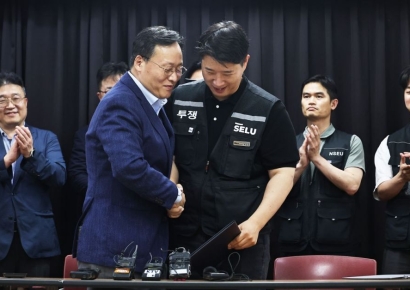 Up to 600 Million Won for Semiconductors, 160 Million Won Bonus for Loss-Making Non-Memory… Samsung Electronics Labor and Management Reach Tentative Deal on Unprecedented Performance Compensation (Comprehensive)
- "Could I Also Receive 370 Billion Won?"... No Limit on 'Stock Manipulation Whistleblower Rewards' Starting the 26th
- "From a 70 Million Won Loss to a 350 Million Won Profit with Samsung and SK hynix"... 'Stock Jackpot' Grandfather Gains Attention
- [Exclusive] 450 Billion Won Korean Investment at Risk as Canadian PE Moves to Acquire US Ascend for $99.2 Million
- "Who Is Visiting Japan These Days?" The Once-Crowded Tourist Spots Empty Out... What's Happening?
© The Asia Business Daily(www.asiae.co.kr). All rights reserved.