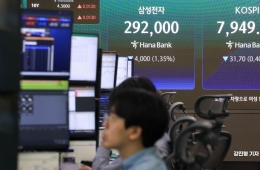
Weak Corporate Governance Led to 'KOSPI Undervaluation in 2022' (Comprehensive)
Exchange and Capital Market Research Institute Hold 'Policy Seminar to Resolve Korea Discount'
"Controlling Shareholders Face No Restrictions on Preferential Transactions"

Kim So-young, Vice Chairman of the Financial Services Commission, is delivering the opening remarks at a policy seminar to resolve the Korea discount, held on the morning of the 15th at the Korea Exchange in Yeouido, Seoul, jointly hosted by the Korea Exchange and the Korea Capital Market Institute. / Photo by Financial Services Commission
View original image[Asia Economy Reporter Lee Myunghwan] "The term 'Korea Discount' first appeared in the domestic media in October 2000. Even though it is now 22 years old, it still remains unresolved."
Kim Junseok, Senior Research Fellow at the Korea Capital Market Institute, said this on the 15th at the Korea Exchange Conference Hall in Yeouido, Seoul, during a policy seminar hosted by the Exchange and the Capital Market Institute aimed at resolving the 'Korea Discount.' The 'Korea Discount' refers to the phenomenon where companies listed on the domestic stock market are undervalued compared to overseas listed companies of similar scale.
At the seminar, it was pointed out that the main cause of the Korea Discount is the concentration of most corporate profits in controlling shareholders. Kim Woojin, Professor at Seoul National University Business School, stated, "While private benefit extraction by controlling shareholders is prohibited for affiliates belonging to large business groups with total assets exceeding 5 trillion won, there are no restrictions on work allocation to personal companies held by controlling shareholders in other general listed companies," adding, "Domestic mergers and acquisitions (M&A) conducted through the transfer of controlling shareholder shares are private transactions among shareholders, so there are no procedures to protect the shareholders of the acquired company."
Professor Kim further advised, "For general listed companies, internal transaction disclosures related to controlling shareholders should be strengthened, and screening procedures such as verifying internal transactions during the general listing of affiliates should be enhanced." Regarding M&A through share transfers, he added, "Measures should be pursued to grant remaining shareholders of the acquired company the right to request stock purchase, along with mandatory tender offers."
During the discussion, various opinions were exchanged regarding the causes and solutions for the Korea Discount. Seo Cheolsu, Head of Research Center at Mirae Asset Securities, said, "Recently, ESG (Environmental, Social, and Governance) has become a hot topic, and it is regrettable that the governance of domestic companies is perceived as lacking compared to global investors," adding, "Shareholder return governance also seems to indicate that shareholder-centered capitalism has not been fully established in a broad sense."
Kim Donghwan, CEO of Sampro TV, emphasized, "While the level of individual investors has improved over the past 3 to 4 years, corporate governance and accounting transparency have not," and added, "If shareholder return policies and accounting transparency that consider individual investors become more advanced, the Korea Discount will significantly decrease."
Besides the pursuit of private benefits by controlling shareholders, other major causes of the Korea Discount include insufficient shareholder returns such as low dividend payout ratios (43%) and low profitability and growth stemming from industrial structure aspects (36%). However, Research Fellow Kim analyzed that geopolitical risks, which have been raised by some, do not have a significant impact on the Korea Discount. He pointed out, "These factors have been highlighted since the Korea Discount was first mentioned," adding, "Everyone knows about them and many efforts have been made, but the problem remains unresolved."

There was also an analysis that the Korea Discount phenomenon is real, as the price-to-book ratio (PBR) of domestic listed companies falls short not only compared to developed countries but also emerging countries such as Thailand and the Philippines. PBR is an indicator obtained by dividing the stock price by the book value per share; a lower PBR indicates undervaluation. Research Fellow Kim analyzed, "Based on data from 45 countries and over 32,000 listed companies, the PBR of Korean listed companies is at 52% of developed countries, 58% of emerging countries, and 69% of Asia-Pacific countries."
Hot Picks Today
 Samsung Electronics Introduces New "Special Performance Bonus" for Semiconductors, Paid Entirely in Company Shares
- "Could I Also Receive 370 Billion Won?"... No Limit on 'Stock Manipulation Whistleblower Rewards' Starting the 26th
- Opening a Bank Account in Korea Is Too Difficult..."Over 150,000 Won in Notarization Fees Just for a Child's Account and Debit Card" [Foreigner K-Finance Status]②
- "From a 70 Million Won Loss to a 350 Million Won Profit with Samsung and SK hynix"... 'Stock Jackpot' Grandfather Gains Attention
- "Who Is Visiting Japan These Days?" The Once-Crowded Tourist Spots Empty Out... What's Happening?
Meanwhile, Kim Soyoung, Vice Chairperson of the Financial Services Commission, expressed at the opening remarks on the day her intention to improve regulations such as the foreign investor registration system and to prepare measures to restore investor confidence. Vice Chairperson Kim said, "The government will swiftly advance national tasks to restore trust in the capital market from investors," adding, "We will identify and dismantle shackles one by one, including regulations unique to Korea that do not exist in developed countries, outdated regulations introduced long ago whose reasons are now hard to find, and rigid regulations that cannot accommodate recent technological changes."
© The Asia Business Daily(www.asiae.co.kr). All rights reserved.
!["Please Help": How Much Do Those Bowing 90 Degrees Really Earn? [Data Pick]](https://cwcontent.asiae.co.kr/asiaresize/307/2026052010120870131_1779239528.png)