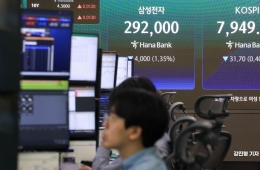
[New York Stock Market] Dow Hits 2-Month Low Amid Tightening Concerns... Nasdaq Down 1.43%
![[Image source=AP Yonhap News]](http://www.asiae.co.kr/news/img_view.htm?img=2022091505240232432_1663187042.jpg)
[Asia Economy New York=Special Correspondent Joselgina] Major indices of the U.S. New York stock market continued to show volatility on the 15th (local time) before all closing lower in the late session. Concerns over prolonged high inflation have spread, leading to a cautious examination of the increasingly uncertain economic outlook.
On this day at the New York Stock Exchange (NYSE), the Dow Jones Industrial Average closed at 39,961.82, down 173.27 points (0.56%) from the previous session. The S&P 500, focused on large-cap stocks, fell 44.66 points (1.13%) to 3,901.35, and the tech-heavy Nasdaq dropped 167.32 points (1.43%) to 11,552.36.
The New York stock market started higher following the release of robust retail sales data before turning downward. The Dow closed at its lowest level since July 14. The three major indices are also expected to fall more than 3% for the week ending on the 16th.
By sector, energy stocks showed notable weakness due to falling oil prices. Occidental Petroleum declined 3.14% from the previous close. ExxonMobil fell 2.91%, and Chevron dropped 1.62%. Technology stocks such as Microsoft (-2.71%), Apple (-1.89%), Amazon (-1.77%), and Alphabet (-1.99%) also weakened. Leading semiconductor stocks fell in succession: Nvidia was down 1.52%, AMD 1.02%, and Intel 1.17%.
On the other hand, financial stocks rose amid increasing interest rates. Major financial stocks such as JPMorgan (+1.51%), Bank of America (+1.89%), and Wells Fargo (+1.99%) all climbed. Airline stocks including United Airlines (+1.22%), American Airlines (+1.71%), and Delta Air Lines (+1.90%) also showed an upward trend.
Additionally, Adobe closed down 16.79% following news that it would acquire design software company Figma for $20 billion. Boeing edged up slightly after management comments revealed expectations for Federal Aviation Administration approval of the 737 Max 7 by year-end. Railroad-related stocks such as Union Pacific and Norfolk Southern rose after news that railroad unions had tentatively agreed to a mediation proposal with intervention from the Joe Biden administration, but gains narrowed to close slightly higher.
Investors closely monitored economic indicators and various reports, contemplating the Federal Reserve's (Fed) interest rate hike path and future economic outlook next week, which was reflected in high intraday volatility.
Retail sales in August increased by 0.3% compared to the previous month, exceeding expectations and confirming continued consumption despite high inflation. However, excluding automobiles, retail sales showed a decline. Manufacturing data also suggested an economic slowdown. Industrial production in August fell 0.2% from the previous month, below market expectations. Weekly new unemployment insurance claims decreased by 5,000 to 213,000, marking a fifth consecutive week of decline.
Experts assess that despite sustained consumption and a robust labor market, these indicators are insufficient to alleviate persistent inflation concerns. Investors worry that the Fed's more aggressive rate hikes to curb high inflation will increase the likelihood of an economic slowdown. Mike Loewengart of Morgan Stanley said, "The dilemma is whether to aggressively tackle inflation at the risk of rising unemployment and recession," adding, "The Fed's focus seems to be precisely on inflation."
According to the Chicago Mercantile Exchange (CME) FedWatch, the federal funds (FF) rate futures market currently reflects over an 80% chance of a 0.75 percentage point rate hike in September. This would mark the third consecutive giant step. The possibility of a 1 percentage point hike, which was raised immediately after the surprising Consumer Price Index (CPI) release, stands at 20%. The federal funds rate is estimated to exceed 4.0% by the end of this year.
Ray Dalio, founder of hedge fund Bridgewater Associates and billionaire investor, predicted, "If rates rise to around 4.5% at the current level, it could negatively impact stock prices by about 20%."
In the New York bond market on this day, short-term Treasury yields continued to rise. The 2-year Treasury yield, sensitive to monetary policy, climbed to 3.87%, reaching its highest level since 2007. The 2-year yield has risen for six consecutive trading days. This movement is closely related to expectations for the Fed's monetary policy actions. The 1-year yield briefly surpassed 4% during the session. The benchmark 10-year yield rose to 3.468% before easing gains.
The outlook for aggressive rate hikes also confirmed a strong dollar trend. The dollar index, which measures the value of the dollar against six major currencies, rose to around 109.7.
Hot Picks Today
 Up to 600 Million Won for Semiconductors, 160 Million Won Bonus for Loss-Making Non-Memory… Samsung Electronics Labor and Management Reach Tentative Deal on Unprecedented Performance Compensation (Comprehensive)
- "Could I Also Receive 370 Billion Won?"... No Limit on 'Stock Manipulation Whistleblower Rewards' Starting the 26th
- "From a 70 Million Won Loss to a 350 Million Won Profit with Samsung and SK hynix"... 'Stock Jackpot' Grandfather Gains Attention
- [Current State of K-Finance for Foreign Nationals]①From Niche to Core... Banks Go All-In on First-Mover Competition
- "Who Is Visiting Japan These Days?" The Once-Crowded Tourist Spots Empty Out... What's Happening?
Conversely, oil prices fell amid the strong dollar trend. On the New York Mercantile Exchange, October West Texas Intermediate (WTI) crude oil closed at $85.10 per barrel, down $3.38 (3.82%) from the previous day. This was the lowest closing price since September 8.
© The Asia Business Daily(www.asiae.co.kr). All rights reserved.