Bang Gi-seon "Holiday demand and raw material price instability persist... Strengthening monitoring"
The 7th Emergency Economic Deputy Ministerial Meeting Held

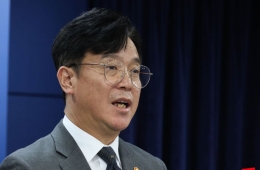
Bang Gi-seon, First Vice Minister of the Ministry of Economy and Finance, is delivering opening remarks at the 'Emergency Economic Vice Ministers' Meeting' held on the 2nd at the Export-Import Bank in Yeouido, Seoul. Photo by Kang Jin-hyung aymsdream@
View original image[Asia Economy Sejong=Reporter Kwon Haeyoung] Bang Giseon, First Vice Minister of the Ministry of Economy and Finance, stated on the 2nd that he will not lower his guard regarding the slowdown in consumer price inflation in August and will "closely monitor potential inflationary risks such as increased demand during the holiday peak season and future trends in international raw material prices."
On the morning of the same day, Vice Minister Bang held the 7th Emergency Economic Vice Ministers' Meeting at the Korea Eximbank in Yeouido, Seoul, and said, "Since the inflation rate remains at a high level, we plan to continue all policy efforts to stabilize prices and people's livelihoods as soon as possible."
The consumer price inflation rate in August was 5.7%, down from 6.3% in the previous month, marking the end of the upward trend for the first time in seven months. Vice Minister Bang analyzed, "This is the first time this year that inflation has shown a downward turn," adding, "this is mainly due to a significant reduction in the rate of increase in petroleum product prices, and policy efforts such as the reduction of fuel taxes also contributed."
In preparation for Chuseok, the government will expand the supply of seasonal goods, focusing on items with higher prices than last year. He stated, "For items such as cabbage, radish, onion, garlic, and potatoes, which have higher prices compared to the previous year, we will utilize government stockpiles to additionally expand supply by about 4,000 tons until just before Chuseok."
Earlier, the government decided to expand the supply plan for 20 major seasonal goods to a record high of 230,000 tons to alleviate the price burden during Chuseok. By the end of August, a cumulative 167,000 tons were supplied in advance, achieving 105% of the original plan (159,000 tons). The discount coupons for agricultural, livestock, and fishery products, with a record budget of 65 billion KRW for the Chuseok period, had 28.3 billion KRW (43.5%) spent by the end of August.
Furthermore, the government plans to lower the perceived grocery prices through promoting the use of discount coupons, reallocating coupon budgets by distribution channels, and cooperating with the distribution industry.
Hot Picks Today
 "Stocks Are Not Taxed, but Annual Crypto Gains Over 2.5 Million Won to Be Taxed Next Year... Investors Push Back"
- "Don't Throw Away Coffee Grounds" Transformed into 'High-Grade Fuel' in Just 90 Seconds [Reading Science]
- Signed Without Viewing for 1.6 Billion Won... Jamsil and Seongbuk Jeonse Prices Jump 200 Million Won in a Month [Real Estate AtoZ]
- "Groups of 5 or More Now Restricted"... Unrelenting Running Craze Leaves Citizens and Police Exhausted
- "Even With a 90 Million Won Salary and Bonuses, It Doesn’t Feel Like Much"... A Latecomer Rookie Who Beat 70 to 1 Odds [Scientists Are Disappearing] ③
Regarding the recent slowdown in export trends and trade deficits, Vice Minister Bang said, "The economic downturn in major export countries such as China continues, and the unit price of key items like semiconductors has declined." He added, "Although energy imports surged, causing a significant expansion of the trade deficit, the current account balance, a comprehensive indicator of external soundness, is expected to achieve a surplus again this year." He emphasized, "We will also sequentially prepare measures to strengthen the competitiveness of key manufacturing and promising industries to fundamentally enhance export competitiveness."
© The Asia Business Daily(www.asiae.co.kr). All rights reserved.