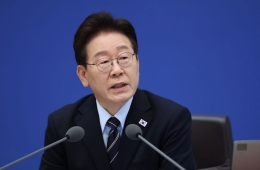
"Reducing Fuel Cost Burden and Vehicle Movement"... Speaker Kim Jin-pyo Proposes Direct Transportation Cost Support
"Constitutional Amendment Advisory Committee, Senior Council, and Economic Diplomacy Advisory Committee to Be Formed"

Kim Jin-pyo, elected as the Speaker of the National Assembly for the second half of the year, is giving his acceptance speech at the plenary session held at the National Assembly on the 4th. Photo by Yoon Dong-joo doso7@
View original image[Asia Economy Reporter Naju-seok] On the 1st, Speaker of the National Assembly Kim Jin-pyo proposed a plan to increase public transportation usage by directly supporting transportation costs. Speaker Kim announced plans to form the Constitutional Amendment Special Committee, the Senior Members' Council, and the Economic Diplomacy Advisory Committee.
In his opening address to the regular National Assembly session, Speaker Kim said, "I would like to make a request to the Prime Minister and Cabinet members," and proposed, "Let us also introduce a system that directly supports transportation costs."
He stated, "On July 20th, the National Assembly formed the ‘Special Committee on Stabilizing the People’s Economy’ to address urgent livelihood issues. The ruling and opposition parties agreed to swiftly expand the reduction of fuel tax and passed a bill to ease the burden of lunch expenses," adding, "We need to take one step further."
Speaker Kim introduced the case of the German government, which temporarily reduced the monthly public transportation pass from 86 euros to 9 euros, resulting in many drivers switching to public transportation, achieving a dual benefit of reducing fuel cost burdens and decreasing vehicle usage.
He said, "If the central and local governments share the costs, this system can be quickly implemented nationwide," and added, "The necessary budget is estimated to be within approximately 3 trillion won. We expect active consideration from the financial authorities."
Regarding the constitutional amendment, Speaker Kim emphasized the need for a paradigm shift, stating, "Let us use the constitutional amendment process as an opportunity to unite public opinion and as a turning point for cooperation between the ruling and opposition parties." He added, "Before the full-scale constitutional amendment, let us first amend the ‘National Referendum Act,’ which was ruled unconstitutional due to the issue of ‘overseas citizens’ voting rights.’ We plan to soon form a ‘Constitutional Amendment Advisory Committee’ directly under the Speaker and begin open discussions on the amendment."
Speaker Kim also revealed plans to form the Senior Members' Council. He explained, "The Speaker’s group intends to fulfill its responsibility for dialogue and compromise politics through coordination and mediation," and said, "If negotiations between the ruling and opposition parties reach a deadlock causing a prolonged gap in National Assembly operations, the Senior Members' Council will support and facilitate negotiations between floor leaders." He added, "The ‘Senior Members' Council’ will bring together ruling and opposition floor leaders, policy committee chairs, senior lawmakers, the Speaker’s group, first-term lawmakers with expertise in relevant fields, related standing committee chairs, and Cabinet members to collectively create mediation opinions. Once preparations are complete, I will report the specific details to the members in detail."
He also expressed his determination to strengthen parliamentary diplomacy. Speaker Kim said, "Parliamentary diplomacy will focus on economic and trade diplomacy, such as attracting the Busan Expo and the defense industry," and added, "To this end, we will form an ‘Economic Diplomacy Advisory Committee’ directly under the Speaker."
Additionally, Speaker Kim criticized the government’s political use of enforcement ordinances. He said, "Recently, policies that are not sufficiently prepared have been repeatedly announced," and urged, "Please keep in mind that there is no rehearsal in national governance." He pointed out, "In the current situation of a ruling party minority in the National Assembly, there may be temptation within parts of the public service to bypass the complex legislative process and substitute it with enforcement ordinances," calling it "a convenient idea that prioritizes efficiency and speed."
Hot Picks Today
 "Stocks Are Not Taxed, but Annual Crypto Gains Over 2.5 Million Won to Be Taxed Next Year... Investors Push Back"
- "Don't Throw Away Coffee Grounds" Transformed into 'High-Grade Fuel' in Just 90 Seconds [Reading Science]
- Prison Sentences Finalized for Husband and Son Who Killed 80-Year-Old After 10 Years of Care
- "Groups of 5 or More Now Restricted"... Unrelenting Running Craze Leaves Citizens and Police Exhausted
- "Even With a 90 Million Won Salary and Bonuses, It Doesn’t Feel Like Much"... A Latecomer Rookie Who Beat 70 to 1 Odds [Scientists Are Disappearing] ③
He emphasized, "The parliamentary democracy we have chosen is a system that reflects the will of the people in state affairs through the National Assembly," and requested, "I ask the Prime Minister and Cabinet members to be especially mindful so that the public service does not fall into the temptation of convenience."
© The Asia Business Daily(www.asiae.co.kr). All rights reserved.