[The Editors' Verdict] The Information Asymmetry Problem Is Even Greater for 'Distressed Companies'
Only Ants Fall on the Tilted Playing Field
Strengthening Disclosure Standards for Failing Companies
KOSDAQ Company A. The company, which used to generate stable annual sales worth hundreds of billions of won, suddenly saw its quarterly sales (based on individual financial statements) drop below 300 million won. The Korea Exchange (KRX) suspended trading of this company's stock. The suspension lasted for several months. During this period, the exchange received materials from the company to examine the reasons for the sharp decline in sales and the possibility of quarterly sales recovery. After several months, trading resumed. Since then, the stock price plummeted, falling to less than half its previous value.
Meanwhile, the company did not make any disclosures. It also did not provide any official explanation to investors on how it planned to resume trading and normalize performance. Investors who bought the stock believing in the company's future had to endure a long period of anxiety without seeing even a single disclosure, let alone detailed explanations. Some investors frequently called the company to check the situation, but they were told either that it was difficult to get through or, if they did, only received generic responses such as "We will do our best to resume trading" or "Please wait a little longer."
Company B. A large loss occurred in its subsidiary. However, the company did not inform external investors of this fact and only disclosed the large loss months later at the time of submitting the quarterly report. This company was immediately designated as a management item, and depending on the case, its stock trading could be suspended. The parent company delayed disclosure and sold its shares in the loss-making subsidiary. It appears to have engaged in 'cutting the tail' before the loss was publicly announced. It is unclear whether foreign and institutional investors had prior access to this information, but they sold a significant portion of their shares. Ultimately, only individual investors suffered losses without knowing what had happened. Investors are left in a situation where they must either endure passively without proper explanations or seek information and devise countermeasures on their own.
Such cases are not limited to just one or two companies in the domestic stock market. According to the Korea Capital Market Institute, a total of 103 companies in the KOSPI and KOSDAQ markets experienced at least one trading suspension in the first half of this year. Additionally, 37 companies received 'non-standard' audit opinions (qualified, adverse, or disclaimer of opinion) on their semiannual reports from accounting firms during the same period?5 in the KOSPI market and 32 in the KOSDAQ market. However, these companies were found to have responded rather passively to information disclosure.
When a negative market event occurs at a company, firms become extremely reluctant to disclose management information externally. This is because those with many weaknesses tend to avoid exposing themselves. Due to companies becoming passive in information disclosure, investors become victims of a paradox where they obtain less company information than usual during periods of extreme stock price volatility. Foreign and institutional investors are more likely to secure information about their invested stocks in advance by utilizing private networks. This is where the results of an unfair 'tilted playing field' become pronounced.
For this reason, efforts to reduce the asymmetry of information cannot be left solely to companies. Financial authorities or exchanges must step in to strengthen regulations or encourage more information disclosure for companies experiencing events that could significantly increase stock price volatility. The intention is to tighten information disclosure standards for companies with higher risks of insolvency.
Arthur Levitt Jr., former chairman of the U.S. Securities and Exchange Commission (SEC), implemented reforms that broke the practice of 'selective information disclosure' by companies shortly after the Enron scandal, the largest accounting fraud in the U.S., devastated the American stock market. Although it was a case of fixing the barn after the horse was lost, continuous expansion of transparency is the secret behind the U.S. becoming and maintaining the world's largest liquidity pool market. It is better to take proactive measures when the market shows signs of instability.
![[The Editors' Verdict] The Information Asymmetry Problem Is Even Greater for 'Distressed Companies'](http://www.asiae.co.kr/news/img_view.htm?img=2022030313473465232_1646282854.png)
Lim Jeong-su, Head of Capital Markets Department
Hot Picks Today
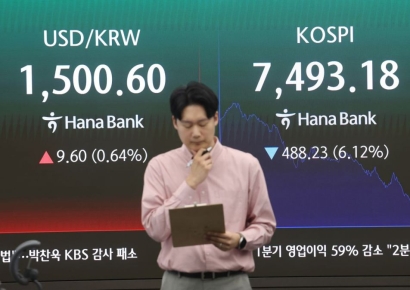 After Topping 8,000 Instead of Hitting 10,000... KOSPI Plunges—When Will It Rebound?
- "Samsung and Hynix Were Once for the Underachievers"... Hyundai Motor Employee's Lament
- [Breaking] Court Rules Against Samsung Electronics Union...1 Billion Won per Day Penalty for Exceeding Strike Scope
- Six Economic Organizations Urge Withdrawal of Samsung Electronics Strike Plan...Warn of National Loss of Opportunity
- "That? It's Already Stashed" Nightlife Scene Crosses the Line [ChwiYak Nation] ③
© The Asia Business Daily(www.asiae.co.kr). All rights reserved.







