[The Editors' Verdict] Yoon Suk-yeol's Invoice

President Yoon Suk-yeol, the 20th president, is attending the inauguration ceremony held at the National Assembly on the 10th, receiving applause from business leaders. Photo by Yoon Dong-ju doso7@
View original image[Asia Economy Industry Chief Reporter Lee Chohee] The three major economic adversities?high inflation, high interest rates, and high exchange rates?are gripping the economy’s ankle, leaving little room for a rebound. Economic downturns are like diseases that make citizens' lives difficult.
The new government's economic policy to overcome this challenge has begun to take shape. Although the opposition party is trying to frame it as a tax cut for the wealthy and a pro-chaebol policy, the business community is generally welcoming it.
The direction of the Yoon Suk-yeol administration’s economic policy is clear. Since his candidacy, he has consistently emphasized the two pillars of business and market, aiming to achieve investment and employment expansion through a private sector-led economy. The national debt, which has ballooned like a snowball due to COVID-19, has made massive government fiscal spending difficult, unlike the previous administration. Expecting the private sector to play a role and easing regulations is a rational choice under the current circumstances.
Corporate tax rate cuts and the abolition of tax incentives for investment and win-win cooperation are particularly welcomed by companies. For the business community, which had complained about the difficulty of doing business due to the flood of regulatory bills during the previous administration, this feels like timely rain.
However, past administrations also implemented so-called "trickle-down effect" policies early in their terms, aiming to increase investment and jobs through pro-business policies, but there is no clear record of success. Between 2007 and 2012, South Korea’s per capita GDP remained around $20,000 with little change. During that period, large corporations grew rapidly. In 2009, large corporations’ net profits surged by 39% compared to the previous year, and in 2011, they increased by up to 60%. This indicates that past pro-business policies failed to bring about the trickle-down effect. During the MB administration, it was expected that lowering corporate taxes would activate corporate investment, increase household income, and stimulate consumption. However, investment did not increase, and statistics showing that corporate retained earnings increased by 28 trillion won over five years are already widely known.
![[The Editors' Verdict] Yoon Suk-yeol's Invoice](http://www.asiae.co.kr/news/img_view.htm?img=2022022110202451865_1645406424.png)
Nevertheless, the consensus remains that the answer ultimately lies in the private sector. This is also the reason why the Yoon administration emphasizes private sector-led policies. Large corporations remain the driving force behind investment and employment. Recently, in line with the new government’s launch, the scale of domestic investment announced by large corporations exceeds 1,000 trillion won. Even if the benefits to companies do not directly translate into prosperity for ordinary citizens, it is undeniable that the more corporate activity increases, the more opportunities open up. The damage to the local economy after GM’s Gunsan plant closure clearly shows why large corporations are necessary.
There is no such thing as a free lunch. The Yoon administration’s promise to remove many regulations and restrictions is also a bill for companies to respond accordingly. If tax reform and deregulation materialize, companies have no reason to delay investment.
The president emphasized regulatory reform and promised to push through unpopular policies. This is a declaration of determination to do what must be done without being swayed by public opinion. Bold courage is only possible during the honeymoon period early in an administration. Politics inevitably depends on public opinion and approval ratings. If the public turns their backs on companies, no matter how brave the administration is, it cannot always side with businesses.
Hot Picks Today
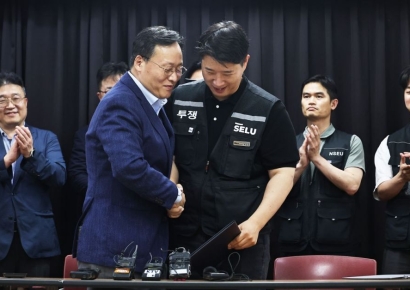 Up to 600 Million Won for Semiconductors, 160 Million Won Bonus for Loss-Making Non-Memory… Samsung Electronics Labor and Management Reach Tentative Deal on Unprecedented Performance Compensation (Comprehensive)
- "Could I Also Receive 370 Billion Won?"... No Limit on 'Stock Manipulation Whistleblower Rewards' Starting the 26th
- "From a 70 Million Won Loss to a 350 Million Won Profit with Samsung and SK hynix"... 'Stock Jackpot' Grandfather Gains Attention
- [Current State of K-Finance for Foreign Nationals]①From Niche to Core... Banks Go All-In on First-Mover Competition
- "Who Is Visiting Japan These Days?" The Once-Crowded Tourist Spots Empty Out... What's Happening?
The ball is now in the companies’ court. If they rely on the government’s pro-business policies but only accumulate retained earnings and focus on real estate speculation without investment, they must realize that the current spring breeze can quickly turn into a harsh cold wind. Everyone is watching how the promise of 1,000 trillion won in investment is fulfilled.
© The Asia Business Daily(www.asiae.co.kr). All rights reserved.