The Yoon Administration Starting with 'S Fear'... The Stock Market's Lifeline is New Funds
New Government's National Task Implementation Plan
Abolition of Capital Gains Tax on Stocks Under 10 Billion KRW
Need for New Capital Inflow and
Measures to Strengthen Competitiveness of Listed Companies
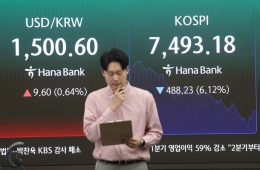
[Asia Economy Reporter Ji Yeon-jin] The Yoon Seok-yeol administration was launched amid fears of stagflation. Inflation and the U.S. interest rate hikes, along with the prolonged Ukraine war, have driven up raw material prices, fueling inflation and creating a vicious cycle of tightening through repeated base rate increases. This has led to concerns about stagflation, where rising prices and economic downturn occur simultaneously. This situation has recently escalated into an economic crisis theory, threatening the stock market. The KOSPI index has shown a decline for eight consecutive trading days this month, marking the longest bearish market since the beginning of the year. Because of this, the market identifies stabilizing the stock market and improving investment sentiment as the Yoon administration’s most urgent tasks.
According to the implementation plan for national tasks by the Presidential Transition Committee on the 12th, the Financial Services Commission has decided to abolish capital gains tax for stockholders holding less than 10 billion KRW per stock as a capital market policy task this year. Starting next year, when the major shareholder taxation system is abolished and the financial investment income tax is implemented, any investor earning more than 50 million KRW (based on domestic listed stocks), regardless of major shareholder status, will have to pay taxes. However, the plan is to tax only ultra-high-value stockholders holding more than 10 billion KRW. Additionally, the Basic Act on Virtual Assets will be enacted within this year, and taxation on cryptocurrency investment profits will also be pursued.
Furthermore, the implementation plan includes President Yoon Seok-yeol’s pledges to protect investors, such as lowering the collateral ratio for short selling by individual investors, introducing a short-selling circuit breaker that bans short selling for a certain period if stock prices fall excessively, strengthening the review of physical division subsidiary listings, and requiring prior disclosure of insider stock transactions.
However, many opinions suggest that such policies will not improve investment sentiment amid the onset of comprehensive global tightening. Experts particularly criticize that abolishing capital gains tax on stocks will benefit only ultra-high-value investors like 'super ants' rather than revitalizing the stagnant stock market. An anonymous financial investment industry official said, "Abolishing capital gains tax on stocks is a typical populist pledge and is unlikely to be realized," adding, "Since it requires amending the Income Tax Act, the Democratic Party will not easily cooperate."
The market sees new capital inflows and strengthening the competitiveness of domestic listed companies as cards that can revitalize the plummeting stock market. Since the domestic stock market after COVID-19 was lifted by liquidity to overcome the infectious disease crisis, new funds need to flow in. Researcher Heo Jae-hwan of Eugene Investment & Securities said, "When interest rates rise, there are many other (investment) alternatives besides stocks, so no matter what policy is implemented, the negative effects of interest rate hikes cannot be offset," adding, "If companies perform well, capital will naturally flow into the stock market." Kim Hyung-ryeol, head of the Kyobo Securities Research Center, also said, "The stock market cannot be improved by policy alone," and "It is most desirable for regulatory authorities not to intervene excessively, and if there are many good companies and poor companies are eliminated, the market will become a good one."
Hot Picks Today
 "Samsung and Hynix Were Once for the Underachievers"... Hyundai Motor Employee's Lament
- "Sold Everything Fearing Bankruptcy, Then It Soared 3,900 Times: How a Stock Once Feared for Delisting Became an AI Powerhouse"
- Court Partially Grants Samsung Electronics' Injunction to Prohibit Industrial Action... 100 Million Won Penalty Per Day for Violations
- Strike Risk Looms Over Pangyo... Kakao Enters Labor Commission Mediation Today
- "That? It's Already Stashed" Nightlife Scene Crosses the Line [ChwiYak Nation] ③
Meanwhile, the inclusion of South Korea in the Morgan Stanley Capital International (MSCI) Developed Markets Index, which was promoted by the Moon Jae-in administration, was not included in this national task implementation plan. According to a report published the day before by the Korea Capital Market Institute, if included in the MSCI Developed Markets Index, South Korea was expected to see a net capital inflow of $5 billion to $36 billion. Also, an analysis of cases in Israel and Greece showed that inclusion in the developed markets index had positive effects, such as reducing the volatility of foreign stock investment capital inflows and outflows and stock prices.
© The Asia Business Daily(www.asiae.co.kr). All rights reserved.