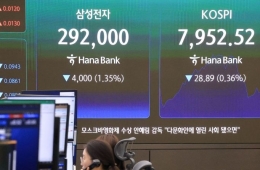
Won-Dollar Exchange Rate Breaks 1270 Won... Hits New 5-Day High (Comprehensive)
![[Image source=Yonhap News]](http://www.asiae.co.kr/news/img_view.htm?img=2022042816234448559_1651130624.jpg)
[Asia Economy Reporter Seo So-jeong] The won-dollar exchange rate closed above the 1,270 won mark.
According to the Seoul foreign exchange market on the 28th, the won-dollar exchange rate closed at 1,272.5 won, up 7.3 won from the previous day's closing price. This is the first time in 2 years and 1 month since March 19, 2020, when the exchange rate rose to the 1,270 won level at closing, a period when the financial market was shocked at the beginning of COVID-19.
The Dollar Index, which indicates the value of the dollar against the currencies of six major countries, rose 0.41 points from the previous day to 103.36, surpassing the 103 level for the first time since January 4, 2017 (103.246).
Amid concerns over the Federal Reserve's (Fed) aggressive tightening and economic slowdown due to China's lockdown measures, the exchange rate has been hitting new highs for five consecutive trading days.
Despite verbal intervention by Deputy Prime Minister and Minister of Economy and Finance Hong Nam-ki on the day, it was insufficient to stop the rise in the exchange rate. Before the market opened, Minister Hong expressed concern, saying, "The won-dollar exchange rate has been rising rapidly this week, and if necessary, we will make efforts to stabilize the market."
The euro weakened due to Russia's suspension of natural gas supply to some European Union (EU) member countries, influencing the dollar's strength. The won is also under depreciation pressure as the yuan continues to weaken amid concerns over China's lockdown measures.
Additionally, the Bank of Japan announced it would keep its policy rate unchanged and continue unlimited purchases of 10-year government bonds, causing the yen-dollar exchange rate to rise to 130.27 yen, the highest in 20 years, further encouraging won depreciation.
Hot Picks Today
 If They Fail Next Year, Bonus Drops to 97 Million Won... A Closer Look at Samsung Electronics DS Division’s 600M vs 460M vs 160M Performance Bonuses
- Opening a Bank Account in Korea Is Too Difficult..."Over 150,000 Won in Notarization Fees Just for a Child's Account and Debit Card" [Foreigner K-Finance Status]②
- "While Others Rest"...3 Million May Have to Work on the Alternative Public Holiday
- Room Prices Soar from 60,000 to 760,000 Won and Sudden Cancellations: "We Won't Even Buy Water in Busan" — BTS Fans Outraged
- "Who Is Visiting Japan These Days?" The Once-Crowded Tourist Spots Empty Out... What's Happening?
Oh Chang-seop, a researcher at Hyundai Motor Securities, said, "Domestic and international uncertainties such as the Ukraine crisis have not been resolved, and rather, anxiety is increasing, leading to a strong preference for the dollar as a representative safe-haven asset," adding, "Until the Federal Open Market Committee (FOMC), concerns over aggressive U.S. tightening will continue, and the upward trend is expected to persist for the time being."
© The Asia Business Daily(www.asiae.co.kr). All rights reserved.
!["Please Help Us": How Much Do Those Bowing 90 Degrees These Days Actually Earn? [Data Pick]](https://cwcontent.asiae.co.kr/asiaresize/307/2026052010120870131_1779239528.png)