[Concall] Samsung Electronics "Foundry Yield Stabilization... Confident in Memory Superiority" (Comprehensive)
"Next-Generation DRAM Development and Mass Production on Track"
Record High Q1 Sales of 77.8 Trillion Won Achieved
Annual Sales Expected to Surpass 300 Trillion Won This Year
![[Image source=Yonhap News]](http://www.asiae.co.kr/news/img_view.htm?img=2022040410321914937_1649035939.jpg)
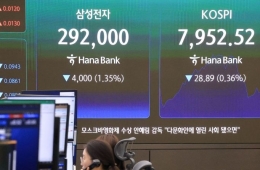
[Asia Economy Reporters Sunmi Park and Jinho Kim] Samsung Electronics stated on the 28th that recent market concerns about the semiconductor sector, including foundry (contract manufacturing) yield rates, are excessive. The company also expressed confidence that it can maintain the semiconductor technological gap it has firmly established. Samsung Electronics announced its first-quarter earnings on the same day, reporting record-breaking sales of 77.78 trillion KRW.
Kang Moon-soo, Vice President of Samsung Electronics' Foundry Business Division, said during the conference call following the first-quarter earnings announcement, regarding the yield of the advanced foundry plants, "The 5-nanometer process has entered the mature yield stage," adding, "We are maximizing supply to key customers based on stable yields."
Vice President Kang added, "Although the initial yield ramp-up for the 4-nanometer process was somewhat delayed, we have focused on early stabilization and are currently within the expected yield improvement curve."
This clearly indicates that concerns about yield issues raised by the market have been exaggerated. There were even reports that Qualcomm in the U.S. had entrusted the next-generation 3-nanometer application processor (AP) contract manufacturing, initially planned for Samsung Electronics, to Taiwan's TSMC.
Regarding the departure of major customers, Vice President Kang explained, "We have signed long-term supply contracts with numerous key customers, and stable fab operations through these contracts will enhance stability," adding, "The order backlog for the next five years is eight times the previous year's sales."
Han Jin-man, Vice President of Samsung Electronics' Memory Business Division, also revealed plans for next-generation DRAM development, stating, "Development is currently underway, and mass production schedules will proceed without issues."
In particular, when asked whether the technological gap with competitors in memory is narrowing, he emphasized, "Despite the competitive environment, we are maintaining leadership as a pioneering company by proactively embracing technological inflection points, such as being the first to introduce EUV (Extreme Ultraviolet Lithography) in DRAM."
![[Concall] Samsung Electronics "Foundry Yield Stabilization... Confident in Memory Superiority" (Comprehensive)](http://www.asiae.co.kr/news/img_view.htm?img=2022042810593947897_1651111179.jpg)
Samsung Electronics overcame adverse factors such as sporadic regional lockdowns due to COVID-19 and the Russia-Ukraine war to set a new record for the highest quarterly sales in the first quarter of this year. Consolidated sales for Q1 reached 77.78 trillion KRW, with operating profit at 14.12 trillion KRW. Both sales and operating profit increased by 18.9% and 50.5%, respectively, compared to the same period last year.
The semiconductor sector was the key contributor to Samsung Electronics' outstanding first-quarter performance. Thanks to a smaller-than-expected decline in memory semiconductor prices, the company achieved these results even in the first quarter, which is typically the weakest quarter for earnings. This reaffirmed the successful formula of "Semiconductors are indeed Samsung."
Samsung Electronics recorded sales of 26.87 trillion KRW from semiconductors alone in Q1, significantly surpassing market expectations of 25 trillion KRW. Although the prices of DRAM and NAND flash were expected to fall by 6.2% and 5.1%, respectively, the actual situation was better than anticipated.
The successful launch of the Galaxy S22 series in Q1, despite the 'GOS controversy,' also played a crucial role. According to industry sources, the Galaxy S22 surpassed 1 million units sold about two weeks earlier than its predecessor, the Galaxy S21. Strong sales of premium TVs such as Neo QLED and growth in key home appliances like the Bespoke line also supported the sales figures.
With this unprecedented strong performance in Q1, Samsung Electronics is on track to surpass 300 trillion KRW in sales this year. If it achieves this, it will mark a new milestone, surpassing the 200 trillion KRW sales recorded in 2012, creating a new history after 10 years.
However, despite the record-breaking Q1 results, market outlooks remain cautious. This is due to the prolonged absence of Vice Chairman Lee Jae-yong amid a global semiconductor dominance competition fueled by massive investments from countries worldwide.
Currently on parole and unable to take full charge of management, Vice Chairman Lee's sentence will expire at the end of July, but under the Act on the Aggravated Punishment of Specific Economic Crimes, he will face a five-year employment restriction. Without a pardon, this effectively means a decade-long judicial risk.
Hot Picks Today
 If They Fail Next Year, Bonus Drops to 97 Million Won... A Closer Look at Samsung Electronics DS Division’s 600M vs 460M vs 160M Performance Bonuses
- Opening a Bank Account in Korea Is Too Difficult..."Over 150,000 Won in Notarization Fees Just for a Child's Account and Debit Card" [Foreigner K-Finance Status]②
- "While Others Rest"...3 Million May Have to Work on the Alternative Public Holiday
- Room Prices Soar from 60,000 to 760,000 Won and Sudden Cancellations: "We Won't Even Buy Water in Busan" — BTS Fans Outraged
- "Who Is Visiting Japan These Days?" The Once-Crowded Tourist Spots Empty Out... What's Happening?
Major issues such as the 20 trillion KRW semiconductor investment in the U.S., fierce competition with Taiwan's TSMC in the foundry market, and the establishment of future strategies to generate new revenue streams are inevitably facing setbacks. Particularly in the DS Division (semiconductors), which accounts for more than half of the 14 trillion KRW operating profit, active investments and mergers and acquisitions (M&A) have stalled, raising concerns that Samsung may fall behind its competitors.
© The Asia Business Daily(www.asiae.co.kr). All rights reserved.
!["Please Help Us": How Much Do Those Bowing 90 Degrees These Days Actually Earn? [Data Pick]](https://cwcontent.asiae.co.kr/asiaresize/307/2026052010120870131_1779239528.png)