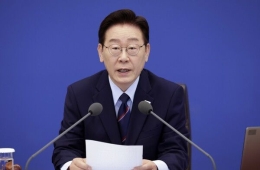
Assemblyman Seodongyong Discusses POSCO Issues with Vice Chairman Kim Hakdong
Concerns Raised by Local Community Regarding POSCO Holding Company's Relocation to Pohang
Vice Chairman Kim Hak-dong Promises Balanced Growth with New Investments in Gwangyang, Including Secondary Battery Materials Business Cluster Development

[Gwangyang=Asia Economy Honam Reporting Headquarters, Reporter Heo Seon-sik] Amid concerns about investment contraction in the Gwangyang area following the announcement of POSCO Holdings and the Future Technology Research Institute's relocation to Pohang, National Assembly member Seo Dong-yong has taken proactive steps to dispel these worries among Gwangyang citizens.
On February 25th (Friday), Seo Dong-yong instructed his staff at his Seoul office to receive reports from POSCO regarding future investment plans. Then, today (the 7th), he met directly with POSCO Vice Chairman Kim Hak-dong in Gwangyang to convey the local community's deep concerns about the relocation of POSCO Holdings and the Future Technology Research Institute to Pohang and to discuss ways for mutual development between Gwangyang City and POSCO.
First, they confirmed that the investment plans totaling 4.9 trillion KRW, including the already announced 1.7 trillion KRW investment in 2022 for the refurbishment of blast furnaces 2 and 4 at the Gwangyang Steelworks and the expansion of production capacity for eco-friendly automobile electrical steel sheets, as well as 1.7 trillion KRW in 2023 and 1.5 trillion KRW in 2024, will proceed without disruption.
Additionally, regarding POSCO's new business investment plans for Gwangyang, they emphasized not only the smooth progress of the previously reported 2.8 trillion KRW new business investments?including four secondary battery projects such as the 900 billion KRW lithium hydroxide plant and the 750 billion KRW expansion of the 7th and 8th units of the Gwangyang LNG terminal, as well as three hydrogen-related projects?but also the discovery and investment in additional new businesses.
Seo emphasized that despite Gwangyang Steelworks having higher production volume than Pohang, local citizens express dissatisfaction that all decision-making?including R&D infrastructure, new business decisions, purchasing, and contract signing?is centered in Pohang. He demanded that, since POSCO Holdings has relocated to Pohang, first, the expansion of POSCO Holdings subsidiaries headquartered in Gwangyang, and second, the presentation of specific and active investment plans for new subsidiaries headquartered in Gwangyang are necessary.
Furthermore, Seo requested that, similar to the establishment of the Future Technology Research Institute in Pohang for the future development of Gwangyang City and nurturing of talent, a research institute dedicated to hydrogen and low-carbon energy research?fields prioritized by Jeonnam Province and Gwangyang City?be established in Gwangyang. He also called for expanded support for vocational education within the Gwangyang area and increased active hiring of local young talent and students from Korea Port Logistics High School.
Moreover, he demanded improvements in the purchasing system, such as conducting independent purchasing for Gwangyang Steelworks within Gwangyang and increasing the purchase allocation ratio for local companies.
Based on these points, he proposed that POSCO Holdings, POSCO, local National Assembly members, and Gwangyang City form and strengthen a continuous partnership.
In response, POSCO Vice Chairman Kim Hak-dong stated, “Not only steel, which is POSCO’s core, but also the group-level new growth businesses will proceed as expansions based on business sites (steelworks), increasing the importance of the key region, Gwangyang.” He added, “Starting this January, we integrated the group’s previously dispersed logistics organizations into POSCO Terminal, headquartered in Gwangyang, and based on the secondary battery materials business in Gwangyang, we will build a cluster encompassing secondary battery materials in the future.”
Additionally, Vice Chairman Kim said, “Carbon neutrality at the steelworks is an urgent task, and to achieve this, large-scale investments such as technology development and facility construction equivalent to building a new steelworks are inevitable. These essential large-scale investments will become a new opportunity for co-growth with local suppliers, companies, and Gwangyang citizens.”
Hot Picks Today
 "Stocks Are Not Taxed, but Annual Crypto Gains Over 2.5 Million Won to Be Taxed Next Year... Investors Push Back"
- "Don't Throw Away Coffee Grounds" Transformed into 'High-Grade Fuel' in Just 90 Seconds [Reading Science]
- Signed Without Viewing for 1.6 Billion Won... Jamsil and Seongbuk Jeonse Prices Jump 200 Million Won in a Month [Real Estate AtoZ]
- "Groups of 5 or More Now Restricted"... Unrelenting Running Craze Leaves Citizens and Police Exhausted
- "Even With a 90 Million Won Salary and Bonuses, It Doesn’t Feel Like Much"... A Latecomer Rookie Who Beat 70 to 1 Odds [Scientists Are Disappearing] ③
Gwangyang=Asia Economy Honam Reporting Headquarters, Reporter Heo Seon-sik hss79@asiae.co.kr
© The Asia Business Daily(www.asiae.co.kr). All rights reserved.