'Minimizing Real Demanders' Damage'... Exceptions Allowed for Funeral and Wedding Fund Loan Limits (Comprehensive)
Early Expansion of DSR Regulations... Personal Loans Expected to Decrease by Nearly Half
Jeonse Loans Exempt from DSR Application... Excluded from Q4 Total Volume Management Limit
Includes 'Youth Multi-Debt Measures' Ordered by President Moon for Countermeasures

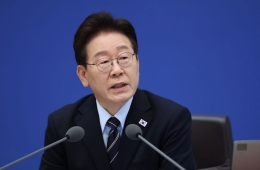
Financial Services Commission Chairman Ko Seung-beom attended the "October Household Debt Management Measures Party-Government Consultation" held at the National Assembly on the 25th and was talking with Kim Byung-wook, the Democratic Party's Policy and Judiciary Committee secretary, during the meeting. Photo by Yoon Dong-joo doso7@
View original image[Asia Economy Reporter Kwangho Lee] The government's supplementary measures for household debt, to be announced on the 26th, include exceptions for unavoidable funding needs such as funerals and weddings in the credit loan limits. This is interpreted as a plan to minimize dissatisfaction among genuine borrowers. It appears to be a measure taken in consideration of public opinion that restricting household loans across the board could cause uncontrollable damage to genuine borrowers. Previously, excluding jeonse loans and balance payment loans from additional measures was also in the same context.
However, since the core of the supplementary measures is to strengthen repayment screening by early expanding the Debt Service Ratio (DSR) regulation that limits loan limits according to income levels, the general view is that the loan freeze at the end of the year will be severe. If the DSR is strengthened, the loan limit an individual can receive in the future may be reduced by nearly half in some cases.
◆Total volume restriction and focus on protecting genuine borrowers= On the 25th, the ruling Democratic Party and the government held a party-government consultation to discuss supplementary measures for household debt, including these contents. The government plans to announce the final plan on the 26th based on the consultation.
The core of the supplementary measures is to strengthen the DSR regulation to lend only to those who can repay, focusing on repayment ability. The DSR refers to the ratio of principal and interest to be repaid relative to income. Unlike the Loan-to-Value ratio (LTV), which only calculates the limit for mortgage loans, it is a comprehensive concept that looks at the principal and interest burden of all financial sector loans, including credit loans and card loans.
Although there was no related discussion at the party-government meeting that day, Financial Services Commission Chairman Seung-beom Ko emphasized at the meeting, "We have created a plan to solidify DSR household debt centered on repayment ability and balanced it to protect genuine borrowers."
The first phase of the 'individual DSR 40%' applied since July covers mortgage loans on houses priced over 600 million KRW in regulated areas (speculative areas, speculative overheating districts, and adjustment target areas) and credit loans over 100 million KRW. The second phase applies the DSR 40% regulation if the total loan amount exceeds 200 million KRW regardless of house price. The second phase was originally scheduled to be implemented from July next year but is planned to be applied earlier. The early expansion is likely to be announced at the beginning of the year.
When the DSR 40% regulation is introduced for loans over 200 million KRW, the loan limit is evaluated by the market to be reduced by nearly half in some cases. For example, under the current DSR standard, Mr. A, who has an annual income of 50 million KRW and a 50 million KRW overdraft (interest rate 3.95%), applies for a mortgage loan (30-year term, interest rate 3.47%) secured by a 700 million KRW apartment in a regulated area. He can borrow up to 200 million KRW. If the second phase is implemented early, Mr. A can borrow only up to 150 million KRW, a 25% (50 million KRW) reduction from before.

An official from a commercial bank said, "If the second phase DSR regulation is implemented early in a situation where asset prices such as real estate have risen sharply, the reduction in loan limits felt by people dreaming of owning a home will be significant," adding, "Especially, the loan impact on low-income groups and self-employed people with relatively low income will not be small."
However, genuine borrowers can exceptionally receive credit loans beyond their income range in cases of unavoidable funding needs such as funerals or weddings. Currently, the credit loan limit in the banking sector is tied to annual income. This is interpreted as a measure to minimize dissatisfaction among genuine borrowers who need emergency funds.
◆Considering expansion to secondary financial sector... loan refugees expected to surge= Financial authorities are expected to propose applying the same level of DSR 40% regulation to the secondary financial sector to prevent a 'balloon effect' where loan demand blocked at commercial banks spills over into blind spots such as the secondary financial sector.
The financial authorities' fundamental stance is not to overlook the recent surge in household debt through card loans and savings banks in the secondary financial sector. They expect that strengthening the DSR regulation will have the effect of curbing loan limits.
The problem is that vulnerable groups, low-income earners, and self-employed people who find it difficult to get bank loans will have even fewer places to borrow money. If the loan threshold rises across all regulated financial companies, they may eventually be pushed into the illegal private loan market.
Regarding the heavily opposed regulation on jeonse loans, it was decided not to apply DSR to protect genuine borrowers among the low-income class. It is also excluded from the household loan total volume management limit (growth rate in the 6% range) for the fourth quarter of this year. Instead, only the amount corresponding to the increase in jeonse prices can be borrowed from commercial banks, and one-homeowners must apply for loans at bank counters and pass screening, with plans to manage this strictly.
It is also reported that the 'multi-debt solution for youth' ordered by President Moon Jae-in will be included. On the 21st, President Moon instructed at a staff meeting to prepare measures for the phenomenon of increasing multi-debtors holding both student loans and financial sector loans due to worsening youth employment difficulties caused by COVID-19.
Hot Picks Today
 "Stocks Are Not Taxed, but Annual Crypto Gains Over 2.5 Million Won to Be Taxed Next Year... Investors Push Back"
- "Don't Throw Away Coffee Grounds" Transformed into 'High-Grade Fuel' in Just 90 Seconds [Reading Science]
- Signed Without Viewing for 1.6 Billion Won... Jamsil and Seongbuk Jeonse Prices Jump 200 Million Won in a Month [Real Estate AtoZ]
- "Groups of 5 or More Now Restricted"... Unrelenting Running Craze Leaves Citizens and Police Exhausted
- "Even With a 90 Million Won Salary and Bonuses, It Doesn’t Feel Like Much"... A Latecomer Rookie Who Beat 70 to 1 Odds [Scientists Are Disappearing] ③
Democratic Party lawmaker Byung-wook Kim, the ranking member of the National Assembly's Political Affairs Committee, told reporters after the consultation, "We reached a consensus to include measures in the household debt supplementary plan to protect genuine borrowers such as those with jeonse loans and balance payment loans, while preventing the risks of domestic and international financial instability such as interest rate hikes and U.S. tapering."
© The Asia Business Daily(www.asiae.co.kr). All rights reserved.