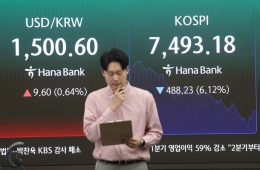
"KOSPI and KOSDAQ Fall Over 1% as 'No Bottom in Sight'"
'70,000 Electronics' Collapse... SK Hynix Also Declines
Individual Investors Buy Alone Amid Foreign and Institutional Net Selling

Samsung Electronics fell more than 2%, breaking below the 70,000 won mark during the session. As of 9:30 a.m. on the 12th, Samsung Electronics was trading at 69,700 won on the KOSPI market, down 2.52% from the previous trading day. In the early session, Samsung Electronics dropped to 69,300 won, marking the lowest price of the year. Photo by Hyunmin Kim kimhyun81@
View original image[Asia Economy Reporter Minji Lee] The KOSPI and KOSDAQ indices are widening their losses. Concerns over prolonged inflation due to rising energy prices, sharp increases in commodity prices caused by China's power shortages, and supply-demand uncertainties are being negatively reflected in the indices.
As of 10:42 a.m. on the 12th, the KOSPI stood at 2,904.28, down 1.76% (52.02 points) from the previous trading day. The index opened the day at 2,950.22, down 0.21% (6.07 points) from the previous close. Looking at investor trends, individual investors bought stocks worth 424.4 billion KRW alone, while foreigners and institutions sold stocks worth 359.1 billion KRW and 81.4 billion KRW, respectively.
Currently, the KOSPI is showing a weak trend with no clear buying entities amid external uncertainties. Shin Seung-jin, a researcher at Samsung Securities, explained, “The US debt ceiling issue has entered a negotiation phase, and global cooperation continues amid soaring raw material prices, which is positive, but this is only a temporary measure and cannot be seen as a resolution of fundamental uncertainties. Currently, rising interest rates and a strong dollar are creating an unfavorable environment for our market in terms of supply and demand.”
By sector, textiles and apparel (1.26%), chemicals (0.36%), steel and metals (0.30%), and electric and gas utilities (0.2%) showed the largest gains. Among the top market capitalization stocks, Samsung Electronics fell 3.22% to 69,200 KRW. For the first time this year, Samsung Electronics dropped below 70,000 KRW. SK Hynix recorded a 2.98% decline to 91,200 KRW. Kim Kyung-min, a researcher at Hana Financial Investment, said, “The won-dollar exchange rate is negative for foreign investor sentiment and supply-demand aspects, and the Philadelphia Semiconductor Index was negatively affected by the rise in the US 10-year Treasury yield. After Micron, a memory semiconductor supplier, announced its earnings, the supply chain disruption limiting production growth is expected to have negatively impacted the stock prices of Korean semiconductor companies with a high memory semiconductor ratio.” NAVER (-3.35%), Samsung Biologics (-0.60%), Kakao (-3.40%), Samsung SDI (-3.06%), and Hyundai Motor (-1.22%) also declined.
The KOSDAQ index at the same time stood at 940.12, down 1.36% (12.99 points) from the previous trading day. The index opened at 951.12, down 0.21% (1.99 points) from the previous close. Looking at investor trends, individual investors bought stocks worth 129.6 billion KRW, while foreigners and institutions sold stocks worth 108.3 billion KRW and 13.7 billion KRW, respectively.
By sector, transportation (2.38%), broadcasting services (1.25%), telecommunications and broadcasting services (0.7%), and IT components (0.22%) showed the highest gains. Among the top market capitalization stocks, EcoPro BM (0.76%), Pearl Abyss (1.82%), and L&F (2.86%) rose, while Celltrion Healthcare (-2.36%), HLB (-4.42%), Kakao Games (-0.46%), and Celltrion Pharm (-2.88%) declined.
Hot Picks Today
 "Samsung and Hynix Were Once for the Underachievers"... Hyundai Motor Employee's Lament
- "Sold Everything Fearing Bankruptcy, Then It Soared 3,900 Times: How a Stock Once Feared for Delisting Became an AI Powerhouse"
- "All Major Corporations Could Leave"... Business Community Fears Overseas Factory Relocation Due to Strike Risks
- 1789 Capital Scales Up 17-Fold with Trump Jr.; Accelerates Investment in AI and Defense
- "That? It's Already Stashed" Nightlife Scene Crosses the Line [ChwiYak Nation] ③
Meanwhile, in the securities industry, there are also forecasts that the cost burden from rising raw material prices will negatively affect the stock market. Kang Dae-seok, a researcher at Eugene Investment & Securities, explained, “Rising raw material prices may be positive for the materials sector, but will act as a cost burden for most sectors. Despite US employment falling far short of expectations, it seems unlikely to cause significant changes to the Federal Reserve’s monetary policy path, increasing concerns about stagflation.” He added, “Volatility is also expected to increase due to inflation indicators and the gradually lowering expectations for third-quarter earnings announcements.”
© The Asia Business Daily(www.asiae.co.kr). All rights reserved.