"Black Friday" Foreigners Spent 2.7 Trillion Won... Individuals Alone Defend KOSPI
![[Image source=Yonhap News]](http://www.asiae.co.kr/news/img_view.htm?img=2021081315541377517_1628837653.jpg)
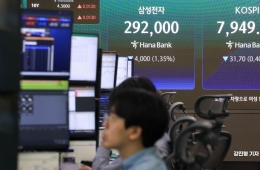
[Asia Economy Reporter Lee Seon-ae] The 13th was a terrifying "Black Friday." The KOSPI index plunged sharply as foreign investors unleashed a selling spree centered on semiconductors. Only individual investors stood alone in defense, barely managing to close above the 3170 level. Although it closed below 3200, considering that it had collapsed to the 3150 level during the session, the decline was somewhat limited. The possibility of changes in the monetary policy of the U.S. Federal Reserve (Fed) due to improved employment and soaring inflation in the U.S. stock market, as well as the won-dollar exchange rate approaching 1170 won, acted as burdens.
On that day, the KOSPI closed at 3171.29, down 37.09 points (1.16%) from the previous day. The last time the KOSPI index closed below 3200 was on May 28 (3188.73). With this day, the KOSPI continued its decline for seven consecutive trading days since the 5th, remaining trapped in a sluggish market.
The KOSPI index opened at 3205.75, down 2.63 points (0.08%) from the previous session, but soon fell below the 3200 level. During the session, the decline widened to as much as 1.92%, reaching 3146.76.
The sharp drop in the KOSPI was driven by a selling spree by foreign investors. Foreigners sold a net 2.6988 trillion won, pulling the index down. Foreign investors maintained a selling bias for five consecutive trading days. Institutions sold a net 165.8 billion won, while individuals bought a net 2.8052 trillion won.
Samsung Electronics, the top company by market capitalization, contributed to the index's decline. Samsung Electronics closed at 74,400 won, plunging 2,600 won (3.38%) from the previous day.
By sector, most sectors showed a downward trend, with only the banking sector (2.92%) recording gains alone. Medical precision (-3.15%), electrical and electronics (-2.42%), transportation and warehousing (-2.11%), and machinery (-2.09%) sectors experienced steep declines.
Han Ji-young, a researcher at Kiwoom Securities, pointed out that the aggressive net selling by foreigners was due to the sharp decline in major domestic semiconductor stocks ahead of the holiday, early tapering mentions by Federal Reserve officials, and the rise in the won-dollar exchange rate. She said, "The history of the domestic stock market shows that declines driven by sentiment often turn out to be short-lived events," adding, "However, since operating profits are improving, it is premature to say that the Korean stock market has deviated from the path of a bull market."
Hot Picks Today
 Up to 600 Million Won for Semiconductors, 160 Million Won Bonus for Loss-Making Non-Memory… Samsung Electronics Labor and Management Reach Tentative Deal on Unprecedented Performance Compensation (Comprehensive)
- "Could I Also Receive 370 Billion Won?"... No Limit on 'Stock Manipulation Whistleblower Rewards' Starting the 26th
- "From a 70 Million Won Loss to a 350 Million Won Profit with Samsung and SK hynix"... 'Stock Jackpot' Grandfather Gains Attention
- [Scientists Are Disappearing]④A Shaky Regional Research Ecosystem... "Professors Now Take the Initiative"
- "Who Is Visiting Japan These Days?" The Once-Crowded Tourist Spots Empty Out... What's Happening?
The KOSDAQ index closed at 1040.78, down 13.31 points (1.26%) from the previous day. In the KOSDAQ market as well, net selling by foreigners and institutions was prominent. Institutions sold a net 116.4 billion won, foreigners sold a net 138.7 billion won, and only individuals bought a net 282.2 billion won. Most of the top market capitalization stocks declined. Celltrion Healthcare (-0.50%), EcoPro BM (-1.54%), Kakao Games (-2.03%), and SK Materials (-1.50%) all fell.
© The Asia Business Daily(www.asiae.co.kr). All rights reserved.
!["Please Help": How Much Do Those Bowing 90 Degrees Really Earn? [Data Pick]](https://cwcontent.asiae.co.kr/asiaresize/307/2026052010120870131_1779239528.png)