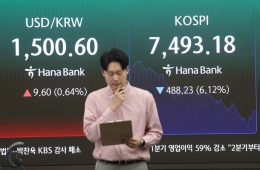
Semiconductor Sector Weakness and COVID-19 Spread... KOSPI and KOSDAQ Close Lower Together
Impact of Over 2% Decline in US Philadelphia Semiconductor Index
Foreign and Institutional Selling Pressure Appears Strong
![[Image source=Yonhap News]](http://www.asiae.co.kr/news/img_view.htm?img=2021071616143137740_1626419671.jpg)
[Asia Economy Reporter Gong Byung-sun] Both the KOSPI and KOSDAQ closed lower due to the waning semiconductor boom and the resurgence of COVID-19. Foreign investors and institutions showed strong selling pressure.
On the 16th, the KOSPI closed at 3,276.91, down 0.28% (9.31 points) from the previous trading day. It dropped to 3,259.32 at 10:04 a.m. but slightly recovered afterward.
The index fell as selling pressure emerged mainly in semiconductor-related sectors. The impact of the Philadelphia Semiconductor Index in the U.S., which fell 2.17% on the 15th (local time), seems to have influenced the domestic market as well. Seo Sang-young, a researcher at Mirae Asset Securities, explained, "The positive factors enjoyed in the first half of the year appear to be ending, as TSMC mentioned easing of the shortage of automotive semiconductors." In fact, the electrical and electronics sector of the KOSPI and the semiconductor sector index of the KOSDAQ, which include semiconductor industries, showed nearly a 1% decline.
The spread of COVID-19 also negatively affected the stock market. In Korea, the number of new confirmed cases exceeded 1,500 for three consecutive days, and in the U.S., the number of confirmed cases increased by more than 50% compared to the previous week in 35 states. However, Seo said, "The decline was not significantly expanded as major companies are about to announce their earnings."
Foreigners and institutions showed strong selling. Foreigners and institutions sold a net 90.9 billion KRW and 572 billion KRW, respectively. Individuals bought a net 693.6 billion KRW.
Sector indices showed mixed results. The textile and apparel sector had the largest decline at 1.45%, followed by machinery (-1.17%), steel and metals (-0.90%), electrical and electronics (-0.82%), and transportation equipment (-0.70%). Pharmaceuticals (1.52%), paper and wood (1.01%), banking (0.95%), medical precision (0.77%), and transportation and warehousing (0.73%) rose.
Most of the top 10 market capitalization stocks fell. SK Hynix had the largest drop at 1.62%, followed by Kakao (-1.57%), Kia (-1.25%), Samsung Electronics (-0.99%), Hyundai Motor (-0.65%), NAVER (-0.45%), and Samsung SDI (-0.13%). Samsung Biologics (2.86%), LG Chem (1.22%), and Celltrion (0.94%) rose.
On the same day, the KOSDAQ closed at 1,051.98, down 0.22% (2.33 points) from the previous trading day. It fell to 1,044.70 at 10:09 a.m. but slightly recovered afterward.
Foreigners and institutions showed selling pressure. Foreigners and institutions sold a net 18.4 billion KRW and 98.3 billion KRW, respectively. Individuals bought a net 126.5 billion KRW.
Many sectors showed weakness. The non-metal sector had the largest decline at 1.12%, followed by pharmaceuticals (-1.08%), finance (-1.03%), semiconductors (-0.99%), and transportation equipment and parts (-0.89%). Digital content (1.34%), chemicals (1.23%), other manufacturing (0.94%), entertainment and culture (0.89%), and textiles and apparel (0.75%) rose.
Hot Picks Today
 "Samsung and Hynix Were Once for the Underachievers"... Hyundai Motor Employee's Lament
- "Sold Everything Fearing Bankruptcy, Then It Soared 3,900 Times: How a Stock Once Feared for Delisting Became an AI Powerhouse"
- Court Partially Grants Samsung Electronics' Injunction to Prohibit Industrial Action... 100 Million Won Penalty Per Day for Violations
- [US-China Summit] China to Purchase $17 Billion in US Agricultural Products Annually...Real Gains for Beijing
- "That? It's Already Stashed" Nightlife Scene Crosses the Line [ChwiYak Nation] ③
Most of the top 10 market capitalization stocks rose. Kakao Games had the largest increase at 6.53%, followed by Pearl Abyss (2.17%), Celltrion Healthcare (1.06%), SK Materials (0.86%), Celltrion Pharm (0.25%), EcoPro BM (0.15%), and Alteogen (0.11%). Seegene (-6.54%), HLB (-3.77%), and CJ ENM (-0.45%) fell.
© The Asia Business Daily(www.asiae.co.kr). All rights reserved.