Government Holds Emergency Review on EU Carbon Border Tax Impact with Steel and Aluminum Industries
[Sejong=Asia Economy Reporter Kwon Haeyoung] The government is conducting an urgent assessment of the impact on the industrial sector following the European Union (EU)'s introduction of the Carbon Border Adjustment Mechanism (CBAM).
The Ministry of Trade, Industry and Energy announced that on the 15th at 3 p.m., Vice Minister Park Jin-gyu will preside over a video conference with executives from steel and aluminum companies to discuss response measures related to the EU's CBAM implementation.
The EU announced the CBAM enforcement bill last night Korea time. This system imposes a carbon price linked to the EU Emissions Trading System (ETS) on the carbon content of products imported into the EU. The carbon price is charged by requiring importers to compulsorily purchase 'certificates' corresponding to the carbon content of each item. Imported goods with high carbon emissions incur additional costs, reducing their product competitiveness.
The CBAM will be initially applied from January 1, 2023, to five sectors: steel, cement, fertilizer, aluminum, and electricity, with a three-year transition period before full implementation in 2026. During the transition period, only reporting obligations such as emissions are imposed, and no financial measures are taken. However, penalties such as fines may be applied if data submission is handled negligently.
It is understood that steel and aluminum companies in South Korea will be affected. In particular, the main impact is expected to be on steel in terms of export volume.
According to the Korea International Trade Association, last year steel exports to the EU amounted to $1.523 billion, with an export volume of 2,213,680 tons, the highest among the five items. Aluminum followed with $186 million in export value and 52,658 tons in export volume, while fertilizer recorded $2 million in exports and 9,214 tons in volume. Cement and electricity had no export value.
The Korean government has emphasized through bilateral consultations with the EU and major related countries that the CBAM must be designed and operated in compliance with World Trade Organization (WTO) rules. It has also stated that this system should not act as an unnecessary trade barrier and must reflect each country's carbon neutrality policies, such as South Korea's emissions trading system.
An official from the Ministry of Trade, Industry and Energy said, "We plan to continue closely analyzing the CBAM bill contents to establish our position and maintain ongoing consultations with the EU and major related countries." "In particular, we will do our best to sufficiently explain our carbon neutrality policies such as the emissions trading system, RE100 (Renewable Energy 100%), and the Renewable Portfolio Standard (RPS) to gain recognition of equivalence."
The government, jointly with related ministries, will review domestic systems related to the CBAM and hold regular public-private joint consultative meetings. Especially for industries affected by the system's implementation, multifaceted support measures such as tax and financial support and carbon neutrality research and development (R&D) will be prepared within the year.
For the steel sector, which is expected to be most affected, detailed impact analysis and response measures will be established through policy research projects, and communication will be strengthened using industry-government-academia consultative channels such as the Green Steel Committee to minimize negative effects.
Hot Picks Today
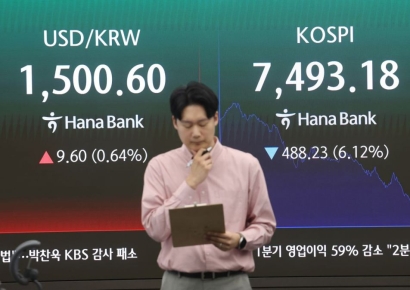 After Topping 8,000 Instead of Hitting 10,000... KOSPI Plunges—When Will It Rebound?
- "Samsung and Hynix Were Once for the Underachievers"... Hyundai Motor Employee's Lament
- [Breaking] Court Rules Against Samsung Electronics Union...1 Billion Won per Day Penalty for Exceeding Strike Scope
- Six Economic Organizations Urge Withdrawal of Samsung Electronics Strike Plan...Warn of National Loss of Opportunity
- "That? It's Already Stashed" Nightlife Scene Crosses the Line [ChwiYak Nation] ③
Vice Minister Park Jin-gyu of the Ministry of Trade, Industry and Energy said, "Even if the CBAM is introduced, if the public and private sectors unite and respond thoroughly, we can turn the crisis into an opportunity." He added, "As carbon neutrality is a global trend, the industry should proactively prepare and respond so that it can have a positive effect on our industry."
© The Asia Business Daily(www.asiae.co.kr). All rights reserved.







