Industry Minister Moon Seung-wook, Focused on Semiconductors, Pledges Concentrated Support for 8-Inch Process Investment to Resolve Supply Shortage
First On-Site Visit After Inauguration
"Making Pangyo a Cradle for Fabless Startups and Growth"
![Moon Seung-wook, Minister of Trade, Industry and Energy. [Photo by Yonhap News]](http://www.asiae.co.kr/news/img_view.htm?img=2021050709055624839_1620345956.jpg)
[Asia Economy Reporter Joo Sang-don] Moon Seung-wook, Minister of Trade, Industry and Energy, stated on the 7th, "We will prepare measures to focus support not only on cutting-edge advanced processes but also on investments in 8-inch foundry processes."
That afternoon, Minister Moon visited Silicon Mites, a power semiconductor fabless company located in Pangyo, and said, "We will expand financial, tax, and funding support related to semiconductor investments."
Silicon Mites is a fabless company that, in 2008, became the first in Asia to domestically produce PMICs (Power Management Integrated Circuits) for displays, leading domestic technology in mobile, small batteries, and display PMICs. Recently, it has been producing power management chips for automotive applications such as organic light-emitting diodes (OLED) and audio-video-navigation (AVN) systems, advancing its automotive semiconductor business.
In the case of system semiconductors, companies are divided into fabless firms that only design without manufacturing plants, and foundries that manufacture based on fabless designs. Semiconductor production requires wafers, thin discs that serve as semiconductor materials, which have evolved from 6-inch (150mm) to 8-inch (200mm), and then to 12-inch (300mm). Larger wafer sizes allow for producing more semiconductors simultaneously. Recently, as demand for system semiconductors has increased, the role of 8-inch wafers, which are relatively inexpensive and suitable for small-volume, multi-product production, has been reemphasized. However, most foundries have shifted their business structure toward producing 12-inch wafers, resulting in a shortage of 8-inch production lines. In response, the government has decided to actively support investments in 8-inch foundry processes to address foundry supply shortages, including the recent shortage of automotive semiconductors.
Industry representatives attending the meeting proposed ▲ quantitative and qualitative expansion of specialized personnel ▲ increased R&D investment and demand-linked support ▲ strengthening capabilities of design houses and intellectual property (IP) specialized companies ▲ support for startup infrastructure.
Hot Picks Today
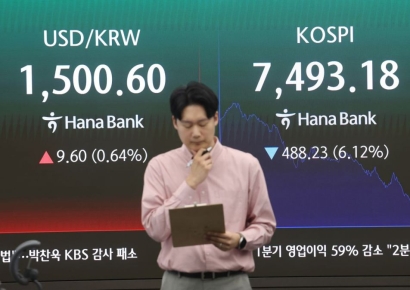 After Topping 8,000 Instead of Hitting 10,000... KOSPI Plunges—When Will It Rebound?
- "Samsung and Hynix Were Once for the Underachievers"... Hyundai Motor Employee's Lament
- [Breaking] Court Rules Against Samsung Electronics Union...1 Billion Won per Day Penalty for Exceeding Strike Scope
- 'Real Strike' Looms as Samsung Union Grows More Hardline... How the 2024 Strike Process Compares
- "That? It's Already Stashed" Nightlife Scene Crosses the Line [ChwiYak Nation] ③
In response, Minister Moon said, "For a comprehensive semiconductor powerhouse, the growth of small and medium fabless companies is crucial. To this end, we will further reinforce infrastructure facilities such as the AI semiconductor design support center located in Pangyo, where the design support center is based, and transform Pangyo into a cradle for fabless startups and growth by providing free semiconductor design software (SW)." He added, "To stably supply semiconductor design personnel to the fabless industry, we will expand semiconductor contract departments, adjust university quotas, establish joint departments, and expand innovative shared universities." He further noted, "We will include specific related content in the soon-to-be-announced K-Semiconductor Belt strategy."
© The Asia Business Daily(www.asiae.co.kr). All rights reserved.







