Gwangju City Launches First Public-Private Collaborative Citizen Solar Power Plant
Rooftops of 4 Apartment Buildings at Nongsung Bit Yeoulchae... Solar Power Capacity of 274 kW

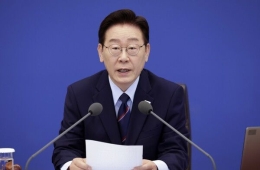
On the afternoon of the 22nd, Lee Yong-seop, Mayor of Gwangju Metropolitan City, attended the "1st Bitgoeul Citizen Solar Power Plant Completion Ceremony" held on the rooftop of Nongsung Bityeoulchae Apartment in Seo-gu. After the event, he reviewed the solar power generation status system with guests including Kim Yong-jip, Chairman of the Gwangju City Council, and Noh Kyung-soo, President of Gwangju Urban Corporation. Photo by Gwangju Metropolitan City
View original image[Asia Economy Honam Reporting Headquarters Reporter Park Seon-gang] The first citizen solar power plant, created through collaboration between citizens and public institutions, has begun operation.
On the 22nd, Gwangju Metropolitan City held a completion ceremony for the ‘Bitgoeul Citizen Solar Power Plant’ at Nongsung Bityeoulchae Apartments in Seo-gu, attended by City Council Chairman Kim Yong-jip, council members Kim Gwang-ran and Jang Yeon-ju, Jeong Eun-jin, chairman of the Bitgoeul Citizen Solar Power Social Cooperative, Kim Seon-min, director of Gwangju Technopark, and Noh Kyung-soo, president of Gwangju Urban Corporation.
The citizen solar power plant was promoted through a joint investment method by the Bitgoeul Citizen Solar Power Social Cooperative (hereafter the cooperative), Gwangju Technopark, and Gwangju Urban Corporation.
In particular, the cooperative raised 200 million KRW from 60 members through citizen funding, while Gwangju Technopark and Gwangju Urban Corporation invested 120 million KRW and 80 million KRW respectively, securing a total project cost of 400 million KRW.
Gwangju City provided administrative support by coordinating roles among project participants.
The Bitgoeul Citizen Solar Power Plant was installed on the rooftops of four buildings of the Nongsung Bityeoulchae Apartments owned by Gwangju Urban Corporation, with a total capacity of 274 kW and an annual power generation of 360 MWh.
This is expected to generate an annual revenue of 74 million KRW and reduce greenhouse gas emissions by approximately 140 tons, equivalent to the amount absorbed by 50,700 20-year-old pine trees.
Gwangju City plans to accelerate its efforts toward carbon neutrality by 2045 and the creation of an energy self-sufficient city, using the operation of the ‘Bitgoeul Citizen Solar Power Plant’ as a milestone.
Currently, Gwangju City supports ‘energy transition citizen education’ and the establishment of ‘energy transition village hub centers’ to ensure the sustainability of voluntary citizen energy transitions conducted by cooperatives or village enterprises.
Through this, they nurture citizen activists and provide practical training from cooperative establishment to solar power permits and construction, promoting grassroots energy transition movements by establishing energy cooperatives or village enterprises centered on ‘energy transition villages.’
Additionally, this year, they plan to support the installation of citizen solar power plants involving cooperatives with a total capacity of 1 MW, install 4.7 MW of solar power plants on soundproof walls and tunnels along the 2nd ring road, and 7.4 MW on 46 public idle sites. The revenue generated from these installations will be deposited into an energy transition fund and reinvested to build a sustainable renewable energy expansion ecosystem.
Jeong Eun-jin, chairman of the Bitgoeul Citizen Solar Power Social Cooperative, stated, “To respond to the climate crisis threatening human survival, it is necessary to establish distributed power facilities using renewable energy sources,” adding, “We will serve as a focal point for expanding citizen-led solar power plants in the future.”
Hot Picks Today
 "Stocks Are Not Taxed, but Annual Crypto Gains Over 2.5 Million Won to Be Taxed Next Year... Investors Push Back"
- "Don't Throw Away Coffee Grounds" Transformed into 'High-Grade Fuel' in Just 90 Seconds [Reading Science]
- Signed Without Viewing for 1.6 Billion Won... Jamsil and Seongbuk Jeonse Prices Jump 200 Million Won in a Month [Real Estate AtoZ]
- "Groups of 5 or More Now Restricted"... Unrelenting Running Craze Leaves Citizens and Police Exhausted
- "Even With a 90 Million Won Salary and Bonuses, It Doesn’t Feel Like Much"... A Latecomer Rookie Who Beat 70 to 1 Odds [Scientists Are Disappearing] ③
Mayor Lee Yong-seop said, “With a shared awareness between the public and private sectors that fossil fuel use, the main cause of the climate crisis, must be reduced, the ‘citizen solar power plant’ created through citizens’ direct ideas is expected to spread a new culture of ‘producing and using my own electricity,’” and added, “Gwangju City will do its best to expand citizen participation and provide a healthy and safe environment for our children.”
© The Asia Business Daily(www.asiae.co.kr). All rights reserved.